Blair County Conservation District marks anniversary
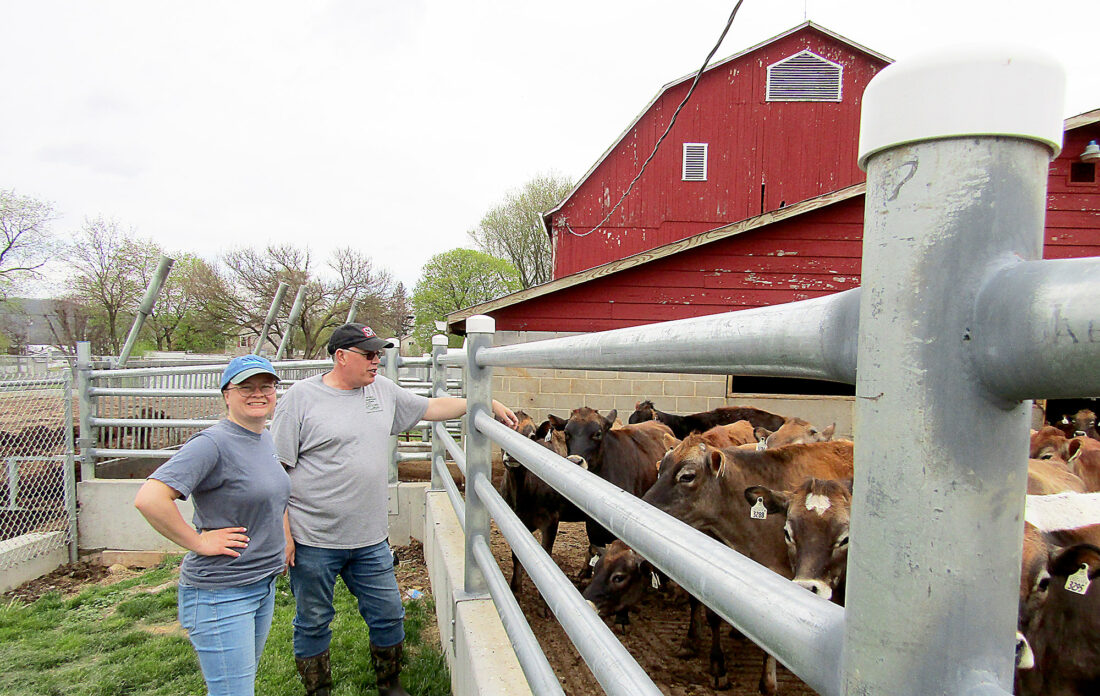
Erin Trouba (left), Penn State Extension educator, and Rich Huether, ag conservation specialist with the Blair County Conservation District, take a tour of Dale Pheasant’s manure storage facility in Williamsburg. Courtesy photo
The Blair County Conservation District has its roots in agriculture.
In 2026, the district is celebrating 60 years of its commitment to the natural resources and to the agricultural community within Blair County.
The Blair County commissioners approved the creation of the conservation district in January 1966.
“The conservation district was started because farmers wanted a soil survey conducted and you needed a conservation district to have that done, you needed a local entity,” said District Manager Donna Fisher, who has been with the district for 40 years. “We are an organization concerned with the protection, preservation and enhancement of Blair County’s natural resources by providing technical assistance and educational guidance.”
The conservation district has multiple roles, with education being among the most significant, Fisher said.
The district supports and conducts educational events related to agriculture. Whether working directly with local FFA chapters or by assisting with community-wide events, the district seeks to increase the knowledge base and inform local residents of the importance of agriculture.
“We try to build an educational component into all of our programs,” Fisher said.
The conservation district is funded from both state and local sources.
“It has changed over the years. In 1966, we had a volunteer executive director and part-time clerk. Now we have nine staff members,” Fisher said. “We receive about 2/3 of our funding from the state, and 1/4 from the county. We generate local revenue through erosion and sediment fees.”
The district is involved with numerous programs and the Farmland Preservation program is one of Fisher’s favorites. It began in Blair County in 1989.
“Pennsylvania started it through a board to commit funds to farmland preservation, it was rolled out to counties to purchase conservation easements. Several local citizens were interested, the most were in Sinking Valley,” Fisher said. “There was a rumor high speed rail was going to go through Sinking Valley, that actually led this to start here. We purchase development rights of farms, they can sell the farm but it can only be used for agriculture in perpetuity.”
At the end of 2025, Blair County had 65 farms containing 9,554 acres in its program.
Chairman Jim Biddle, who has been on the district’s board of directors since 1992, has been involved with many of the district’s programs at his Mill Hill Farms near Williamsburg.
“As a cooperator, Mill Hill Farms has received assistance to fence streams, install Riparian Buffers, enhance our cover cropping and reduce runoff, which ultimately protects our valuable soils and nutrients,” Biddle said.
Mack Kline of Pheasant Hill Farm, between Martinsburg and Williamsburg on Clover Creek Road, recently started working with the district and is currently working with them towards a manure management program for their farm which has needed one for probably 30 years.
“They’ve been very helpful putting us in contact with the people that we need for this project as well as helping us plan our farm and our management practices,” Kline said. “The Blair County Conservation District is pretty unique because in high school and FFA I competed in the Blair County Envirothon every single year in high school and got to meet Donna and Rich (Huether, ag conservation specialist) and it’s actually because of this association that I sort of got the ball rolling on this manure management process.”
The district’s biggest program was when it worked on acid mine drainage. The Glenwhite Run Watershed Restoration Project was initiated in 1995 and completed in November 2002 in which approximately 3.8 miles of stream were restored by mitigating abandoned mine drainage pollution in the 3,500 acre watershed. More than $2.5 million dollars was secured from federal and state grant sources as well as settlement funds through the attorney general’s office for the project.
“It included 7-8 projects to manage the impact of acid mine drainage to the reservoir. It is again time to do maintenance on this, it was the first big project the district undertook, it cost over $2 million, there were no local funds used,” Fisher said.
The Chesapeake Bay Program agreement was signed in 1989 to provide funding to landowners across the county for implementation of best management practices for ag operations.
“Just over $900,000 has been allocated to Blair County landowners. It provided technical and financial assistance to farmers, we hired our first ag technician, he is still there today,” Fisher said.
In 2016, the district received a Growing Greener Grant in the amount of $82,000 to begin completing stream restoration work. Three projects would be completed with these funds and it would launch the district’s work through grant funds and with partners to minimize sediment loads by reducing streambank erosion.
“We were able to hire a watershed specialist,” Fisher said.
The Nutrient Management Program has also been important.
The district accepted responsibility for completing inspections on Blair County farms related to erosion control and nutrient management in 2016. The district secured an AmeriCorps member to serve the ag community by completing Ag E&S and nutrient management plans. Also in 2016, the district received one of 20 grants from the National Association of Conservation Districts for the promotion of Urban Agriculture BMP’s and reduction of stormwater by transition of land use from impervious to pervious surfaces.
“Our board took this seriously when looking at the program,” Fisher said.
In 2017, agreements solidified the formalization of the MS4 workgroup into the Intergovernmental Stormwater Committee and also with the conservation district for the coordination and fiscal management of ISC activities and funds. The agreement was written for a two year period through December 2018. The first district employee was hired in August 2017 to serve the ISC as a stormwater coordinator.
“Blair County became an example for others to follow with cooperation and collaboration. They worked together and developed committees. We hired a coordinator, and people across the state looked at us,” Fisher said.
Another major project was the development of the NatureWorks Park.
“We bought the Kline farm at the bottom of Catfish in 2012. It was a 15.2-acre tract of ground along Bedford Street in the Borough of Hollidaysburg. Plans for the property include an outdoor environment education area, LEED certified district office and use of the existing early 19th century bank barn,” Fisher said.
In March 2018, ground breaking was held followed by a notice to proceed issued to Ventura Construction for the completion of the trails, pavilions and signage at NatureWorks Park. Final construction was completed in 2019, Fisher said.
“We chose to first do the park, we had some designs for the office building but decided to do the park first. The office building will be done within the next several years,” Fisher said.
The conservation district is known for its work with area school districts.
“The conservation district offers a wide variety of educational programs and experiences for students in grades K-12. It is fun to have gone through the conservation districts programs as a student and now work alongside the staff as a teacher with my students,” said Robyn Bechtel, Williamsburg agriculture teacher and FFA advisor.
One of those programs is the annual land judging competition.
“I feel this contest is important because it teaches the students how to look at the land and see what its potential uses are for agriculture, recreation and development. We have gone to some locations with surprises underground and the students quickly learn that you can’t judge a soil by the surface. As part of land judging at school, we discuss different conservation methods and the students can see those practices being applied at the farms during the contest,” Bechtel said.
Another event is the annual Blair County Envirothon, where students perform tasks such as forestry, soil evaluation, wildlife identification, aquatics, and problem solving, said Heather Van Winkle, Central Cove FFA advisor.
“In order to prepare for the contest, district staff have come to school and worked with the students doing macroinvertebrate studies, soil activities and forest management / tree identification. This is extremely helpful as a teacher because I don’t have the time or knowledge to be a master in every aspect of the Envirothon,” Bechtel said.
Central Cove has collaborated with the district on other projects as well.
“Last year, they asked if we could help in constructing rain barrels. I believe there were approximately 15 barrels that we helped make. This year, they reached out to see if we could help build some raised garden beds and a work table for the greenhouse at Nature Works Park in Hollidaysburg,” Van Winkle said.
Fisher said the future of the district is bright.
“It looks strong, we have a board that is careful about what they choose to do so we are not chasing money, we are strong and solid and ready to move into the future,” Fisher said.
Mirror Staff Writer Walt Frank is at 814-946-7467.
Local News
Blair letter carriers take part in food drive
One of America’s greatest days of giving — the National Association of Letter Carriers Stamp Out Hunger Food ...
Altoona man seeks dismissal of case
The city man charged for his alleged part in a June 2024 assault that left a man with skull fractures is asking a ...
Altoona man waives preliminary hearing in alleged shooting
A city man charged with allegedly shooting at his wife and another man waived his right to a preliminary hearing on ...

FFA spotlight: Jocelynn Morgan
Agriculture briefs
Penn State Extension helps plant trees UNIVERSITY PARK — More than 1,300 large trees were planted across ...