
Intergovernmental Stormwater Committee project leads to more visible river at Legion Park
Trending
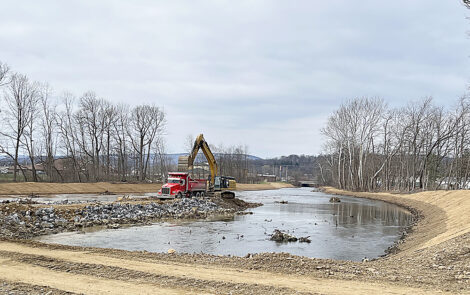
The recent substantial completion of Phase 1 of the Intergovernmental Stormwater Committee's floodplain restoration on the Beaverdam Branch of the Juniata River behind Legion Park in Hollidaysburg has created a striking vista.
The river now runs as it did before the days of colonial settlement, although without the woods that would have encroached upon the waterway then.
The river is much wider than in recent years, and far more visible to patrons of the park, including many children who will soon be coming with their families to watch their siblings playing in the ballgames held there -- children who will likely be drawn to a river no longer hidden by an embankment, trees and brush.
On Thursday, ISC officials wrestled with how to deal with concerns expressed by park officials about the attractive danger the river now presents -- a struggle that will need to take into account issues of safety, liability, permitting, cost and perhaps aesthetics.
Park officials' safety concerns came to the attention of committee officials during a recent walk-through to create a punch list for the contractor that did the work.
Sediment removal left the river along a 1/3-mile stretch in a more natural state, one that will lead to far less sediment eroding from the formerly steep banks and heading downriver toward Chesapeake Bay.
The elimination of the legacy sediment's erosion potential helped the committee fulfill the requirement for its current Municipal Separate Storm Sewer System (MS4) permit from the state Department of Environmental Protection.
To deal with the safety issue, officials Thursday first discussed whether to install horizontal slat fencing along the 700 feet of river edge that was exposed by the project, with the bottom slats of the fence left out to allow for floodwaters to flow freely through and around the fence, but with plantings of sedge grass or other vegetation to conceal that lower opening.
The cost for the project contractor to install such a 4.5-foot fence would be $68,000, according to committee stormwater coordinator Chelsey Weyant.
The proposal elicited several doubts and objections.
It's unclear whether DEP would permit the fence to be installed close to the river, in spite of the open design, officials said.
If it were in the river's floodway, it would clearly not be permitted, one said.
If it were merely in the flood plain, it might be OK, someone said.
But the boundary between those two elements along the river's edge is currently unclear, due to the changes wrought by the sediment removal project -- although it might be safest to go with the old official map, officials said.
Regardless, if the fence were to be open at the bottom, it probably wouldn't prevent children from getting under it to the river, even if the opening were concealed by plantings, officials said.
The plantings might actually make it less safe because kids could get through the vegetation, then disappear from sight, due to those plantings, said committee member Doug Brown of Antis Township.
Furthermore, the cost of the fence is too high, according to committee member Frank Hicks of Hollidaysburg.
If the fence turns out to be permissible, and ultimately desirable, it might behoove the committee to bid it out to local contractors to get a better price, officials said.
The committee could enhance safety by installing signs warning of the danger, some said.
But not all parents and kids would heed the signs, and some of the kids would be too young to read them, officials said.
Officials decided for now that upon learning from DEP what is permitted in the area, the best temporary measure would be to install orange plastic construction fencing, along with the danger signs, which would also be temporary.
The committee authorized Weyant to spend up to $1,500 on the fencing and signs.
The posts and the labor for installation of the fencing and signs would be provided by the highway departments of committee municipalities.
Ditch now necessary
The committee agreed to pay up to 60% of the $10,000 cost to create a 147-foot-long drainage ditch filled with stone to keep water from ponding in a spot on a fairway at Sylvan Hills golf course, to rectify a problem caused by a recently completed floodplain restoration project along Brush Run at the course.
The water has been ponding in an area where historical pictures show it wasn't ponding before, said committee consulting engineer Brian Shura of Stiffler McGraw.
It's probably ponding now because extensive project activity in that area broke a set of underground drainage pipes that previously kept the fairway dry, Shura told the committee board.
Neither he nor the contractor nor the current management of the golf course knew of the existence of the drainage system before the project began, Shura said.
They learned of it in the process of trying to find an explanation for the problem, after contacting a retired course official who located drawings of the pipe system.
The initial proposal was for the committee to pay the entire cost of the proposed new drainage ditch, but board member Henry Fownes of Frankstown Township objected, given that the committee wasn't told of the drainage system's existence beforehand.
If the contractor knew it was there before the project started, workers may have been able to avoid the area, although it's possible that in doing so, they might have created other additional costs, Shura said.
Timeline unclear
A couple who lives in the Fort Fetter area complimented the committee on the Beaverdam Branch floodplain restoration project, calling the renewed stretch of river "amazing" -- while asking whether Phase 2 will be forthcoming.
Phase 2 would have taken the sediment removal project about 0.45 mile farther downstream, stopping a moderate distance before the Allegheny Street bridge.
Board members thanked the couple, but didn't elaborate on their plans.
The committee has relegated Phase 2 to "the back burner" due to funding issues, opposition by some residents who live along the Phase 2 section -- including their unwillingness to grant necessary easements -- and the committee having approached the end of its permit cycle with DEP, according to committee solicitor Patrick Fanelli.
The new permit cycle will call for jurisdictions to reduce the volume of water discharged during storms to streams, rather than the amount of sediment carried to those streams, Fanelli noted.
Therefore, there may not be a call for projects like the one designed to reduce sediment flowing into the Beaverdam Branch.
The new five-year permit cycle calls for urbanized jurisdictions to provide annualized plans over 50 years for stormwater control measures (SCMs) that account for 88% of their impervious areas, so that that one inch of rainfall percolates into the ground, rather than running into streams, according to Shura and online sources. While not specifically calling for elimination of pollutants, volume reduction would have the effect of reducing pollutants, as the less water flowing into streams, the less pollution those streams will carry.
Mirror Staff Writer William Kibler is at 814-949-7038.