Area companies reflect on COVID-19
-

- The Emerie Board owner Meagan Robinson (right) works on Coalport resident Katlynn Kuhn’s nails at the beauty salon in Duncansville on Feb. 25. Mirror photo by Matt Churella
-

- Doug and Jo Ellen Mingle, owners of True Value Hardware in Roaring Spring, were allowed to keep the store open during the COVID-19 pandemic. Mirror photo by Matt Churella
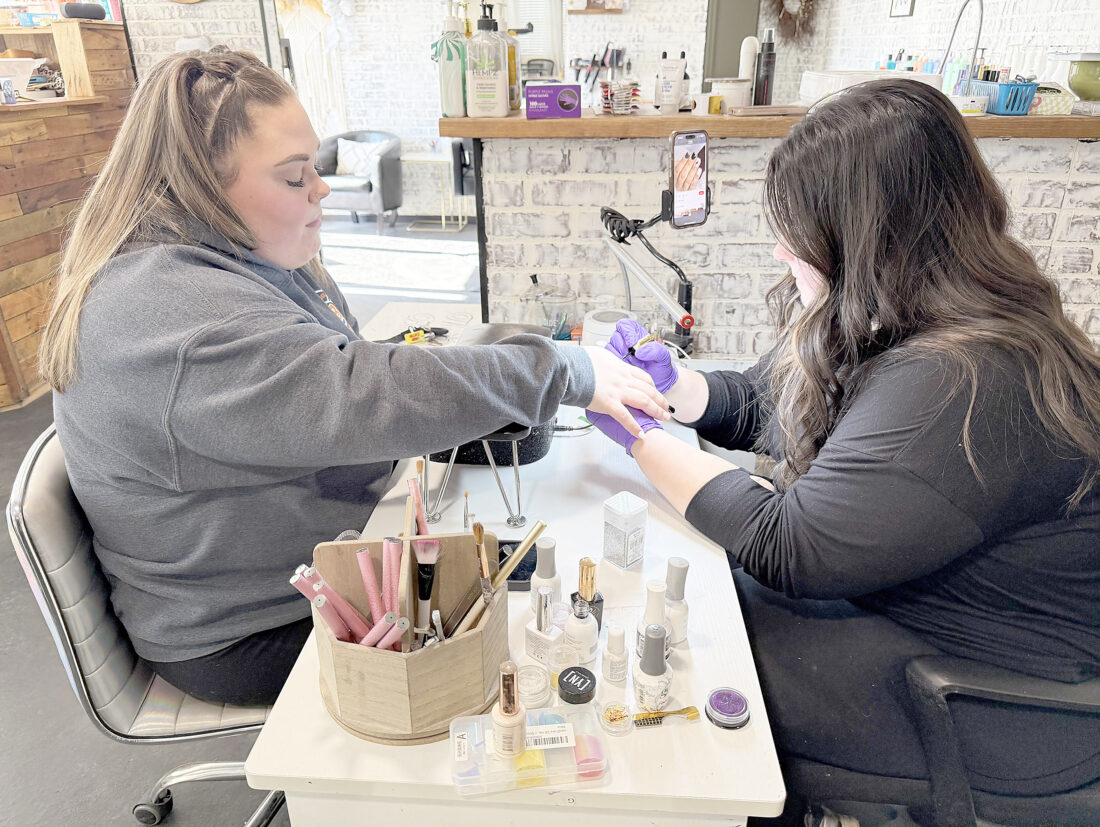
The Emerie Board owner Meagan Robinson (right) works on Coalport resident Katlynn Kuhn’s nails at the beauty salon in Duncansville on Feb. 25. Mirror photo by Matt Churella
Editor’s note: This is the second in a series looking back five years at the COVID-19 pandemic.
In January 2020, Meagan Robinson had just opened her own business, The Emerie Board beauty salon in Duncansville, so she could set her own schedule and be home with her infant daughter more often.
By March, when the COVID-19 virus was first reported in Blair County, her business was deemed nonessential and was forced to shut down due to government restrictions. Robinson said she was “super worried” how she was going to make ends meet.
After a friend suggested she sell press-on nails, Robinson found a company called Apres Nail, which had a full-coverage tip product that could be used to create custom sets for clients.
People would put their hand down next to a quarter, take a picture of their hand and send it to Robinson, who could zoom in with her phone to size the image up with her own quarter and create the custom-sized sets, she said.
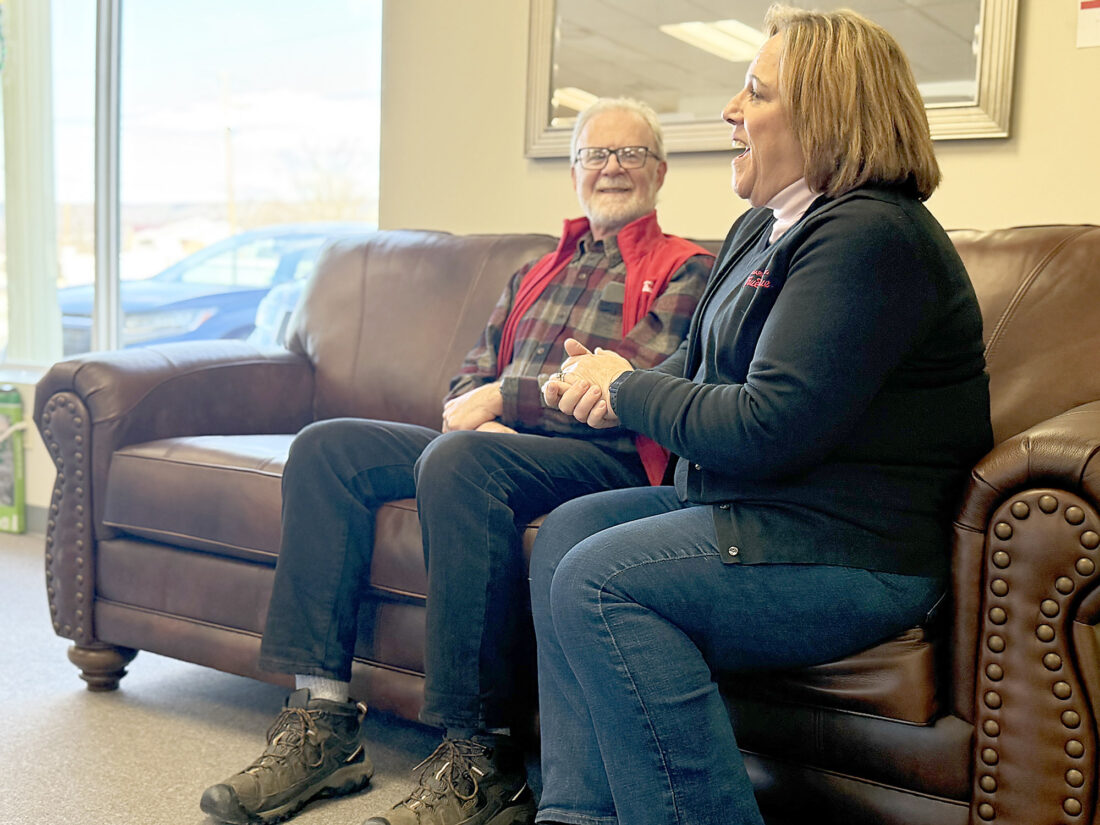
Doug and Jo Ellen Mingle, owners of True Value Hardware in Roaring Spring, were allowed to keep the store open during the COVID-19 pandemic. Mirror photo by Matt Churella
After Robinson’s daughter fell asleep, she made the sets in a nail room at her house. It typically took “just a couple of days” to get them done, she said.
Robinson said she mailed the sets, along with the needed accessories to apply them, to her clients for about eight weeks before her salon was permitted a “soft opening” — one person in the salon at a time, wearing face masks and following COVID-19 health protocols and safety procedures.
“My clients respected that they had to sit in their cars out in the parking lot and wait until I finished with the previous client,” Robinson said.
“It’s funny to look back on it now because everything has changed so much,” Robinson said. “Now you could get a cold and you’re coughing and everybody’s like, ‘Oh, you’re fine. It’s not a big deal.'”
At the time, not only was it a big deal to have cold symptoms, it was also a scary time to be a business owner because people needed to be assured that businesses were following COVID-19 protocols, Robinson said.
Moved to selling online
Cartridges Galore along Valley View Boulevard was another nonessential business that struggled to get by, despite video game sales “skyrocketing” during that time, according to co-owner Garrett Eagan.
According to Eagan, the retro video game company has businesses in Maryland, West Virginia and Pennsylvania — with locations in Altoona, State College and Johnstown.
The COVID-19 pandemic was “really difficult” for Cartridges Galore because there were different guidelines and lockdown requirements stores had to follow.
The company had over 30 people on staff in all three states whom they were trying to take care of and keep on payroll, Eagan said, adding they still had to pay rent, utilities and other bills during the pandemic.
In Pennsylvania, store locations were shut down and the business moved to selling their inventory online through Amazon and Facebook Marketplace listings, Eagan said, noting the biggest sellers at the time were Nintendo Wii gaming consoles, Guitar Hero games and equipment and Pokemon games and trading cards.
Traditionally, Cartridges Galore sells Nintendo Wii consoles for $80, Eagan said.
During COVID, they were “easily” getting that much for their consoles, “if not more,” he said.
“Really anything we put up was selling,” Eagan said. “If we listed it out online, it was going to sell.”
When the store was allowed to reopen, in addition to wearing masks and cleaning surfaces regularly, the company installed plexiglass at the counters to have a barrier between customers and employees, Eagan said, noting people would often go window-shopping “just to get out of the house.”
“At that time, everybody was so hell bent to just get out and try to do something,” Eagan said. “But once people got comfortable, they were coming in and still shopping with us, which we appreciated.”
Paint, craft supplies popular
Other businesses, like True Value Hardware in Roaring Spring, were deemed essential.
The store was allowed, and encouraged, to stay open to provide what people needed for their homes, said owners Doug and Jo Ellen Mingle.
A couple part-time employees opted not to come to work because they had vulnerable family members, Doug Mingle said, adding another employee decided to retire, but all of the store’s full-time employees decided to stay and work through the pandemic.
During that time, craft supplies and paint sales “took off pretty fast,” he said.
“As soon as the schools were closed and people were needing to stay home with their kids, it seemed like there was a real sudden spike in paint sales,” Jo Ellen said, noting people were either working from home or not working, staying home to pursue house projects — painting a bedroom or a part of the house that had been neglected for a long time.
Paint respirators, dust masks and other items that were normally “readily available” from distributors were selling out “pretty quickly,” Doug said.
While furniture stores were deemed nonessential and were forced to close from March to June 2020, True Value Hardware, which has a furniture department in it, was able to sell recliners, mattresses and “those kinds of things people didn’t have access to elsewhere,” Doug said.
“That’s one of the things that we were able to help people with,” he said.
Jo Ellen said, when the weather got nicer, people started gardening. As a result, the store saw a big spike in canning supplies.
Although there were some “lingering effects” on the business after the COVID-19 pandemic, they weren’t permanent, Doug said, noting most of the challenges facing his business today stem from the fact that people’s buying habits have changed.
A lot of people who never shopped online before the pandemic have continued to do a lot of online shopping in the years since, Doug said.
“Our merchandise seems to be readily available again, but people just got into the habit of just buying things online, and we still see that lingering today,” Doug said.
“We’re still obviously able to operate and make a living. But the kind of spike in sales that we had for the first couple of years after the COVID emergency hit has leveled off and even dropped a little bit because people just found other ways to get merchandise,” he said.
Funeral services changed
Stevens Mortuary was another essential business that was restricted to having only 10 people present for funeral services, owner Joe Stevens said.
“For many families, what we were doing was having the same funeral three or four times, so that we could bring in a group of 10, have the funeral, they could leave and another group of 10 would come in,” Stevens said.
The number of cremation services during the pandemic rose, but not for any kind of medical reason, Stevens said, adding there was no reason why bodies couldn’t be embalmed and viewed.
“There were just a lot of people who, because they weren’t coming for funeral services, chose to go that route,” he said, noting many families have since gone back to having funeral services and full visitations.
Funeral home staff had to be vaccinated, but were otherwise unaffected by the pandemic, according to Stevens.
“It didn’t restrict us. We were here and employed throughout the entire process,” he said. “It didn’t really affect our staffing to the extent that we were still handling bodies and making removals. People were still passing away and actually in bigger numbers.”
Local News
Adam Holliday chapter of DAR will host Community Day to celebrate America250
The Adam Holliday Chapter, National Society Daughters of the American Revolution, is planning a Community Day to ...

Hajzus receives appointment to U.S. Merchant Marine Academy
America250PA announces VIP ticket giveaway
America250PA is hosting a VIP ticket giveaway for the highly anticipated Commonwealth Concert Series. As several ...
Spiced nuts, seeds create tasty snack
This recipe is excerpted from the cookbook “Linda McCartney’s Family Kitchen.” Linda was ahead of her time on ...

PSU Altoona prof named laureate