Shot clock possibility keeps on ticking for state high school basketball
PIAA basketball
STATE COLLEGE — The Pennsylvania Interscholastic Athletic Association took the first step toward implementing a shot clock requirement in high school and junior varsity boys and girls basketball Wednesday during its summer meeting at the Nittany Lion Inn.
Following a spirited discussion about both the advantages and concerns — including one board member asking if the PIAA had ever enforced an “unfunded mandate” upon its schools — of using a shot clock in Pennsylvania, as 31 other states do, District 7 representative Brian Geyer made a motion for the PIAA to accept implementation of a basketball shot clock for varsity and junior varsity boys and girls basketball beginning in the 2028-2029 school year on a first reading basis.
The motion was seconded by District 10’s Kirk Scurpa and passed on a 22-9 vote.
The vote to add a shot clock supported a PIAA survey sent out to both school districts and officials that supported the addition of a shot clock by a slim margin. However, the PIAA basketball steering committee voted down a motion to suggest implementation of the shot clock to the main board, 6-5, on June 17.
“The survey results are from the officials and the schools,” Geyer said. “Overall, people are very favorable of the shot clock. It’s time to have some action. We have talked about this at length for ad nauseam. This gives school districts three years to get the funds, get the right people trained and get the teams ready to be in a shot-clock era. I think it was important to get it started. I think the hesitation from several committee members was that it was too soon, so I think that the extra year at a new cycle break is better for everybody.”
District 3 representative Branden Lippy spoke up when the steering committee’s suggestion to not implement the shot clock was announced.
“There were financial concerns about paying for the shot clock itself and then paying for event workers to now run that part of the game,” Lippy said. “Right now, you have event workers running the scoreboard and keeping the book — now you have to employ someone to run the clock. That was the biggest concern.”
Lippy’s suggestion, which was backed by many on the board, was to push the start date of the shot clock back to the start of not the next two-year PIAA cycle, but the one after that in 2028-2029.
“The important piece to anything, especially in public education, is budgeting in advance,” Lippy said. “It’s important to not just spring it on our constituents. We had talked before about implementing it in a year or two, which is not enough time. You can read based on the survey that it is split down the middle or in some situations it’s not split down the middle but very highly for it, and it’s part of improving the sport and moving everything forward, which is our job.”
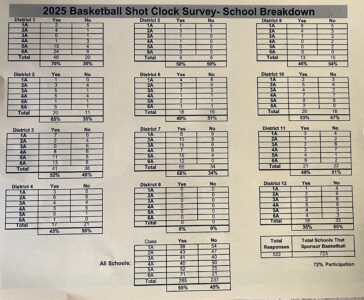
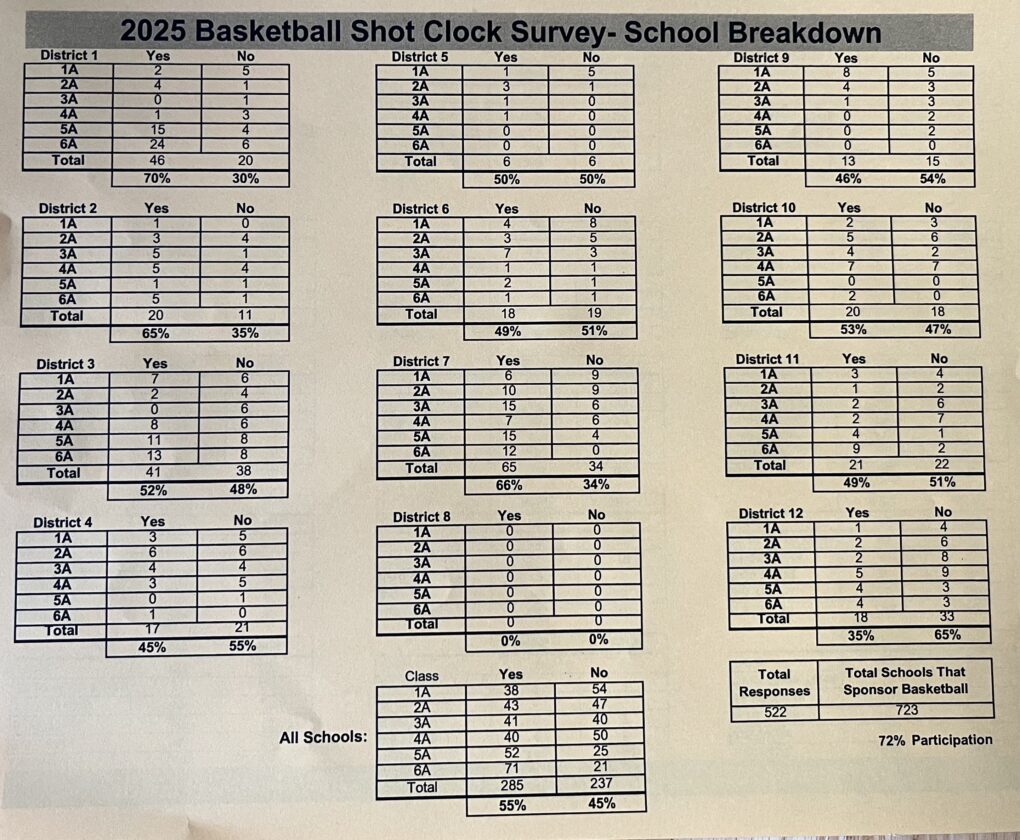
The survey results handed out at Wednesday’s meeting revealed that 72% (522 of 723) of the schools who were sent the shot clock survey participated.
A total of 285 (55%) supported the shot clock compared to 237 (45%) that did not. Most of the opposition came from smaller schools. The margin in Class 1A was in favor of no, 54-38. In 2A it was no, 47-43. In 3A, it was yes by a single vote, 41-40, and it was back in favor of no at 4A at 50-40. But the larger schools heavily voted yes with 5A voting 52-25 and 6A at 71-21.
Many of those larger schools come from District 1 near Philadelphia.
“My own personal thoughts are not the way I’m instructed to vote,” District 1 representative Michael Barber said. “I’m expected to represent my constituents. I was a basketball coach in the past, so I do have some personal thoughts on the shot clock. I think the data will tell whether the product is improved if it’s implemented, but I think that providing student athletes in District 1 and across the commonwealth the opportunity to participate and to experience similar rules that are at the next level would be beneficial.”
District 6 schools did not support a shot clock by one vote, 19-18. In 1A, it was 8-4 no; 2A was 5-3 no; 3A was 7-3 yes, 5A was 2-1 yes and 4A and 6A were both 1-1.
District 6 representative Ralph Cecere was one of the nine to vote against the shot clock because of the survey within his district.
“It came from the data from the surveys we received from our member schools,” Cecere said. “A small majority of our schools were not in favor of the shot clock. Most of those were smaller, rural schools and smaller enrollment schools, which (a shot clock) would place a little bit of a financial burden on them. In these challenging financial times now with federal monies possibly being cut and federal budgets being at an all-time low for school funding, we have to be aware of every dollar that is spent.
“It’s not something I am opposed to. I think the shot clock is going to come eventually, just right now our member schools, based on the numbers we received, are not in favor of it at this time.”
Cecere noted that the survey was taken before the date of implementation changed to three years from now.
“We’ll go back and seek some additional feedback from our member schools,” Cecere said. “We’ll see if that plan and that timeline is something they would be willing to accept among their local school boards, athletic departments and their administrations in general. If we find that indeed that is the case, we may move forward in a different way in the future.”
In District 5, the vote was split among schools, 6-6. But District 5 representative Paul Leonard voted in favor of the shot clock after the timeline was moved ahead.
“In our district, it was a 50-50 vote,” Leonard said. “Having the three-year window to have them installed and giving districts time to purchase them and get them lined up instead of telling them to get the shot clock going next year made a difference. The timeline pushed me over the line. It gave me that 51%.”
Leonard said schools he spoke with were split, even among their own district, on the decision.
“I conducted my own survey, and I asked schools if their boys and girls coaches differed on the choice of having a shot clock,” Leonard said. “I had several that yes, the boys coach was for it and the girls wasn’t, or the opposite. That also came out 50-50.”
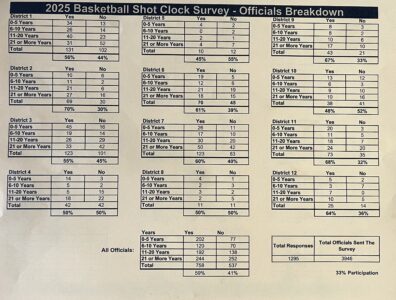
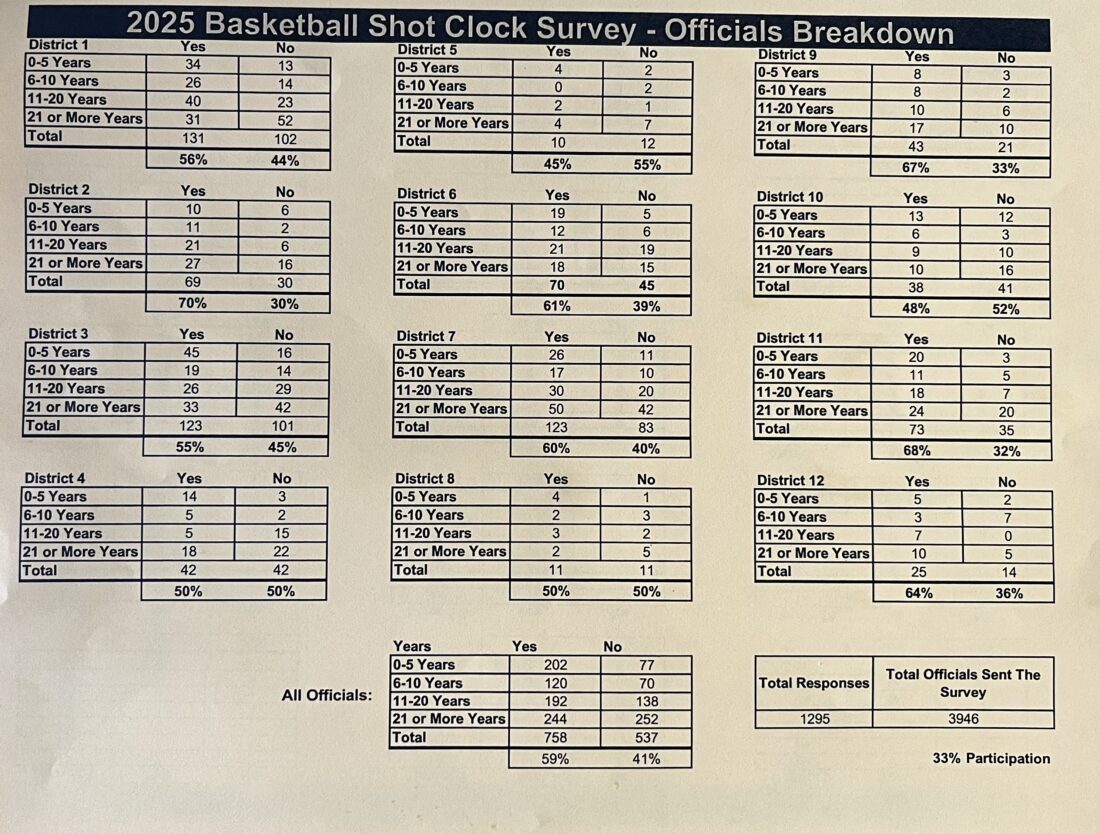
In addition to the school survey, one was also sent to 3,946 officials. Only 1,295 returned the questionnaire (33%), but 59% who did favored the addition of a shot clock (758-537).
Maureen Williams, the PIAA-registered Female Officials Representative, was hesitant to vote yes on the shot clock during roll call but did so to back up her fellow officials that answered the survey.
“What I took from the discussion was the (steering committee) vote was very close, with an abstention, and another committee member who was absent,” PIAA Executive Director Robert Lombardi said. “I think what the board did was look at that, and what I gathered was that they looked at the statistics of the survey and saw that in some cases, they were compelling, like our officials representative (Williams) said.”
Following the vote to push the shot clock discussion ahead — it must pass two more readings at future PIAA meetings to become official — Barber made a subsidiary motion to seek more feedback from the steering committee before the next steps, and that motion passed, 28-3.
“We value our steering committees, and we value their input,” Barber said. “Having the opportunity to make the subsidiary motion and continuing to gather data on what obstacles we may not think of in this room that it could face is important. There are a lot of great minds across the commonwealth, and this provides them the opportunity for them to come back to us with those concerns and make sure everybody has their voices heard.”
Lombardi said in June that finding a timeline to implement the shot clock seemed to be more of a debate than if one would actually be used and said on Wednesday that he believed pushing the start date back to 2028-2029 was important.
“I think this is a step that the board took feeling this is maybe three years away to give people time to plan and yet recognize it’s important to get back to the steering committee — the experts — to see if there’s anything else that they would like to have considered,” Lombardi said. “I think the process worked. The board took all the information from the survey, steering committee and the leadership of (Assistant Executive Director) Jenn (Grassel) moving it forward and made an educated decision to see how it works. It helped eliminate the financial burden, if there is one. Budgets were already set when they met, and that led to some of the angst.”
Chris Rickens recently took over for Mike Hudak as the District 6 male officials representative on the basketball steering committee and was present on June 17 when that committee voted not to recommend the shot clock.
“The timeline was a big thing,” Rickens said. “Obviously it wasn’t going to happen this year. They tried to push it back to 2026-2027, but ultimately it failed based on the district votes.”
Some members of the PIAA board worried about the ethics of going against their own steering committee during the discussion prior to the vote.
“To me, it doesn’t bother me,” Rickens said. “We’re a steering committee. We don’t make the law or the rule of the law. We advise what our thoughts are from a steering committee perspective.”
As for how he feels personally, Rickens sees both sides of the argument.
“From an official’s perspective, many of us are concerned,” Rickens said. “Many of us are concerned about the increased amount of diligence that we’re going to have to pay to the clock. I watched my son play in college, and there was a shot clock issue definitively once or twice every game. That’s college level. It’s concerning to officials, because we have to get the right people. We’re going to have to train them obviously, and I’m not suggesting there aren’t people that can do it, because there certainly are, but it’s a difficult thing to judge. Did the ball touch the rim? Did it not touch the rim? Should it be reset or shouldn’t it be? Does it reset to 20 seconds or 10 seconds? All of that stuff comes into play and can give officials trepidation.
“Having said that, I would assume it will make for a more interesting game, especially toward the end of the game.”
Local Sports

Curve put together big fourth inning in victory

Pirates’ Lowe won let All-Star snub ruin his moment

Jones pitches six perfect innings for Pirates, who lose to Braves

Area champions

Spitz delivers on offense for BCO in City League win