
Some businesses close in ‘day without immigrants’
Not all on board with movement
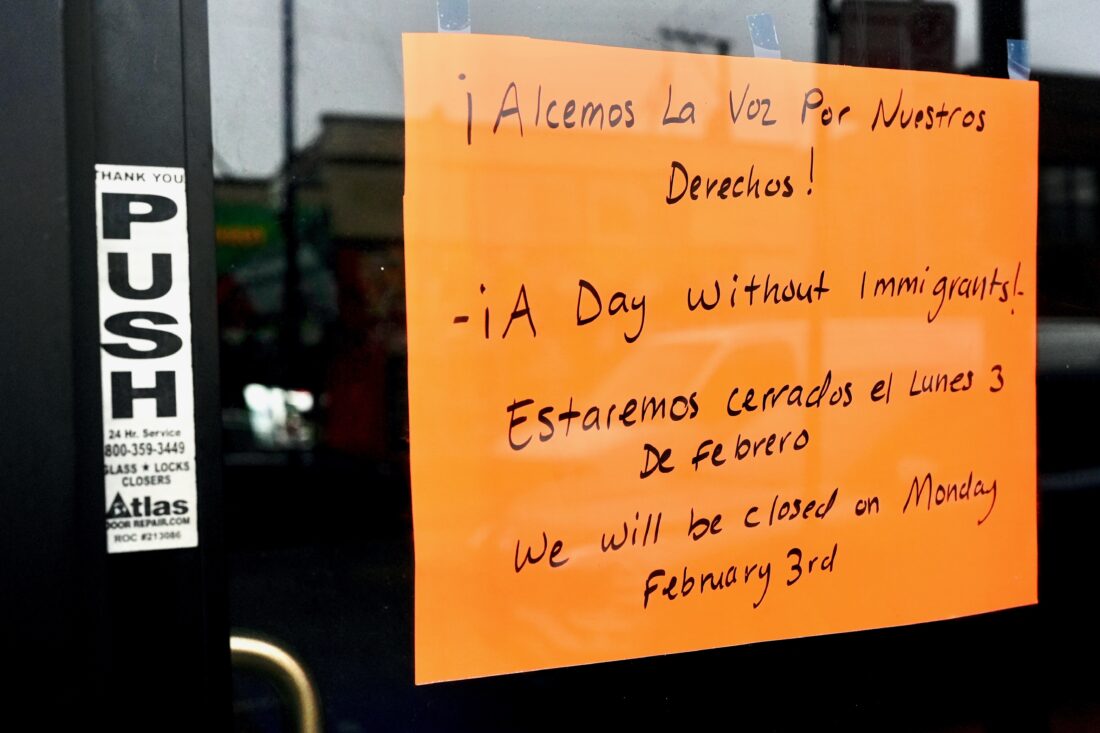
The Associated Press / A closed sign is displayed at a local business in the Little Village neighborhood of Chicago to stand with immigrants in Chicago on Monday.
Several businesses from day cares to grocery stores and hair salons closed Monday across the U.S. in a loosely organized day of protest against President Donald Trump’s immigration policies.
But participation in the “day without immigrants” faced headwinds from employees and business owners who said they need the income — especially as rumors of widespread raids, often false, are leaving many migrant communities afraid to venture outside, affecting even some schools. Monday’s event also came on the heels of street protests Sunday in California and elsewhere.
Noel Xavier, organizing director for the North Atlantic States Regional Council of Carpenters, said that while it’s important to remind the country of the value migrant workers bring to the communities they toil in, many workers couldn’t afford to take a day off.
“If I don’t go to work today, that’s one day less that I have, you know, to be able to pay for my next rent,” Xavier said of the prevailing sentiment among the workers he organizes. “I didn’t see this big rallying around being able to do that, or having the luxury to be able to do that.”
Jaime di Paulo, president of the Illinois Hispanic Chamber of Commerce, noted that small restaurants and retailers in Chicago’s biggest Latino neighborhoods closed, but most major employers as well as those in construction and other industries were operating normally.
“This is only hurting our own community,” he said.
Andrea Toro decided to close her hair salon in Chicago’s Pilsen neighborhood. She added that many of her clients are teachers and have seen children missing school since Trump took office last month because they fear it may not be safe to go. In Chicago, as in San Diego, school districts said some students and families were participating in Monday’s protest.
“If we don’t have immigrants, we don’t have anything work around here,” said Toro, who is from Puerto Rico. “If we’re mute, we’re in silence, then they’re going to do whatever they want.”
National News
Rory McIlroy moves up leaderboard at Truist Championship with big second round
CHARLOTTE, N.C. — It took 27 holes, but Rory McIlroy started to return to his Masters form. The No. 2 player in ...
US stocks fall as oil prices yo-yo
NEW YORK — U.S. stocks fell from their records Thursday after oil prices yo-yoed as Wall Street waits to see ...
Federal court strikes down new global tariffs
A federal court ruled Thursday against the new global tariffs that President Donald Trump imposed after a stinging ...
Shipping firms being whipsawed as they wait for Hormuz to open
NEW YORK — With hundreds of vessels still stuck in the Persian Gulf and costs piling up, shipping companies are ...

CNN founder Ted Turner has died at age 87
GOP Bill would fund $1 billion in White House security for ballroom
District of Columbia WASHINGTON — Senate Republicans are pushing $1 billion in White House security upgrades ...