
Nineteen states pass cash transaction rounding bills
Legislation pending in Pa. following phase-out of penny
Trending
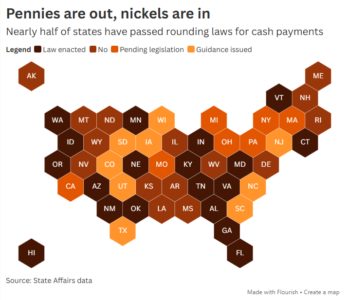
Nineteen states have enacted laws this year in response to the U.S. Treasury Department's phase-out of the penny, giving merchants guidance on rounding cash transaction totals to the nearest nickel.
Bills in two other states are awaiting governor signatures, and lawmakers in six states are still considering bills. Nine other states have issued guidance but not passed legislation.
President Donald Trump last year ordered the Treasury to stop manufacturing pennies, which cost more to make than their store of value. Production of the copper-coated coins ceased in November.
The Treasury issued guidance the following month advising that as pennies fall out of circulation, "merchants will need to round transactions either up or down to the nearest five cents." It noted that most states require sales tax to be calculated on the final sale price rounded to the nearest penny, meaning states will have to amend their sales tax laws to reflect the new normal.
The guidance cited a report from the National Conference of State Legislatures, which details Canada's rounding approach after stopping the production of pennies in 2012. Totals ending in .01, .02, .06 and .07 were rounded down to the nearest 5 cents, and totals ending in .03, .04, .08 and .09 were rounded up.
"While there are multiple potential routes forward, the evidence suggests that clear, potentially uniform solutions are within reach -- solutions that can preserve tax integrity, minimize legal exposure, and reduce undue burdens on all stakeholders," the NCSL report said.
All but 11 states have introduced or passed legislation or issued guidance on how to respond to the penny phase-out. Four of those -- Montana, Nevada, North Dakota and Texas -- were not in session this year.
States have taken varied approaches, but the majority including Connecticut (HB 5349), Florida (SB 1074) and Maryland (SB 893) give retailers discretion to round up or down to the nearest nickel off of the total of the retail transaction. Arizona House Bill 2938 is the only law to mandate retailers use the Canadian system.
New York Assemblymember John McDonald, D-Cohoes, the primary sponsor of Assembly Bill 9274, which the Legislature passed, told State Affairs that he and Sen. James Skoufis, D-Orange County, who introduced the Senate version, worked with the NCSL to craft the legislation to ensure there was consistency for businesses and consumers.
"Due to the nature of the phase-out of the penny without congressional approval, consumers, businesses and those involved with exchange of currency were left in a state of confusion on handling what is normally a simple transaction," McDonald said. "To be clear, I agree that the penny production should cease, but the uncertainty needs to be corrected."
McDonald said as a former business owner, he knows the regulatory requirements can be complex but that businesses want to comply.
"This legislation will help bring that clarity, and I am hopeful that it will find favor with the governor in the coming months," McDonald said.
Indiana Senate Bill 243 leaves the discretion of rounding up or down to the retailer but includes the Canadian system for reference. The law also requires state and local taxes to be rounded down to the nearest nickel. Some states -- like Alabama (HB 545) and Kentucky (HB 757) -- require the rounding to be done post-tax.
Pennsylvania Rep. Nathan Davidson, D-Dauphin, introduced the Pennsylvania Common Cents Act, House Bill 2388, which has advanced to the Senate, after a county treasurer in his district told him the federal government's phase-out was causing "confusion and administrative strain ... for our county treasurers, tax collectors and municipal governments."
"Everyone deserves a predictable and uniform standard if they choose to use cash," Davidson told State Affairs. "This legislation is important and timely to protect businesses, state and local government entities, and, most importantly, everyday Pennsylvanians."
California Assemblymember Christopher Ward, D-San Diego, said he is "a very proud Democrat, but one thing I agree strongly with is an executive order from President Trump to discontinue the penny."
"It was a century ago that we did away with the ha'penny, the half penny, and so this isn't the first time the country has done this," Ward said. "But doing so does actually create a problem for how we are conducting our business in cash transactions."
Ward's Assembly Bill 1793 -- the number is a nod to the year the penny was first minted -- would make it the second state, along with Arizona, to require merchants to round prices to the nearest 5 cents when paying with cash.
Ward, who was stationed in Germany while serving in the military, noted that overseas U.S. bases have not used pennies since 1980 when the Department of Defense decided it was too cost-inefficient to ship the heavy coins.
"If you were shopping for groceries, you just rounded to the nearest nickel, and they were able to do that because it was a federal facility," Ward said. "I remembered that nugget amid today's context, and it seemed odd that this question wasn't answered."
Many states that have not passed laws have issued guidance on how to treat retail transactions. Utah was the first state to do so in November. The state has yet to sign a comprehensive bill on rounding, but the governor signed House Bill 597 in March, which only applies to cash liquor sales.
Some states' provisions only apply to payments by state agencies and parties transacting on their behalf, such as
Minnesota House File 4591 and Oklahoma House Bill 3075. New Mexico House Bill 291 only applies to state taxes, property taxes and Motor Vehicle Code payments; the state does not yet have a retail rounding bill on the books.
Bills failed in Alaska (HB 281), Iowa (SF 2456), Kansas (HB 2797), Mississippi (SB 2680, SB 2847), South Carolina (HB 4617), West Virginia (HB 4476) and Wyoming (HB 71). Both Iowa and South Carolina have issued guidance.
Michigan Senate Bill 1014, introduced last month by Sen. Jeff Irwin, D-Ann Arbor, would take the novel approach of mandating businesses round down on cash transactions, something no other state has done.
Both chambers of Congress are debating the Common Cents Act -- SB 1525 and HR 3074 -- but neither has had any action since last year.
States with actively pending legislation:
– California: AB 1793
– Massachusetts: HB 5450
– Michigan: SB 1014
– Missouri: HB 2819
– New Jersey: SB 3977
– New York: AB 9274
– Ohio: HB 737
– Pennsylvania: HB 2388
States that have enacted rounding laws this year:
– Alabama: HB 545
– Arizona: HB 2938
– Connecticut: HB 5349
– Florida: SB 1074
– Georgia: HB 1112
– Hawaii: SB 3255
– Idaho: SB 1350
– Indiana: SB 243
– Kentucky: HB 757
– Maryland: SB 893
– Minnesota: HF 4591
– Nebraska: LB 838
– New Mexico: HB 291
– Oklahoma: HB 3075
– Oregon: HB 4178
– Tennessee: HB 1744
– Vermont: S 327
– Virginia: HB 954