
Trending
For the fifth consecutive year, Pennsylvania's government failed to pass a budget by the June 30 constitutional deadline.
The latest delay adds to the state's long history of missed budget deadlines, a pattern reflected in five decades of budget records.
Lawmakers appear poised to vote on budget-related bills this weekend in a bid to wrap up the budget a little less than two weeks late. An "off-the-floor" Senate Appropriations Committee meeting is scheduled for Friday evening with the Senate scheduled to hold voting sessions on Saturday and Sunday and the House due to return for session on Sunday. Among the issues on the table are education tax credits, data centers and potential legislation to regulate skill games, according to PA legislators.
As talks continue, Pennsylvania remains one of just two in the country without a budget, raising concerns about timely funding for state-supported agencies.
Massachusetts Gov. Maura Healey signed that state's $63.4 billion budget on July 9, leaving Pennsylvania and South Carolina as the only states without a budget approved.
There are a number of factors that may contribute to Pennsylvania legislators' difficulty in coming to a budget compromise. For one, as Gov. Josh Shapiro has said, Pennsylvania is a historically partisan state, where the legislature is more often than not divided. The Commonwealth is also economically and culturally diverse with two large metro areas, many mid-sized cities and rural areas with a large spread out population. Finding a general fund that fits every constituent's needs is near impossible. Reaching a compromise that satisfies all those competing interests is a heavy lift in normal budget seasons.
Gubernatorial party control
Since 1977, Pennsylvania has been governed almost equally by Democrats and Republicans. During Democratic administrations, however, the state has been more likely to miss the fiscal deadline by a significant margin. Republican administrations, by contrast, have more often enacted budgets ahead of the deadline.
But party control of the governor's office tells only part of the story.
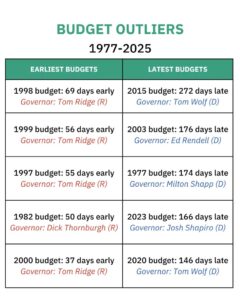
Among the five latest budgets since 1977 -- all under Democratic governors -- four occurred when the governor faced a legislature controlled at least in part by the opposing party. Meanwhile, each of the five earliest budgets was enacted under unified Republican control of the governor's office, Senate and House.
In other words, while late budgets have been more common under Democratic governors, the data suggest that divided government, not the governor's party alone, is a stronger predictor of budget delays.
Outliers
Two of those delays coincided with major economic crises.
Seven Pennsylvania budgets have been enacted more than 100 days after the June 30 constitutional deadline.
In 1977, the budget was enacted 265 days late as Pennsylvania grappled with nationwide "stagflation," which is a period of slow economic growth, high inflation and rising unemployment. The prolonged stalemate delayed welfare payments, prompting widespread protests from recipients. More than three decades later, the 2009 budget was finalized 101 days late as the Great Recession battered state revenues and complicated negotiations.
Education funding has also been a recurring source of conflict.
In 2003, lawmakers did not complete the budget until 176 days after the deadline because of disagreements over an income tax increase to fund new education programs. More recently, disputes over public school funding, school choice and private school vouchers have contributed to prolonged negotiations.
The 2015 budget was not completed until March 2016 after a months-long standoff between Democratic Gov. Tom Wolf and the Republican-controlled General Assembly. Negotiations centered on public education funding and broad-based tax increases. With school districts, nonprofits and other state-funded agencies facing mounting financial strain, Wolf ultimately allowed the budget bill to become law without his signature after a temporary stopgap funding measure was enacted in December.
Under Shapiro's administration, both the 2023 and 2025 budgets stretched more than 100 days beyond the deadline. In 2023, negotiations stalled over a proposed $100 million private school voucher program known as the Pennsylvania Award for Student Success Scholarship. Shapiro ultimately agreed to line-item veto the appropriation after it became clear the House and Senate were at an impasse. In 2025, negotiations deadlocked over education and mass transit funding and environmental policy.
The COVID-19 pandemic also disrupted the budget process in 2020. Rather than passing a single comprehensive spending plan, Wolf and lawmakers approved the budget in two stages: an initial budget in March to address the immediate public health emergency, followed by a second package in November that completed the state's spending plan.
State revenue drops amidst economic recessions and disagreements over public versus private education funding have been two of the most significant contributing factors to a late budget.
Turning points
All but one of Pennsylvania's budgets enacted more than a week after the constitutional deadline have occurred since 2000.
The shift may be due, in part, to two legislative reforms in the Pennsylvania budget process.
Following the 2005 midnight pat raise controversy, lawmakers in 2006 enacted a series of rules reforms intended to ensure more transparency. Those reforms included barring votes after 11 p.m. and requiring more public notice before votes can be taken.
Another element that may have contributed to longer budget impasses was a 2009 state court ruling requiring state employees to be paid even when a budget had not been enacted. The decision reduced one of the most immediate consequences of missing the budget cutoff, easing public pressure on lawmakers to reach an agreement quickly.
Budget impasses have remained a fixture of Pennsylvania politics, but their consequences and optics have changed. The passage of the 1986 Pennsylvania Sunshine Act, which requires state government agencies to deliberate and vote on agency business in open, public meetings, changed how much of the modern budget process has unfolded in public view.
Earlier stalled negotiations brought immediate financial hardship for state workers and dramatic "Friday Night Fight" confrontations at the Capitol, while modern negotiations tend to play out through controlled media events and public messaging.