
UPMC Altoona nurses rally amid SEIU Healthcare-PA union negotiations
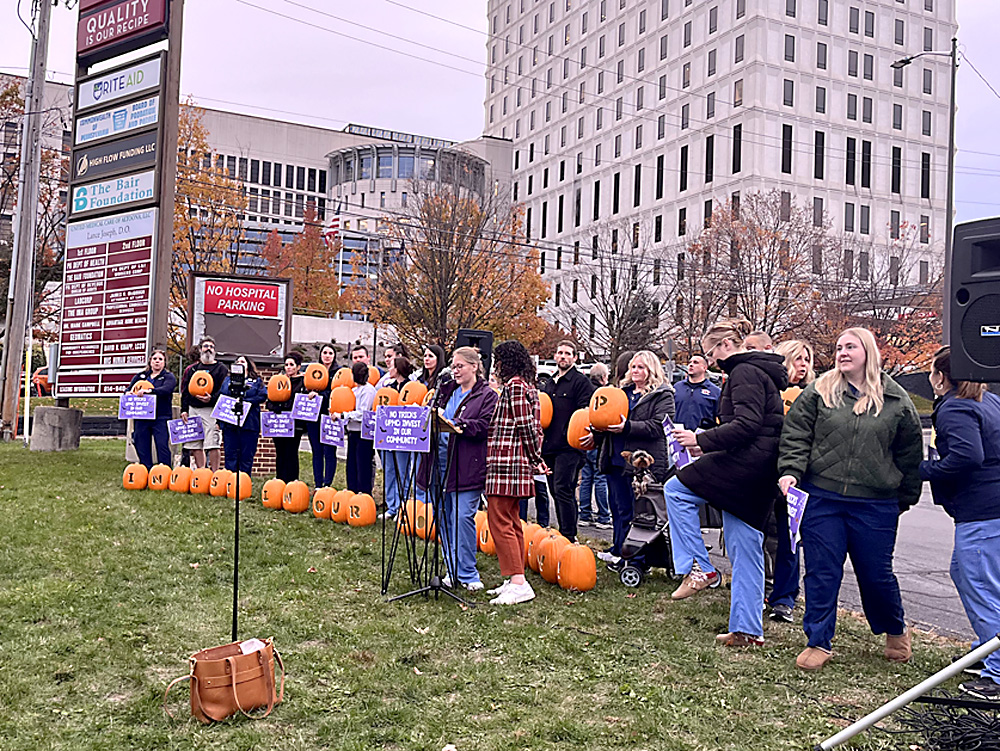
About 80 UPMC Altoona nurses rallied in a grassy area along Howard Avenue across from the hospital Wednesday evening to call attention to what they say is underinvestment and understaffing that violates promises made by UPMC when it took over the hospital in 2013. Mirror photo by William Kibler
About 80 UPMC Altoona nurses rallied in a grassy area along Howard Avenue across from the hospital Wednesday evening to call attention to what they say is underinvestment and understaffing that violates promises made by UPMC when it took over the hospital in 2013.
Some of the nurses lined up side-by-side held pumpkins individually carved with letters spelling out “No more tricks UPMC” while a line of pumpkins at their feet spelled “Invest in our community.”
The rally was held in the context of negotiations between the hospital and the nurses’ union, SEIU Healthcare-PA, for renewal of a contract that expires at the end of the year.
There are now more than 300 fewer nurses than the 840 who worked at the hospital in 2013, reflecting the understaffing that has led to stress, overwork and burnout that compromises patient care and forces inexperienced nurses into situations they’re not ready for, leading to more stress, overwork and burnout, the nurses said.
The hospital didn’t respond to repeated invitations to comment on the rally.
Given that the hospital earned $364 million on operations during 2024 before interest, depreciation and amortization (although that only represents 1.2% of revenue), and given that CEO Leslie Davis earns $11 million a year — and given other trappings of corporate wealth — the hospital has the resources to fix the understaffing problem, according to speakers at the rally.
One of the key issues is alleged non-competitive RN pay.
The high caseloads and long shifts that sometimes result from the understaffing “wreak havoc on bodies, minds and family lives,” said nurse Paula Cain.
It also leads to “moral injury,” because nurses can’t give the kind of care they should, according to union local President Jaime Balsamo.
That moral injury can come from being “torn” between responsibilities to different patients, according to Elyssa Sitar, who recently transferred out of intensive care.
Once for her, such conflict occurred because of care needed by one patient who was dying and one who was unable to move, she said.
It causes distress, yet nurses are expected to be resilient — to “behave as if nothing has happened,” Sitar said.
Thirteen-year nurse Leann Oppel was one of 65 RNs in the Surgical/Progressive Care unit, she said. None of those are left. Problems that drove them away included nurses who were just a few months into their careers being assigned to be in charge, or to train other new nurses or to care for critically ill patients, she said.
“Stop the vicious cycle,” she said. “Bringing in new nurses, chewing them up and throwing them away.”
Representatives of other unions expressed support, including Bob Kutz, president of the Blair-Bedford Central Labor Council; Bob Miller, vice president of the Pennsylvania State Council of Machinists and Patrick Miller, president of the city’s International Association of Fire Fighters local.
“This is bull—-,” said Bob Miller, whose wife worked at the hospital for 30 years, of the situation.
A relative who came to the hospital gravely ill had to wait for hours in the Emergency Department for lack of beds on the floors, Bob Miller said.
Two floors of the hospital are currently closed, said Patrick Miller.
The responsibility for such issues that cause problems with care “falls squarely on UPMC,” Bob Miller said. “Corporate greed.”
“Stay loud, stay united, stay union,” Patrick Miller told the nurses.
Local News
Tyrone Area School District budget calls for tax increase
TYRONE — Faced with a deficit of about $1.2 million, the Tyrone Area School District’s 2026-27 preliminary ...
Blair County Prison Board weighs options
HOLLIDAYSBURG — The Blair County Prison’s inmate population was down to 308 as of Thursday, its lowest level in ...

Challenge accepted: Students take part in statewide remake learning days festival
Blair County Prison Board weighs options
HOLLIDAYSBURG — The Blair County Prison’s inmate population was down to 308 as of Thursday, its lowest level in ...
Tyrone Area School District budget calls for tax increase
TYRONE — Faced with a deficit of about $1.2 million, the Tyrone Area School District’s 2026-27 preliminary ...