
Griffiths shares pain, joy of writing journey
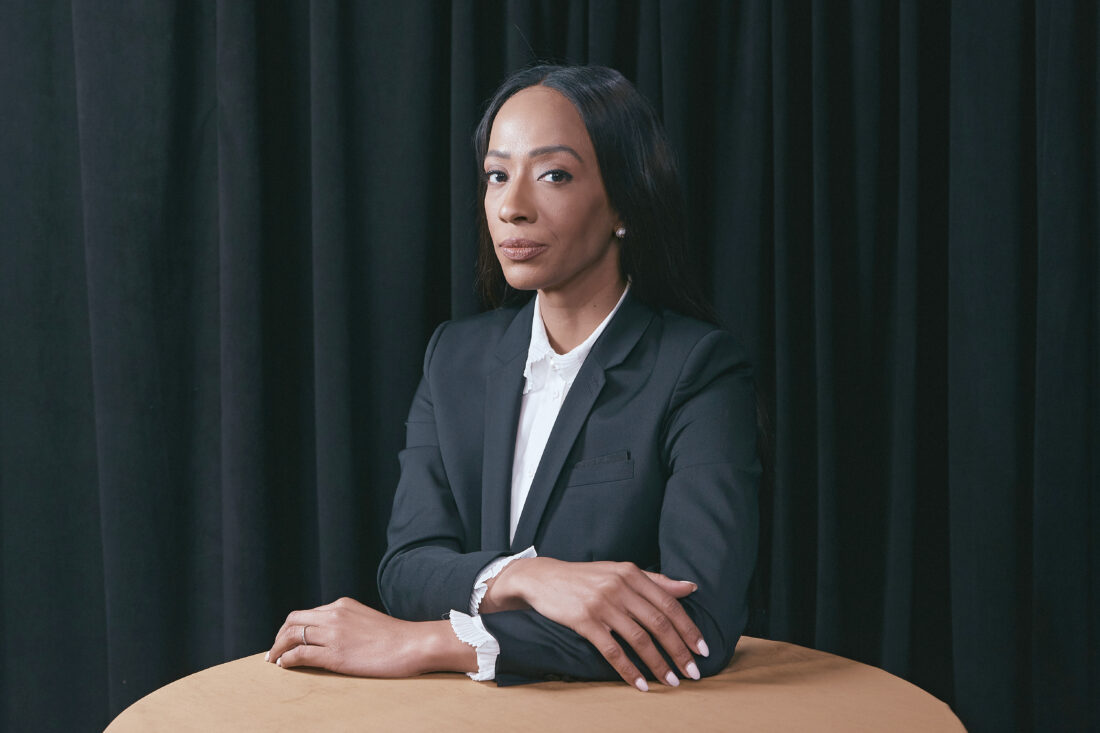
American poet, novelist and visual artist, Rachel Eliza Griffiths, poses for a photograph on Friday, Jan. 16, 2026. (AP Photo/Andres Kudacki)
NEW YORK — After her best friend died on the day Rachel Eliza Griffiths married Salman Rushdie and her husband was nearly stabbed to death a year later, the author and multimedia artist was left with no choice over what she would write about next.
“I think there was a struggle when I tried not to put it into words, when I tried to avoid it, when I thought, ‘All of these life events have happened to me, but now I’m going to think about my next novel and my next collection of poetry,'” says Griffiths, whose memoir “The Flower Bearers” released in January. She ultimately conceded, “You cannot pass through these kinds of personal life events and ask your brain and your being to go back to who you were because you’re not the same.”
“The Flower Bearers” comes out nearly two years after “Knife,” Rushdie’s account of the 2022 assault that hospitalized him and blinded him in one eye. Griffiths’ book is framed around Rushdie and her close bond with poet Kamilah Aisha Moon, whose death is ever entwined with her wedding, an “uncanny Janus coin.”
As she writes in “The Flower Bearers,” Griffiths and Rushdie met at a PEN America event in May 2017, a relationship sealed out of a mishap that seems comic compared to what happened later: As they were stepping out onto a terrace, Rushdie banged into a plate glass door and fell, bleeding. He was embarrassed and in pain and wanted to leave. She offered to ride home with him and ice the wounds on his head and nose.
“We talked and laughed for hours,” she wrote.
She well knew Rushdie’s history, the 1989 fatwa from Iran’s Ayatollah Ruhollah Khomeini that called for the author’s death because of the alleged blasphemy of his novel “The Satanic Verses.” But she, and Rushdie, thought his days of fearing for his life were well behind him — until Aug. 12, 2022. She was alone in her living room, drinking coffee, when a friend called and told her that Rushdie had been “hurt.”
Rushdie was preparing to deliver a lecture at the Chautauqua Institution, in western New York, when a man rushed to the stage and stabbed him repeatedly. (The assailant, Hadi Matar, has since been sentenced by a state judge to 25 years in prison for assault and attempted murder.)
“Please don’t take him away from me yet,” Griffiths remembers thinking. “Please don’t let Salman die.”
A prizewinning poet, novelist, photographer and filmmaker, the 47-year-old Griffiths is a graduate from the creative writing program at Sarah Lawrence College, where Moon was a fellow student. Before Griffiths met Rushdie or Moon, she had endured grief and trauma and the fear of a loved one being in peril. Her beloved mother had suffered from poor health since Griffiths was a girl and died in 2014, at 59. Griffiths is also a survivor of sexual violence who has struggled with mental health issues and says she deals with PTSD on a daily basis.
Her book echoes Rushdie’s beyond their memories of each other. Rushdie, who last year published the story collection “The Eleventh Hour,” told The Associated Press at the time that he couldn’t get back to other kinds of writing until he completed his memoir. And, like “Knife,” Griffiths’ memoir is a story of improbable resilience, what she calls the discovery of grace in the midst and aftermath of malicious violence and cruel luck.
“I can kind of look back and think, ‘Wow, that woman, she was tough as nails,'” she says. “I’m very different than the Rachel Eliza who wrote this book, and the Rachel Eliza who was living through all of these experiences. In the moment, people would say, ‘Be strong, be strong.’ And I’m like, well, ‘I am strong.'”
Griffiths spoke with the AP about Rushdie, Moon, the writing of her book and her feelings of gratitude.
AP: Now that you’ve written this book, are other things starting to come into your head, like poetry? Has a path been cleared?
GRIFFITHS: I definitely feel the path has opened up for me for poetry, for visual art. I feel as if I might want a break from language for a bit and plant myself a little bit more into my photography.
AP: You have a line from your (2020) collection “Seeing the Body,” in which you write, “Forgive my estranged affair with the present.” What’s your relationship with the present now?
GRIFFITHS: It’s not estranged now.
AP: It’s reconciled?
GRIFFITHS: It’s reconciled. It’s realigned. It’s immediate and it’s joyous. It’s joyous because I now know how easily I could not be here, how easily Salman could not be here.
Books
Story explains gap between life, horrors of World War II
Corleone crime family returns in a new ‘Godfather’ novel
NEW YORK — Decades after the last “Godfather” movie and more than 10 years since the last “Godfather” ...
Publisher’s Weekly US best sellers
Hardcover Fiction 1. “Whistler” by Ann Patchett (Harper) 2. “Yesteryear” by Caro Claire Burke ...
Rachel Maddow takes on DOJ’s 150-year saga in her new book
NEW YORK — After writing bestsellers about the military, the oil and gas industry and the state of democracy, ...
Book talk set for June 10
William R. Huber, author of “Charlie Schwab: President of Carnegie Steel, U.S. Steel and Bethlehem Steel,” will ...
Author plans visits
Lynn A. Haller of Duncansville, a trauma informed therapist, author and educator, has several book readings and ...