
Role-playing poverty
Exercise teaches community how to help the poor
Trending
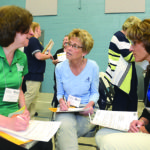
Among approximately 150 people assembled in a church hall on Juniata Gap Road last week for a "Poverty Simulation" were few who were actually poor.
Most instead were human services workers learning how to empathize better with poor clients, whom the workers help through the disbursement of funds, counseling, guidance and other assistance.
Ironically, there might have been many more poor people at the event, except for the very difficulties that the attendees were pretending to experience: transportation problems; the conflicting demands of family, work and school; and a shortage of money.
Participants in the event, sponsored by a work group of the Healthy Blair County Coalition, played assigned characters based on instructions in a kit obtained by event organizers from the Missouri Community Action Partnership, which created the poverty simulation program.
Most participants played members of poor families.
They sat together, then dispersed when called to interact with other participants who were seated behind tables, pretending to be social service workers, employers and officials at a bank, a public transit authority, a payday loan and check cashing company, a library, a pawn shop and a school.
The event, which lasted an hour, represented a month in the life of the characters, so that, for example, a workday lasted seven minutes.
"The simulation is not a game," the instructions stated. "Millions face the challenge that is before you."
38 millon in poverty
About 38 million people in the U.S. have incomes below the poverty line, according to the instructions.
The "families" included:
Stella Smith, an 85-year-old homeless woman living in a shelter and receiving a retirement income of $552 a month, $27 more than expenses.
The Nattins, four people supported by a father earning $1,781 a month, $305 more than expenses that included a mortgage and an auto loan.
The Isma family, comprised of an ex-inmate, his girlfriend and her child, living in a mobile home and surviving on the ex-inmate's $511 income, which was reduced by child support garnishments and which exceeds the family's expenses -- including repayments on a vehicle-collateral loan -- by just $94.
The five-member Boling family, including a father who is laid off and a mother who works as a receptionist, earning $1,324 -- not enough to cover expenses, except for $200 in the bank.
It wasn't easy for the characters.
"This is tricky," said a role-player at the bus pass table.
"I'm going to walk home," said a participant unwilling to pay for a pass.
"Wow, you people are really screwing me," another said.
Participants designated as children were encouraged to act the part, whining and crying if their parents neglected them.
The police would be called if someone noticed such neglect, said Ashley Gay Vocco, a member of the coalition work group.
One participant who played a child whose duties included taking care of a younger sibling said, "I felt like I had to grow up too fast."
Another participant found it galling when agency workers told clients matter-of-factly that they couldn't help, then sent those clients to other agencies, where they experienced similar disappointment -- either because of closed offices, further referrals or outright denials.
Participant Steffan H., who works for the Blair County Juvenile Probation office, dutifully made his way around the room, encountering long lines at the bank that prevented him from cashing his check and finding the school closed before he arrived to pay a bill.
"If this was real life, the situation would be very stressful," Steffan said.
It almost felt like he had to be in three places at once, he said.
The exercise reminded Tom Spallone, an employee of Catholic Charities, of the struggle-filled early days of his marriage.
Frustrated, angry, powerless
Afterward, participants spoke of situations that, if real, would have left them feeling overwhelmed, frustrated, confused, angry and powerless.
The problems were especially bad for minority characters.
It seemed "the system was stacked against (them)," one participant said.
Overall, the system seemed set up for participants to fail, said another.
Characters tended to start out optimistic, but after a couple "weeks," grew angry, conniving and opportunistic, one participant said.
The difficulty of simply making it to various tables for shopping, paying bills, signing forms and satisfying other obligations within the allotted times shows how difficult it can be in real life for the poor, especially in rural areas, where there is little public transportation and service centers are far away from one another, one participant said.
The exercise made it clear that the lack of a car can be crippling.
Obtaining a car may be nearly impossible for the jobless, according to Denise Gummo, an employee of Blair County Children, Youth & Family Services.
"To get a job, you need a car, (but) to get a car, you need a job," Gummo said.
The exercise also disclosed issues with child care, domestic violence, early dropout, drugs and benefit stoppage.
The community needs to take responsibility for making it easier for the poor, one participant said.
Consolidating agency functions to minimize travel requirements would help, according to some.
Clients should be taught how to advocate for themselves, said another — adding that such advocacy needs to be tempered so as not to become too aggressive.
More service agencies, employees of the judicial system and elected officials — especially lawmakers — should take the poverty training, one participant said.
It would help if those who set the guidelines for aiding the poor got a feel for trying to live on the kind of incomes those guidelines produce, Vocco said.
Real poverty
Debora Gray of Altoona, who was walking with two young children along Fifth Avenue on Thursday, has experienced actual poverty -- as well as periods of relief from poverty -- and has a few suggestions.
As a young single mother, Gray couldn't work and had to go on welfare.
After she married, she joined the middle class, as her husband worked for the railroad and made decent money.
When her husband had surgery, however, and couldn't work, the family struggled to pay bills.
When her husband returned to work, the family made ends meet again -- even though there were three children.
But starting 10 years ago, her husband had to go on disability, which paid only $2,200 a month, and the struggles recommenced.
"We were making it," she said.
But just barely.
They couldn't afford health insurance for her.
She got depressed sometimes, even thinking of suicide.
"You wonder whether you want to live," she said.
A week ago, her husband died, which means the struggles will intensify, she said.
She would like to see adjustments in social service programs to eliminate all-or-nothing situations.
And she would like the government to create more beneficial incentives.
It doesn't make sense to provide no help at all if monthly income is barely over an arbitrary limit, she said.
That can be a disincentive to work, she said.
Conversely, something should be done to discourage people from declining to work just because it's easier to collect welfare, she said.
Maybe assigning volunteer-type activities to those who collect welfare without being employed would help, she said.
She and her husband taught their children to accept welfare only when necessary, she said.
"That's how we lived," she said.
Mirror Staff Writer William Kibler is at 949-7038.