
Warming waters: Park managers ensure lakes, streams safe for humans, wildlife
Park managers ensure lakes, streams safe for humans, wildlife
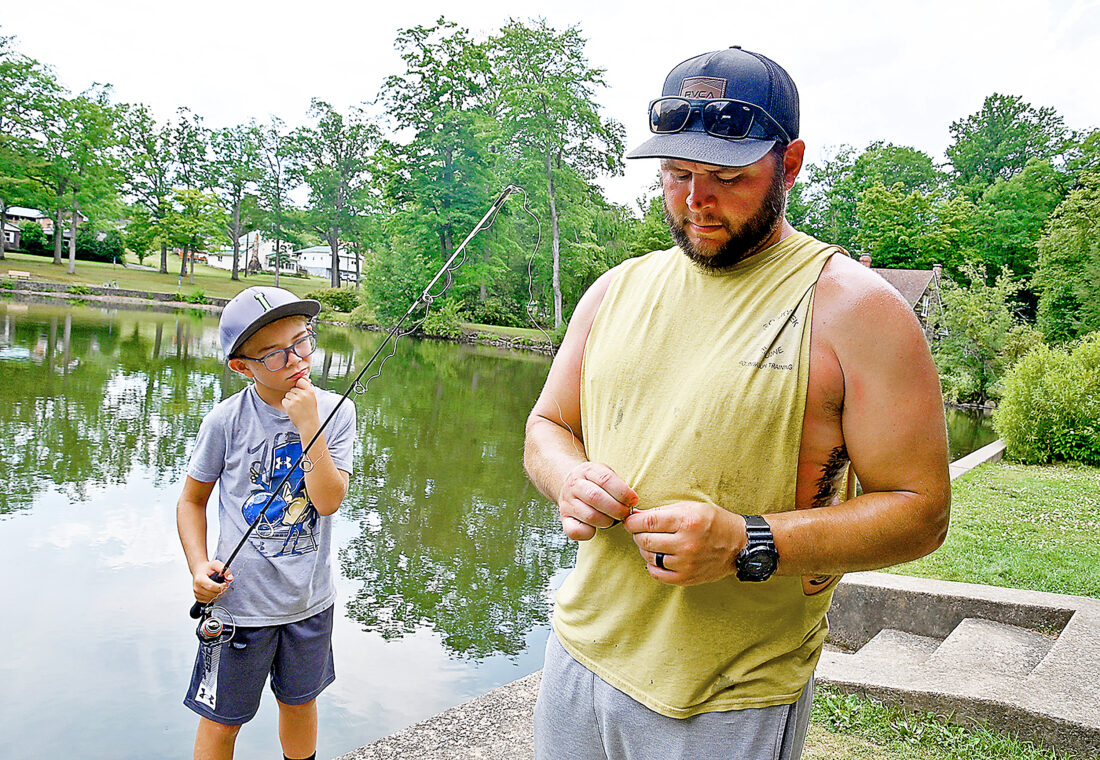
Brady Williams helps his son, Xander, 8, both of Bellwood, with his bait while fishing at Reservoir Park in Tyrone on Monday afternoon. While area residents enjoy water sports this summer, area park managers are ensuring the lakes and streams remain safe for humans and wildlife. Mirror photo by Patrick Waksmunski
As hot and humid conditions persist across the region, area park managers are keeping an eye on lakes and streams, ensuring the water remains safe for public use and native wildlife.
Shortly before the Fourth of July holiday, officials at Shawnee State Park, Schellsburg, were forced to close the swimming beach due to elevated bacterial counts.
According to park manager Jim McCorkle, an elevated reading for E. coli bacteria during a routine test prompted the closure.
This was the first beach closure in the park in eight years, he noted.
A test the following day gave a reading within the state-mandated safe range, allowing the swimming area to reopen in time for Independence Day festivities, McCorkle said.
While this reading may have been a “fluke,” McCorkle said, state park officials are continuously monitoring their waterways to ensure the health of humans and wildlife, which may be at risk due to algal blooms caused by prolonged exposure to high temperatures.
According to McCorkle, Shawnee Lake recently reached 80 degrees.
“The lake is definitely getting warmer,” McCorkle said, “it’s getting up there pretty good.”
Glendale Lake warns of hydrilla
In June, an area of high pressure in the atmosphere above the upper Midwest and Northeast created a heat dome effect, breaking single-day temperature records in Philadelphia, Pittsburgh and Scranton, among several other cities according to the National Aeronautics and Space Administration.
According to environmental education specialist Leo Magulick, Glendale Lake in Prince Gallitzin State Park hasn’t seen any serious negative impact from recent heat events.
The lake’s water level has remained stable, and has avoided any algae blooms or unwanted bacterial growth, Magulick said.
The main concern for park staff, he noted, is a small surge in growth of the invasive hydrilla plant which grows along the bottom of the lake.
Hydrilla, which if left unchecked can grow rapidly and out-compete native species for space and available nutrients in shallow water, is adapted to survive in the high heat and typically grows during warm summer months.
According to the National Invasive Species Information Center, hydrilla is federally recognized as a noxious weed, making its import or unlicensed transport across state lines illegal.
Park staff encourage anyone using the lake to check their boats for hydrilla shoots to avoid spreading the invasive plant to uncontaminated waterways, Magulick said.
Canoe Lake ‘layers’ changed over
At Canoe Creek State Park, manager Joseph Basil said Canoe Lake has not experienced any significant harm from the heat wave, though it is still being closely monitored.
In his time as manager, Basil said that the lake is most at risk for algae blooms when temperatures are high and there is a reduced water level due to drought.
The low level allows the water to stagnate, making it more susceptible to rapid algae growth, he said.
Since this has been a relatively wet summer, Basil said, Canoe Lake has received a sufficient flow of fresh water to avoid blooms.
Another reason the lake has avoided negative consequences of the ongoing heat is the hydraulic turnover effect, Basil said.
This phenomenon is when warm, less dense water switches with the cold, dense water along the bottom of the lake, allowing these “layers” of water to change places, Basil said.
Because Canoe Creek Lake turned over earlier this year, Basil said, the water temperature has remained at a safe level for aquatic life despite the heat dome in June.
“The heat affects everything, from water and fish to humans,” Basil said.
Fish go deep for oxygen
According to Lisa Haas, a conservation education specialist at the Blair County Conservation District, the high heat can negatively impact several native fish species.
Eastern brook trout are adapted to live in cold freshwater spring-fed streams and lakes in the Great Lakes and Appalachian Mountain region, and will often swim into deep water when temperatures rise, Haas said.
Colder water carries more oxygen, so when fish “get stressed out, so they want to go down where there is colder water with more oxygen,” Haas said.
Trout will often lose appetite and will be less active in warmer water, she added.
If temperatures change too quickly or reach a high enough level, then fish may die outright.
Another major concern for fish is the potential loss of species further down the food chain, according to Western Pennsylvania Conservancy Chesapeake Bay watershed manager Jennifer Farabaugh.
The ecosystem represented by local lakes and streams contains all the living and nonliving things in the environment, including the atmosphere, soil, flora and fauna that interact with one another, according to the U.S. Geological Survey.
Since trout feed primarily on insects and small invertebrates, which are susceptible to the heat, their populations may decline during prolonged periods of extremely warm weather, Farabaugh said.
These species of invertebrates live in “very clean, high-oxygen water,” so a decrease in available oxygen in the environment may negatively impact their numbers, she said.
Algae blooms, which is when algae colonies grow rapidly and suck up much of the available nutrients and oxygen in an aquatic ecosystem, are commonly caused by either high heat or fertilizer runoff, Farabaugh said.
These events can cause a drastic decrease in available oxygen, which can kill species outright if levels reach a critical level.
Algae blooms, if left unaddressed, can become a regional threat, according to Penn State Altoona biology professor Ed Levri.
In the Gulf of Mexico, fertilizer runoff from agricultural operations along the Mississippi river creates an annual algal bloom large enough to leave an oxygen-free anoxic zone “about the size of New Jersey,” Levri said.
These anoxic areas are completely devoid of life due to the low oxygen level, Levri said.
Riparian zones offer protection
One of the most impactful ways to control runoff and promote waterway health is protecting riparian zones, Levri said.
Riparian zones, the areas directly alongside a creek, stream or river, can help deter soil erosion and improve water quality, Levri said.
By providing shade along the edge of the waterway, riparian zones also play a role in helping to control excessive heat, Levri said.
Mirror Staff Writer Conner Goetz is at 814-946-7535.