
Springtime crappies provide fishing fun and good eating
Around mid to late May is usually a prime time to catch crappies as these popular panfish migrate to the shoreline prior to spawning. And when crappies are biting, it’s one of the best ways I know to get the main ingredient for a wonderful fish fry. Many lakes throughout our region offer good crappie fishing. Canoe Lake in Blair County, Glendale Lake in Cambria County, Raystown Lake in Huntingdon County and Sayer Lake in Centre County are all popular crappie waters.
Catching crappies usually isn’t difficult once you find them. In the spring, expect to locate crappies relating to some type of shoreline cover as they prepare to spawn. Fallen trees and sunken brush piles are usually crappie magnets, attracting numbers of fish that prey on minnows and other small fish seeking shelter among the branches. Weed lines and the edges of weed beds will also hold crappies. When fishing a weed line, be prepared to keep moving along the cover, catching a few fish here and there. Crappies will also relate to the edges of drop-offs, especially if the structure contains some additional cover. Extensive areas of riprap, such as along a dam breast or causeway, will also attract springtime crappies.
Live minnows are unquestionably the best bait for crappies, and can be rigged either on a plain hook or a jighead and suspended below a small bobber.Crappies will readily strike a variety of artificial lures. Small spoons and spinners will take them when they are congregated in open water. The most versatile and productive crappie lure, however, is a jig. Tiny,1/32- or 16-ounce jigheads dressed with feathers, marabou, twister tails or soft-plastic tubes are perfect for tempting crappies. I like to carry a good assortment of those lures in several color combinations such as white, pink, chartreuse, yellow and black.
Crappies have three important behavioral traits that anglers can use to their advantage. First, crappies tend to suspend at a particular depth near some kind of cover or bottom structure. Finding the depth where the fish are holding is obviously important, and on a given day that can be influenced by several factors such as water clarity, sunlight and water temperature.
Crappies are sight feeders that like to approach their prey from below, so they will readily swim up to take a bait. Putting the bait on the bottom will not interest many crappies. Using a small float or bobber to keep a minnow or jig just above the level where the fish are suspended is the simplest method of attracting them. Use small, sensitive pencil bobbers that go under with minimal resistance when a fish takes the bait or lureand adjust the distance from the float to the bait a foot or so at a time until you find the strike zone.
Finally, crappies are notorious light biters. A crappie can gently inhale a bait or lure and then slowly swim away with it. Set the hook by lifting the rod tip firmly rather than with a hard snap. Crappies are sometimes called “papermouths,” and that nickname is certainly appropriate. Setting the hook too hard can actually tear it loose. Once a crappie is hooked, simply reel it in with just enough pressure from the rod tip to keep the line tight and lift it from the water carefully.
A light-action rod works best for crappies. I like one that is sensitive enough to detect light bites and has a flexible tip to avoid tearing the hook from a crappie’s delicate mouth. I also prefer 4- or 6-pound-test line for crappie fishing. The light line casts easier and is also more sensitive with the lightweight crappie lures. Because crappies are fond of hanging around underwater brush and submerged treetops, getting snagged on these obstructions can be a frequent occurrence. When this happens, it’s better just to break the line, get rerigged and fishing again. The lighter line makes that task much easier.
Many consider walleyes to be the best-eating fish in freshwater, but personally, I’ll take crappies over walleyes any day. Filleting a batch of crappies is somewhat of a chore, so most avid crappie fishermen also tend to be proficient with a fillet knife. But the bit of extra work involved makes a successful crappie fishing trip all the more worthwhile.
Depending on personal taste, the fillets can be coated with seasoned flour or a prepared fish breading mix. I prefer to cook crappies and other panfish without any breading, then drain the small fillets on paper towels and sprinkle them with celery salt and a little fresh ground pepper or Old Bay seasoning. Serve up that main course with some French fries and coleslaw, and you have one of my favorite rites of spring to be sure.
Local Sports
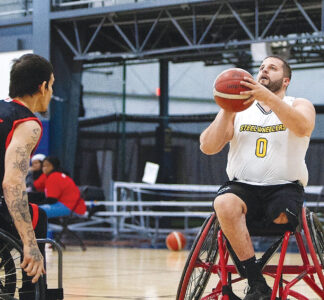
Getting a second chance: 11 years after tragedy, Williamsburg’s Kurt Detwiler doing ‘best that he can in life’

Claysburg-Kimmel Lady Bulldogs softball team begins quest for another PIAA playoff run

Sylvan Hills golf course undergoes improvements

Thrower on Team USA coming to Mansion Park
HoopsFest event returning for 24th year
HoopsFest, the Mid-Atlantic’s largest outdoor 3-on-3 basketball tournament for all ages, returns for its 24th ...
Steinbugl delivers for Sheetz in City League baseball victory
LILLY — Aidan Steinbugl had two hits, three RBIs and scored three times as Sheetz crushed Sinisi Detailing, 20-4, ...