
The Flight that Changed History: Friends of Flight 93 work to ensure heroism aboard doomed plane is never forgotten
-
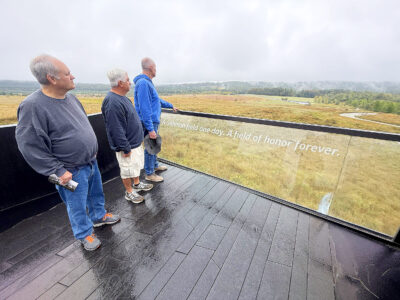
- Brothers (from left) George and Gary Mueller and Dr. Daniel Meenan gaze at the ‘field of honor’ where United Airlines Flight 93 crashed on Sept. 11, 2001, from the Flight 93 National Memorial’s flight path overlook. Mirror photo by Matt Churella
-
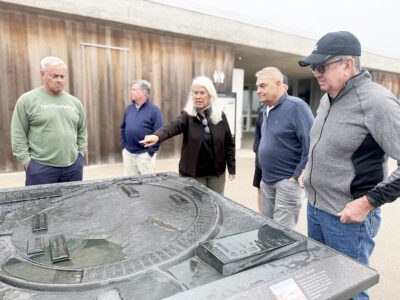
- Friends of Flight 93 Executive Director Donna Gibson greets visitors of the Flight 93 National Memorial in Stonycreek Township, Somerset County, with an orientation of the site. From left: Bob Koons, Philadelphia; Ed Bradley, Philadelphia; Thomas Bonnar, southeast Georgia; and Jim Hagen, Raleigh, North Carolina. Pictured behind Bonnar is Dan Wilkens of Atlanta, Georgia. Mirror photo by Matt Churella
-
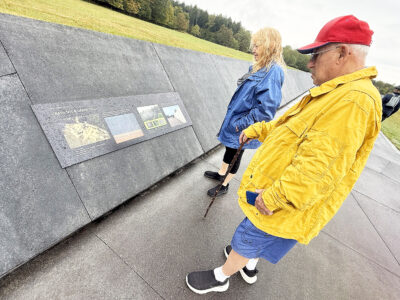
- Kathleen Swanson and Joseph Romano Sr., both of southern New Jersey, read a sign at the Flight 93 National Memorial’s memorial plaza. Located in Stonycreek Township, Somerset County, the plaza is a black walkway that marks the edge of the debris field and crash site. It’s about a quarter of a mile in length and connects the visitor shelter with the wall of names, where people can pay their respects to the 40 passengers and crew members who lost their lives. A large boulder marking the crash site is viewable from the plaza. Mirror photo by Matt Churella
-
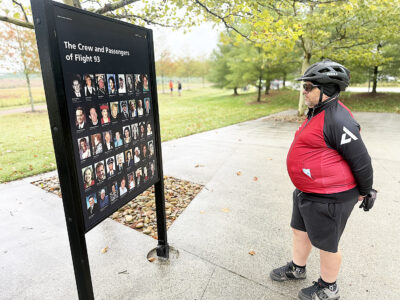
- Patrick Prosser of the Pittsburgh area reflects on the heroic actions made by passengers and crew members aboard United Airlines Flight 93. After the plane had been hijacked, the passengers and crew members made phone calls to loved ones, learned of other hijackings that had taken place minutes earlier and voted to take action against the terrorists once the plane was over rural land, according to National Park Service volunteer Ginny Barnett. Mirror photo by Matt Churella
-
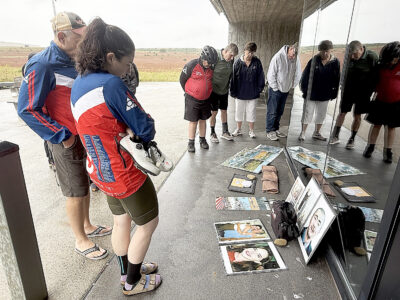
- A group of Flight 93 National Memorial visitors gather at the Visitor Shelter to pay their respects to the plane’s 40 passengers and crew members whose actions prevented the flight from reaching its likely target of the United States Capitol building in Washington, D.C. Mirror photo by Matt Churella
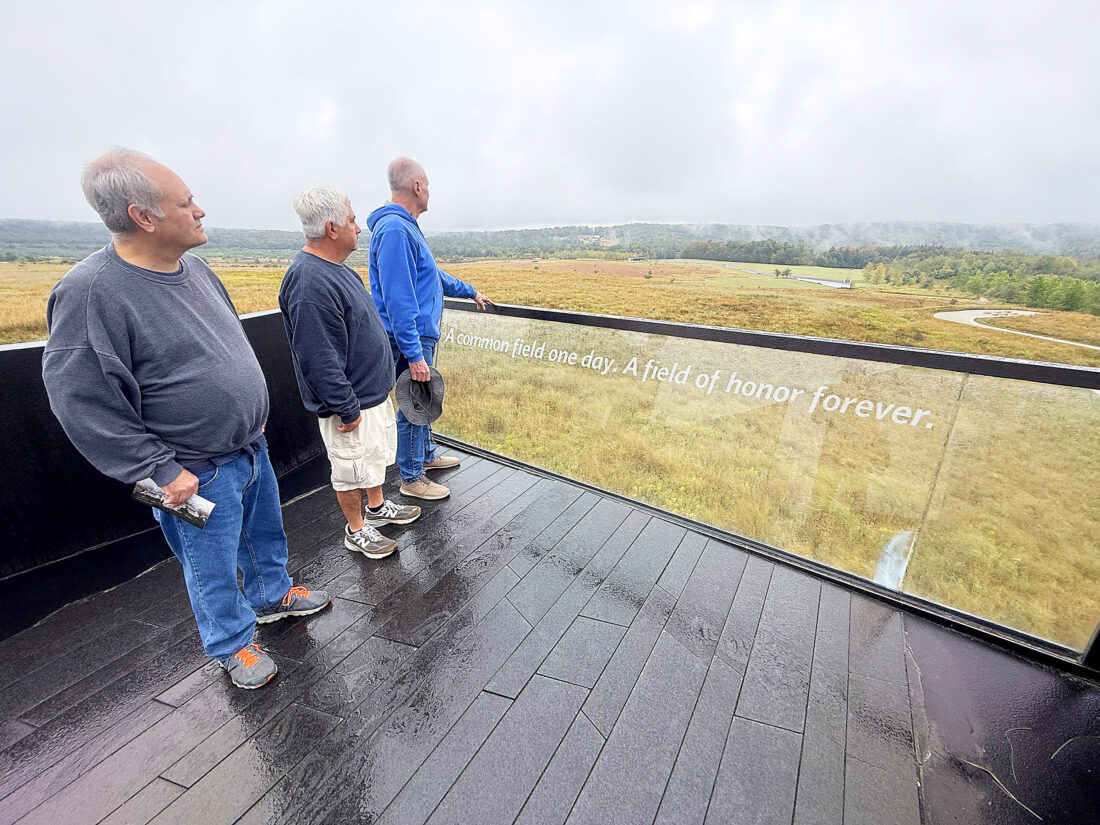
Brothers (from left) George and Gary Mueller and Dr. Daniel Meenan gaze at the ‘field of honor’ where United Airlines Flight 93 crashed on Sept. 11, 2001, from the Flight 93 National Memorial’s flight path overlook. Mirror photo by Matt Churella
SHANKSVILLE — Donna Gibson never thought terrorist attacks would occur on American soil.
That changed on Sept. 11, 2001.
On that day, Gibson was working for a financial corporation in Pittsburgh. She was in a meeting when one of her colleagues interrupted and said, “Hey, you need to watch this.” It was footage of United Airlines Flight 175 crashing into the south tower of the World Trade Center in New York City.
About 21 minutes beforehand, United Airlines Flight 93 took off from Newark Airport, heading toward San Francisco, California. The flight was delayed about 25 minutes due to heavy air traffic at the airport, according to Ginny Barnett, a National Park Service volunteer who recounted the day’s events last weekend with visitors at the Flight 93 National Memorial in Stonycreek Township, Somerset County.
Barnett said the hijacking teams on the first three flights all acted within 15 to 30 minutes of their takeoffs. The Flight 93 hijackers waited until minute 46 before tying red bandanas around their foreheads and taking action to break into the cockpit — killing a passenger in first class and a flight attendant with box cutters and knives — as the plane flew over eastern Ohio, she said.
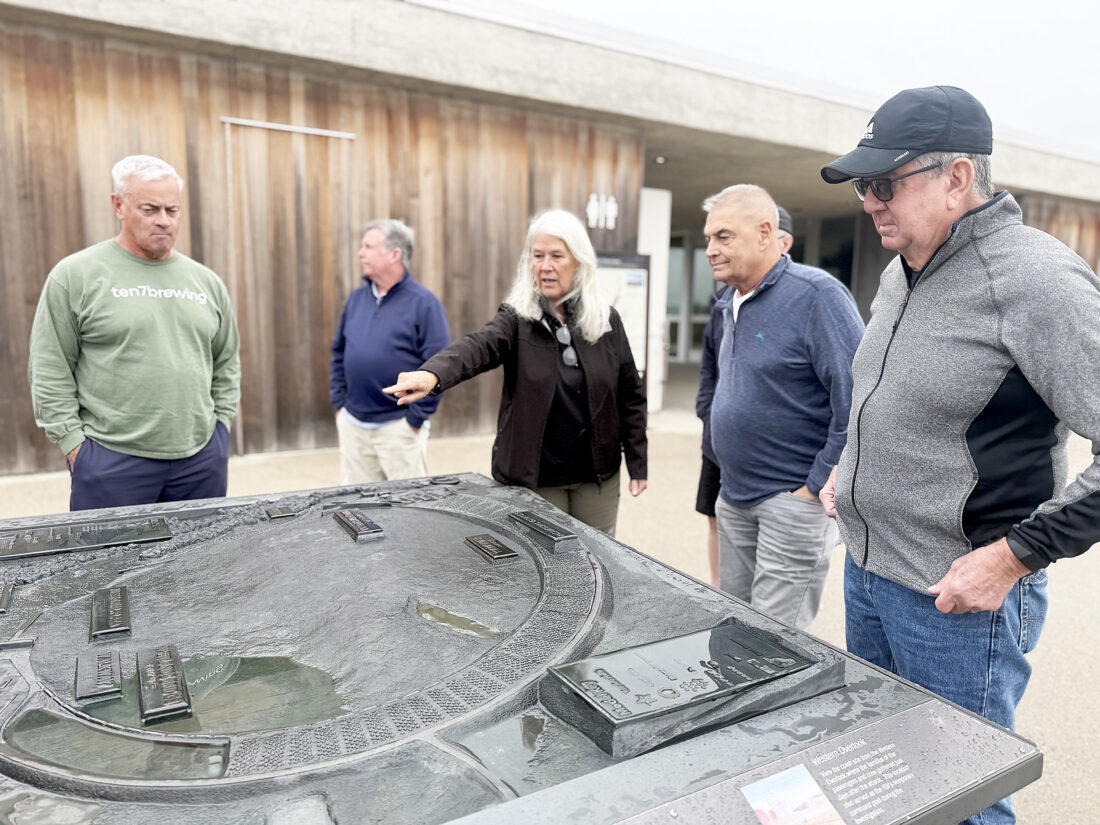
Friends of Flight 93 Executive Director Donna Gibson greets visitors of the Flight 93 National Memorial in Stonycreek Township, Somerset County, with an orientation of the site. From left: Bob Koons, Philadelphia; Ed Bradley, Philadelphia; Thomas Bonnar, southeast Georgia; and Jim Hagen, Raleigh, North Carolina. Pictured behind Bonnar is Dan Wilkens of Atlanta, Georgia. Mirror photo by Matt Churella
Essentially, there was a double delay of sorts for Flight 93, Barnett said, noting the delays played a significant role in what happened that day.
By minute 55 of the flight, 13 passengers and crew members made 37 phone calls to loved ones and learned of the terrorist attacks on the ground at the World Trade Center and at the Pentagon building in Washington, D.C., Barnett said.
Knowing they were likely heading for a target as part of a suicide mission, the passengers and crew members begin discussing what to do, if anything, Barnett said, noting they collectively voted to fight back.
“I want to put this vote into the context of that day,” Barnett said.
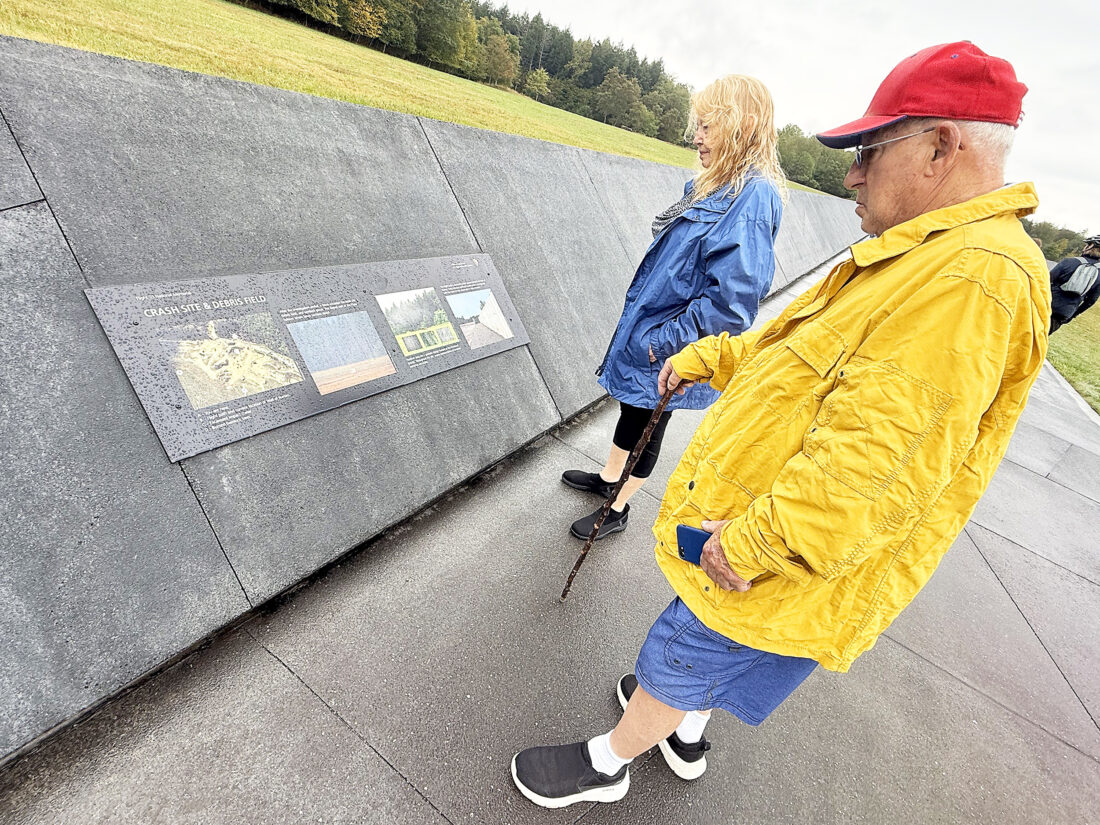
Kathleen Swanson and Joseph Romano Sr., both of southern New Jersey, read a sign at the Flight 93 National Memorial’s memorial plaza. Located in Stonycreek Township, Somerset County, the plaza is a black walkway that marks the edge of the debris field and crash site. It’s about a quarter of a mile in length and connects the visitor shelter with the wall of names, where people can pay their respects to the 40 passengers and crew members who lost their lives. A large boulder marking the crash site is viewable from the plaza. Mirror photo by Matt Churella
Up until that point in time, the process of hijacking a plane meant that demands were made and, if somehow those demands were resolved, the plane would likely land, she said, adding airline crews of that day were trained to cooperate completely with hijackers.
In the case of Flight 93, she said, the hijackers moved everyone to the back of the plane before announcing that they had a bomb on board and were heading back to the airport.
According to Barnett, officials believe the plane was heading toward the U.S. Capitol building in Washington, D.C., where both the House of Representatives and the Senate were in session. Another possible target was the White House, she said.
The flight data recorder showed that the terrorist pilots had entered the coordinates of Reagan National Airport into the autopilot system to get them into the area, Barnett said.
The White House sits low, making it difficult to locate, especially for inexperienced pilots, Barnett said, noting the building was guarded by radar and rooftop snipers on Sept. 11, 2001.
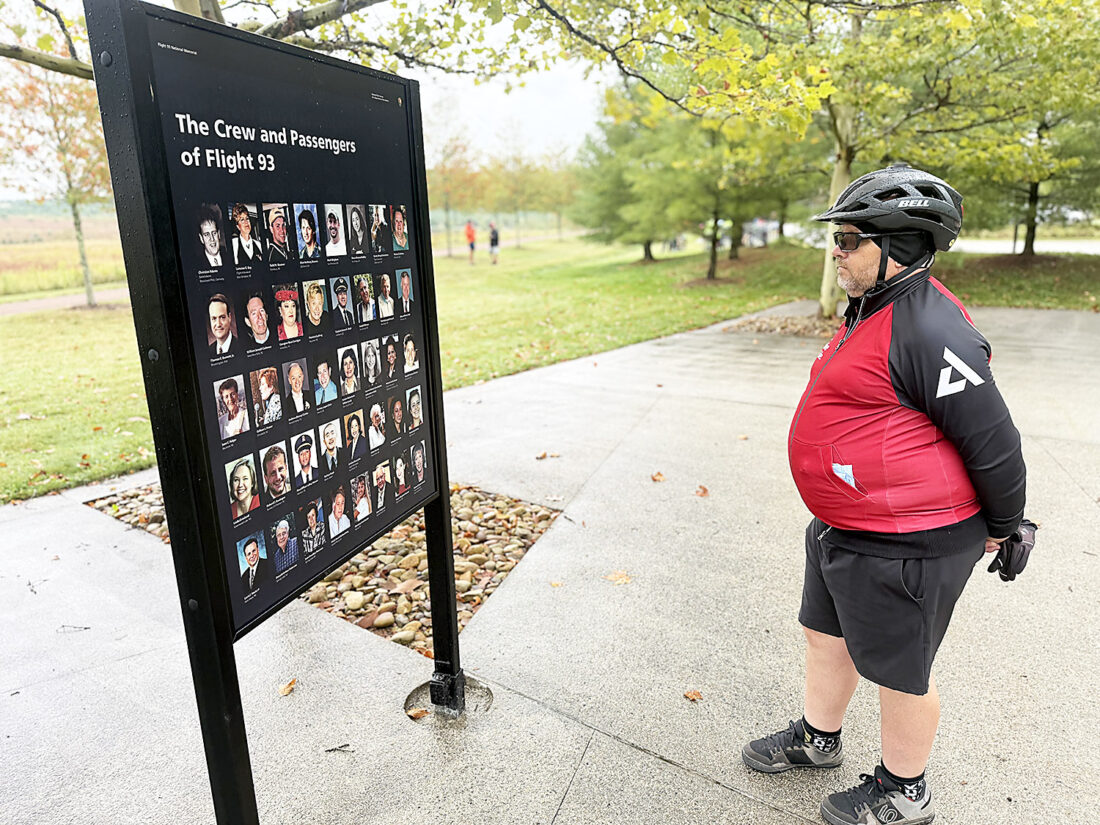
Patrick Prosser of the Pittsburgh area reflects on the heroic actions made by passengers and crew members aboard United Airlines Flight 93. After the plane had been hijacked, the passengers and crew members made phone calls to loved ones, learned of other hijackings that had taken place minutes earlier and voted to take action against the terrorists once the plane was over rural land, according to National Park Service volunteer Ginny Barnett. Mirror photo by Matt Churella
The Capitol building, on the other hand, was not guarded by radar on that day, she said, adding it sits high up on a hill and is easy to recognize because of its huge dome structure.
“Had that been hit as a target, they could have wiped out our government,” Barnett said.
Sadness and heroism
Gibson, who became involved with the Friends of Flight 93 National Memorial nonprofit group after moving to Somerset County in 2011, said she’s doing everything she can to make sure people never forget the heroic actions of the 33 passengers and seven crew members who made the ultimate sacrifice to save others.
After serving in various leadership positions, including vice president and president, Gibson is now the group’s executive director.
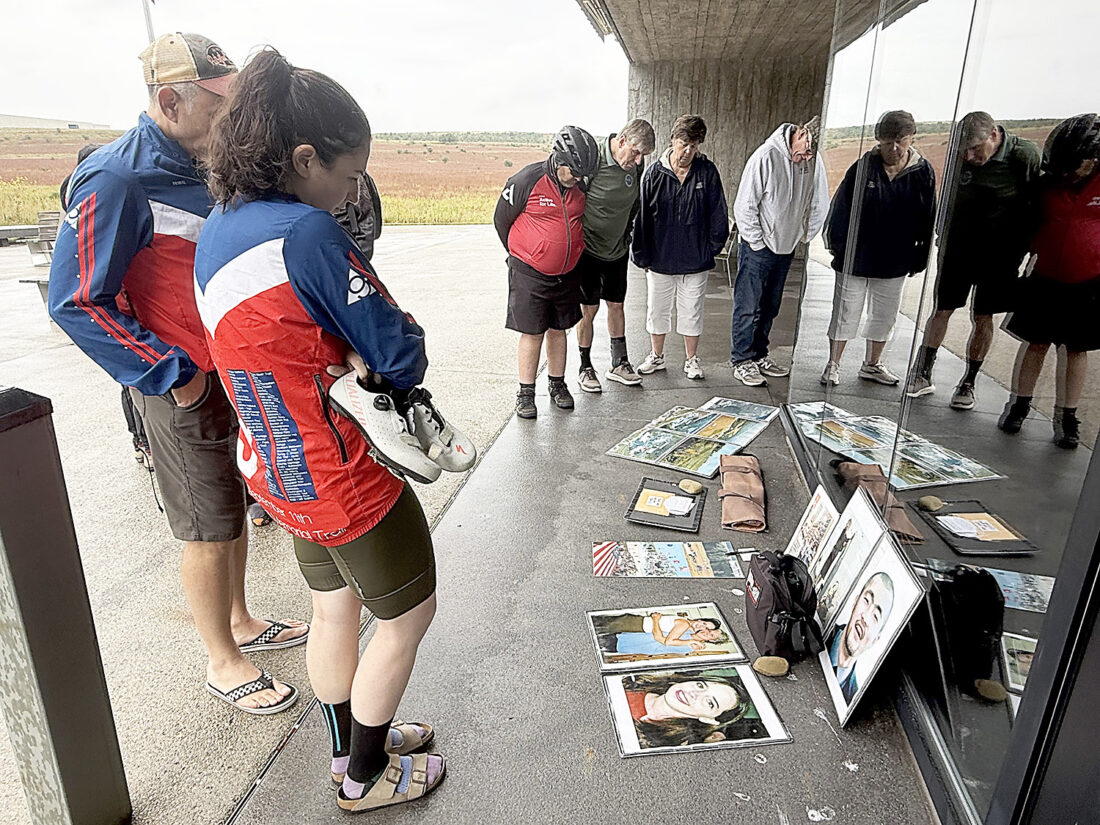
A group of Flight 93 National Memorial visitors gather at the Visitor Shelter to pay their respects to the plane’s 40 passengers and crew members whose actions prevented the flight from reaching its likely target of the United States Capitol building in Washington, D.C. Mirror photo by Matt Churella
“It kind of becomes an obsession that you want everyone else to understand what happened that day and to be aware,” Gibson said of her involvement. “The people who lived it are starting to pass on and if we don’t pass the stories onto the next generation, who will?”
Although there’s a lot of sadness in what happened on Sept. 11, 2001, there’s also a lot of inspirational stories of heroism, Gibson said, noting New York City firefighters ran into buildings not knowing whether they would come out alive.
“It was just an American resilience that occurred on that day,” Gibson said. “Everybody came together.”
As Friends board member Ken Nacke said, “If we could all behave the way we did on September 12, 2001, every day, the world would be a better place.”
Nacke is the younger brother of Flight 93 passenger Louis J. Nacke II, who was traveling that day as a routine part of his job as the director of a New Jersey distribution center for Kay-Bee Toys.
Flight 93 passenger Todd Beamer’s dad, David, told Gibson a story of how he was on the West Coast when someone pulled him out of a business meeting to tell him what had happened to Todd. Unable to catch a flight, as all aircraft were ordered by the Federal Aviation Administration to land, a colleague drove him across the country to his home on the East Coast.
“He tells this story about coming across America and the flags, the patriotism and all of the people he saw, and they didn’t know who he was or what had happened to his son particularly, they just knew what happened in the world,” Gibson said.
“It was that kindness, that empathy for one another and just being more respectful and kind” that people should take away from hearing the stories of family members, she said.
‘Let’s roll’
Todd Beamer was one of the passengers who attempted to regain control of the aircraft from the hijackers. In the midst of the hijacking, Beamer attempted to call his wife by Airfone. When the call failed, he was connected to Lisa Jefferson, an Airfone supervisor with whom he recited the Lord’s Prayer before saying his last words, “Are you guys ready? OK. Let’s roll.”
During the 20th anniversary of the 9/11 attacks, Gibson said she interviewed David Beamer for a podcast and wanted to use photos of the many schools and monuments that are named in Todd’s honor as a backdrop, but David refused, stating, “My son is one of the 40. He collectively worked with the people on that plane and was no different. He should not stand out in any way.”
Barnett said only a few names became popular because of media reports and books written about Flight 93, but she encourages visitors of the memorial to reflect on each and every name listed on the memorial’s wall of names.
Each one played a part in the deliberation and vote, Barnett said, noting some were boiling water to throw on the terrorists while others were tasked with looking out their windows for rural land.
“They were the ones to sound the call to action. This was a collective act of heroism,” Barnett said. “Recognize each one for their heroic act and their ultimate sacrifice.”
Transported back in time
Stonycreek Township is only 18 minutes flying time to the D.C. area, Barnett said, adding that she can’t imagine what it must’ve been like to be on Flight 93.
Gibson said passengers Andy Garcia and Donald Freeman Green both had pilot licenses. Their belief was, if they could gain control of the plane, those two would have the wherewithal to be able to land them safely, she said.
Official records indicate that the passengers and crew were using a food cart as a battering ram to gain access to the cockpit before the plane hit the ground at 563 miles per hour. It was carrying more than 5,000 gallons of jet fuel and exploded on impact, throwing debris into the nearby hemlock grove, according to a sign in the Flight 93 National Memorial visitor center.
Arriving within minutes of the crash, first responders found a smoking crater, burning trees and the ground littered with fragments of the plane, the sign reads. There were no survivors.
Upon walking into the visitor center and hearing President George W. Bush’s address to the nation, many people are mentally transported back in time to that day, Gibson said.
“Some days it just punches you in the face because you just go back to that day and how you felt that day,” she said.
During a Sept. 6 visit to the memorial, many visitors inside the center could be heard sobbing after listening to voicemail recordings left by two passengers and one crew member minutes before they died.
Gibson said she’s read the transcripts of those recordings but has never listened to them herself because it’s too surreal.
“I can’t listen to the voices,” she said. “I can’t listen to them.”
‘Defending democracy’
Among the visitors on Sept. 6 were Thomas Bonnar and Dan Wilkens of Georgia, Jim Hagen of North Carolina and Ed Bradley and Bob Koons of the Philadelphia area. They were visiting the memorial on their way to Pittsburgh for a baseball game, Bonnar said.
They worked together for the Defense Criminal Investigative Service and were each part of 9/11 relief efforts, either at the Pentagon or at “ground zero,” which is a name used to indicate the site in lower Manhattan where the Twin Towers fell, Bonnar said.
They declined to elaborate on their memory of Sept. 11, 2001.
Gibson said many people from Ohio also have a great connection with the memorial because they saw the plane as it was being turned around by the terrorists.
George Mueller of Hermitage, Mercer County, was visiting the memorial for the first time alongside his brother, Gary Mueller, and their friend, Dr. Daniel Meenen, an anesthesiologist in Johnstown who has a home in Sarasota, Florida — about 20 miles north of Venice, where some of the terrorists learned how to fly.
George Mueller said he was working when the Twin Towers were hit. He remembers telling his supervisor, “Oh my gosh, this is a terrible thing. This is going to get real bad.”
He said his supervisor responded, “It’s already bad.”
Gary Mueller said the passengers and crew members of Flight 93 were “defending democracy” on that day.
“They were heroes to be able to take the plane down,” Meenan added.
Teach to remember
Friends of Flight 93 board member Patrick Neff, who teaches Latin at Bedford Senior High School, grew up in the South Hills of Pittsburgh and was in eighth grade when 9/11 happened.
In the morning, Neff’s principal made an announcement over the school’s public address system to prevent teachers from turning on their televisions, he said, noting many parents came to the school to pick up their kids.
Then, at lunch, the principal told them the country had been attacked.
“Even though we didn’t have the terrible images of the planes hitting the towers, the principal coming in and telling us what had happened really stuck in my memory,” Neff said.
Neff said his mother eventually came to pick him up. She later went to a church and knelt down to pray — another image that has tattooed itself into his memory, Neff said.
“That, in a way, was when it really struck me how serious this was because she was quite visibly disturbed,” Neff said. “Then I got home and was watching the news like everyone else.”
On his way to interview for his position in Bedford, Neff visited the Flight 93 National Memorial for the first time. At that time, the memorial didn’t have the museum experience that it does today, but it was still “very interesting and moving” to be there, he said.
A few years into his career, Neff met Gibson and her husband at a restaurant they both frequent in Bedford County and that’s how he became a member of the Friends of Flight 93 nonprofit group, he said.
Neff joined the group’s education committee, which prepared booklets about the memorial for the National Park Service’s junior ranger program.
Currently, the Friends sponsor a scholarship to cover the transportation costs for Pennsylvania school districts, like Bedford, to visit the memorial every year, Gibson said. They also have a Teach to Remember virtual program, which has participating schools from as far as Hawaii and Africa, she said.
Neff said the Bedford Area School District takes its ninth grade class to the memorial every year in either September or October. Social studies teachers teach 9/11 in advance of that trip, he said.
Gibson said it’s important to teach programs, both in schools and at the memorial’s learning center, because more than 100 million Americans have been born since 9/11 and a whole generation of young adults have no living memory of that day.
Only 19 states require education about 9/11, Gibson said, noting the states that require education don’t provide the needed curriculum for teachers.
That was one of the main reasons behind starting the Teach to Remember program, she said.
Before they started the program, Friends of Flight 93 board members had conversations with educators to ask them what resources they needed to teach 9/11. Many responded that they lacked reliable information that they could depend on to prepare their curriculum, she said.
The Friends have online resources teachers can use to create their own program, but they are also allowed to participate in the Friends’ programs at the memorial’s learning center, Gibson said, noting many of the programs were prerecorded in the past.
This year, they’re being livestreamed from the learning center classroom all week long.
Gibson said she is currently working with the National Park Service, already planning programs for the 25th anniversary next year.
Although they’re still trying to conceptually decide what they’re going to do, one of the thoughts being thrown around is to cover what unfolded during the first 72 hours after Flight 93 crashed.
There were more than 75 organizations involved in the investigation — including the American Red Cross, the Salvation Army and the Federal Bureau of Investigation.
“All of these people who came together and they were able to conduct the investigation and close it within 13 days, which was incredible,” Gibson said. “This was the only crash site that had a black box that was recovered, and we want to tie in how Flight 93 changed American history going forward.”
Mirror Staff Writer Matt Churella is at 814-946-7520.
Local News
The Mill acquires tenant for portion of building
Altoona Silk Mills Properties Inc., owners of “The Mill” in partnership with the Altoona Blair County ...
Shredded cheese sold in dozens of states recalled
There is a recall for more than 260,000 cases of shredded cheese sold in 31 states, including Pennsylvania, and ...
Bellwood dam, water treatment plant project nears end
The Altoona Water Authority is drawing close to the end of its dam and water treatment plant renovations in ...
A house divided: Tyrone church’s plan to create transitional housing for homeless draws criticism
Clearfield County not required to fund challenge to inmate’s sexually violent predator status
Clearfield County is not obligated to provide funding to a Penfield man who wanted to challenge his classification ...
Portage Area School Board OKs repair bid for football stadium
The Portage Area School Board approved a $209,000 bid from Allegheny Restorations for a stone wall repair project ...