
Historic Gems: Blair County dotted with architecture rich in the stories of area’s growth
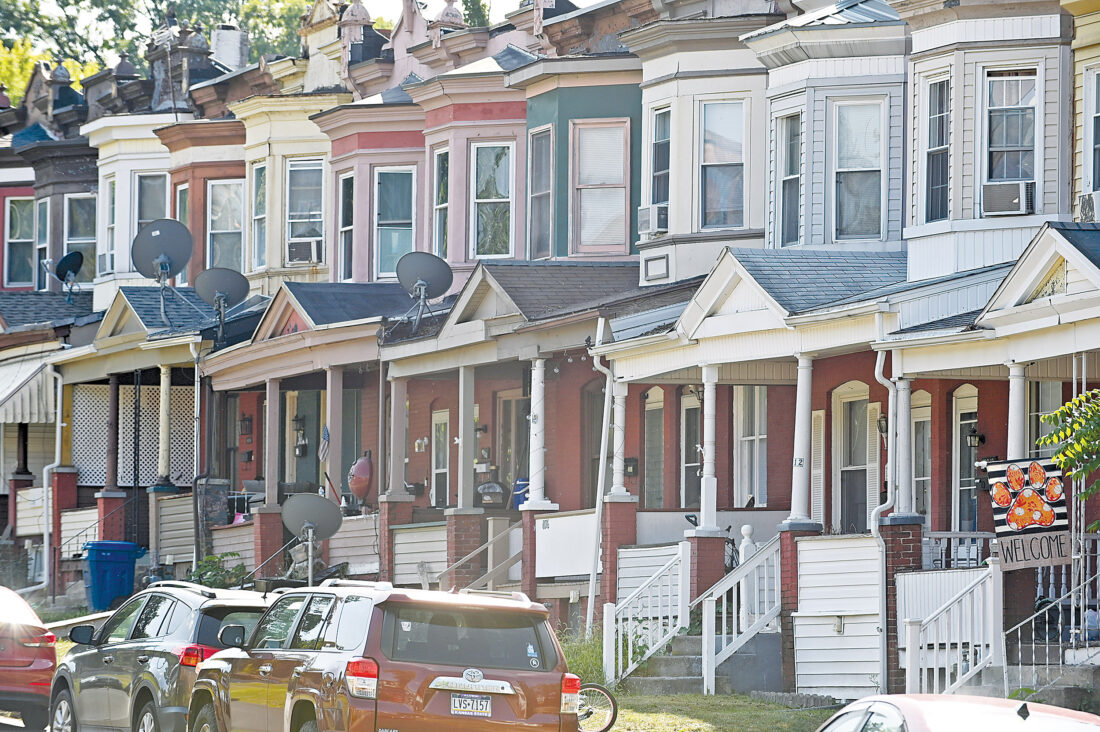
The Knickerbocker development is at 3901-3943 Burgoon Road, and the 3900 block of Fourth and Fifth Avenues in Altoona. Mirror photo by Patrick Waksmunski
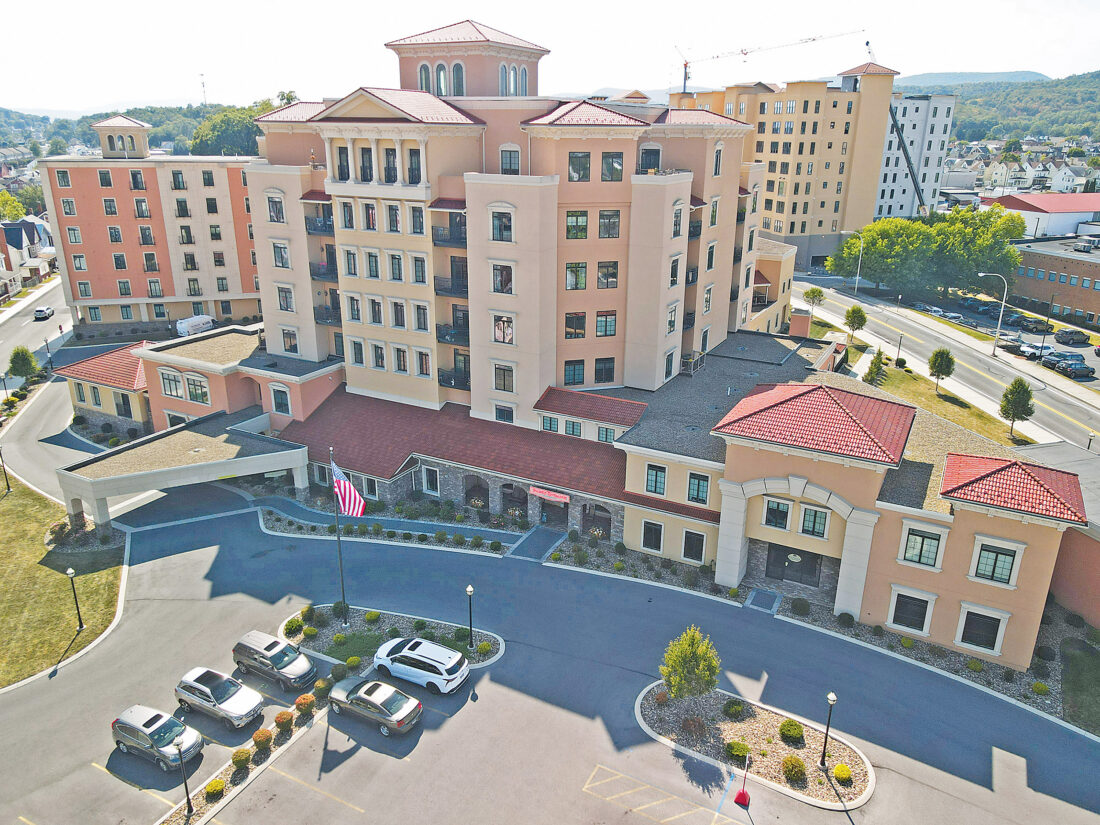
The Graystone Grande Palazzo, 2500 Seventh Ave., was formerly Bon Secours hospital. “We transformed a boring looking 1950s building into something neat and exciting. … Instead of tearing it down,” said architect Joe Oricko, who worked with developer Jeff Long on the project. Mirror photo by Patrick Waksmunski
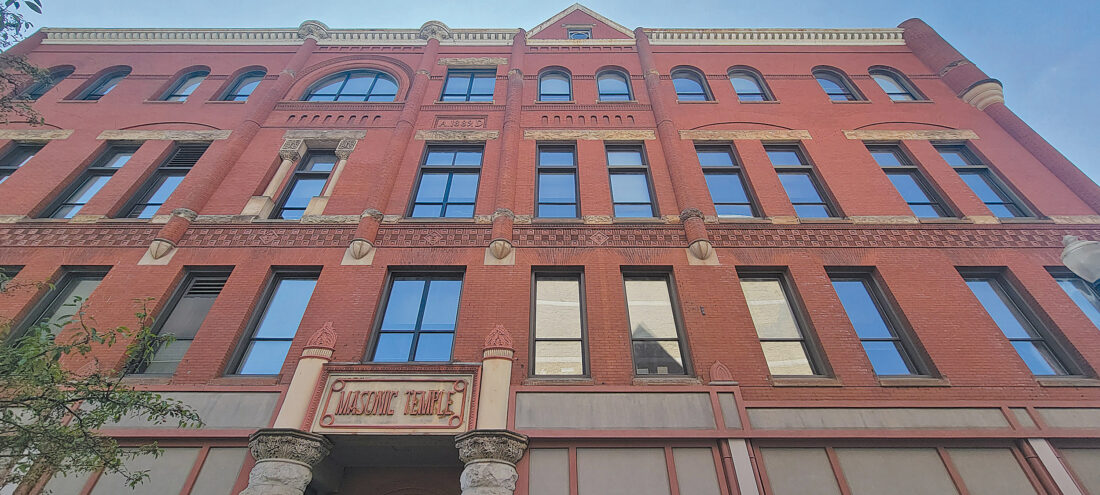
The Masonic Temple, on the 1100 block of 11th Street, is a “massive four-story, impressive red brick structure” that is reminiscent of Philadelphia office buildings constructed around the turn of the 20th Century, Altoona Historian Jared Frederick said. Mirror photo by Patrick Waksmunski
The Knickerbocker development is at 3901-3943 Burgoon Road, and the 3900 block of Fourth and Fifth Avenues in Altoona. Mirror photo by Patrick Waksmunski
The Graystone Grande Palazzo, 2500 Seventh Ave., was formerly Bon Secours hospital. “We transformed a boring looking 1950s building into something neat and exciting. … Instead of tearing it down,” said architect Joe Oricko, who worked with developer Jeff Long on the project. Mirror photo by Patrick Waksmunski
The Masonic Temple, on the 1100 block of 11th Street, is a “massive four-story, impressive red brick structure” that is reminiscent of Philadelphia office buildings constructed around the turn of the 20th Century, Altoona Historian Jared Frederick said. Mirror photo by Patrick Waksmunski
Trending
Community leaders in Blair County talk frequently about economic development, but rarely about architecture -- the unique build of many a structure that showcases a style inherent to a decade, an architect or a way of life.
For Altoona historian Jared Frederick, local buildings and complexes that are "interesting and revealing of the times in which they were constructed" include the Knickerbocker complex in Eldorado, the Masonic Temple downtown, the Albert McDonald house near the former Altoona YMCA, the formerly great homes on Broad Avenue and Llyswen Station.
The Knickerbocker
Built by developers from
Philadelphia, the Knickerbocker was
a Philadelphia-style row house neighborhood constructed in 1903 to serve as housing for the Pennsylvania Railroad's South Altoona shops nearby, said Frederick, assistant teaching professor of history at Penn State Altoona.
"It was a microcosm of Philadelphia in Altoona," Frederick said.
"Their uniformity was very telling," Frederick said. "It was very typical of the sort of company town (common) in the Gilded Age."
The Knickerbocker development featured characteristic Victorian architecture and craftsmanship, he said.
It remained a kind of company town until after World War II, when the tenants could buy the homes, according to Frederick.
It was also a kind of "blueprint" for the suburban style housing developments that bloomed after the war, except that those post-war developments tended to have a mass-produced look that contrasted with the aesthetic features of the Knickerbocker, Frederick said.
The Philadelphia-based PRR established Altoona in 1849 as its headquarters for servicing locomotives to take trains up and down the Allegheny Front on the newly constructed Horseshoe Curve route, he said.
The ground in the vicinity of Burgoon Road and Sixth Avenue was formerly part of ironmaster Elias Baker's estate.
The Albert P. MacDonald house
Built in 1884, the Albert P. MacDonald House at the corner of Lexington Avenue and Ninth Street, across from the former Altoona YMCA, is a "really impressive" example of homes built by the second generation of Altoona residents who could afford it, according to Frederick.
Altoona began with an "urban industrial look" -- clapboard homes and cabins, along with a few brick buildings for the PRR offices and homes for the railroad higher ups, according to Frederick.
But as the Gilded Age began in the 1880s, the second generation of Altoonans aspired to a "more aristocratic, suburban look," leading to demolitions of the old homes and construction of more sophisticated, fancier ones in the city's older neighborhoods -- as well as in newly created neighborhoods as the city expanded, Frederick said.
MacDonald was an insurance agent, according to the Historic American Buildings Survey commissioned by America's Industrial Heritage Project, to which Frederick referred.
MacDonald built his home in the Queen Anne style.
It included a square, three-story spire with gables all around that is now reminiscent of the Munsters TV show, Frederick said.
"A spooky, yet classical look," he added.
There was a wraparound porch.
The home in recent times fell into disrepair.
There were many homes built on Broad Avenue constructed in similar style, Frederick said.
Baker Mansion
One of the best-known buildings in Blair County frequently misleads visitors, who mistake it for a Southern plantation house, based on their idealized version of such structures, according to Frederick.
Some ask how many slaves Baker kept, Frederick said.
His answer is none, of course, because slavery was outlawed in the North.
Those visitors' notions of the typical Southern plantation house are based mainly on images perpetrated by movies like "Gone With the Wind," rather than the reality for middle class Southern plantation owners, who usually lived in what are more like the typical farmhouse, Frederick said.
When he brings visitors to the mansion, he drives them up to the front on Baker Boulevard, not to the more commonly accessed back entrance on Oak Lane, because the front view is more impressive.
"People are quite taken aback," he said. "It's not what they expect to find here."
The mansion is "incongruous" with their ideas of Altoona as a railroad city, he said.
Finished in 1849, the mansion took five years to construct, because of "drama" due to disagreements with how the building should look, and because of the difficulty getting materials to the site, due to its remoteness.
The limestone with which it was built, however, was local: it was extracted from the area in Lakemont that is now the lake that gives that neighborhood its name, Frederick said.
The mansion was built in the Greek Revival style and cost $15,000, according to blairhistory.org.
"Cost overruns, coupled with falling prices for iron, pushed Mr. Baker to the brink of financial ruin before the home was finished," the website states.
Baker lived in the house for 15 years before his death.
The Beezer brothers
Blair County is home to the first buildings designed by Bellefonte-born identical twin architects Louis and Michael Beezer -- who moved on to Pittsburgh, then to Seattle, where they reached the apex of their fame and where they died, according to local historial Michael Farrow, in the brochure "Altoona's Broad Avenue Historic Buildings" -- available from the Blair County Historical Society.
The Beezers designed Sunbrook Manor, which sits high above I-99 near the Cross Keys interchange. With a red roof, yellow exterior walls and white trim, it was constructed in 1896 as a summer house for Altoona banker John Lloyd.
The Beezers also designed adjoining homes on Logan Boulevard in Llyswen -- the southernmost one where Michael Beezer lived and the other where his brother Louis lived.
They also designed the four-story First National Bank on Pennsylvania Avenue in Tyrone, built in 1906, with what looks like limestone on the first floor and brick with three-sided bay windows on the upper floors -- along with limestone accents on the cornice and elsewhere. The upper stories have been demolished, but the ground floor now serves as the Tyrone-Snyder Public Library.
Other homes designed by the brothers were built on Broad Avenue -- once a fashionable location -- and one where the Beezers "made a name for themselves," according to Frederick.
Among the brothers' designs that were constructed on Broad Avenue were a home for attorney Edward Flick in 1896 at the corner of 26th Street, and two smaller look-alike "cottages" on the same block -- one built for Flick and one for attorney William Hammond.
Both of those smaller structures were designed in the Queen Anne and Colonial Revival styles and were built of brick, but are now sided in vinyl, compromising their architectural integrity, according to the brochure.
A book published in 1894 by the Beezers when they were still based in Altoona, "Architecture Practical and Theoretical," features drawings that included many gable ends facing the street, along with dormers and conical towers. There are designs for homes, business and public buildings.
Architect Robinson
Blair County is also home to many buildings designed by Virginia-born architect Charles Morrison Robinson, including the old, domed Altoona High School, the Masonic Temple, St. Mary's Catholic School on Fourth Avenue, the Mountain City Hebrew Synagogue -- now Holy Trinity Greek Orthodox Church -- and the First Lutheran Church, among 60 buildings overall, according to another Farrow brochure about Altoona's Golden Age Architect.
The Masonic Temple on the 1100 block of 11th Street is a "massive four-story, impressive red brick structure" that is reminiscent of Philadelphia office buildings constructed around the turn of the 20th Century, Frederick said.
There's a big ballroom on the top floor.
"Unfortunately, you can't see the entirety of it," due to the construction decades ago of a nearby nursing home, Frederick said. "You can't sit back and absorb its magnificence."
The temple is a forerunner to the big buildings later constructed on 11th Avenue in Altoona, Frederick said.
It was designed by Philadelphia architect James Windrim, according to the America's Industrial Heritage Project survey.
Like the Beezers, Robinson moved on from Altoona to Pittsburgh, where he designed many Western Pennsylvania churches, according to Farrow.
He then went to Virginia, where he became one of the South's most prominent architects, designing more than 100 buildings, including structures for college campuses along with department stores, theaters, libraries, hospitals, schools, hotels and business buildings -- mostly in the colonial and Greek Revival styles.
'Timeless homes'
Developer Randy Green prizes two mid-20th Century homes built for a pair of brothers on Sylvan Drive, not far from Frankstown Road.
They have walls inside and out made of stone quarried on the properties, batten and board walls of old barn wood, windows facing south to take in the sun, slate inside to soak up and preserve the heat that comes through those windows, cedar shake roofs and grounds sculpted to accentuate the features of the house -- with ground-level entrances for both basement and first floor and strategically planted trees.
The homes are "timeless," Green said.
They are the closest examples in Blair County today to the works of Frank Lloyd Wright, he said.
For both aesthetic and practical reasons, the real stone used for the walls is far superior to veneer stone that is far cheaper and much more common nowadays, Green said.
"You couldn't build them today," not only because of the material and labor costs, but also because of the scarcity of artisans to do some of the masonry work, he said.
It took a while after the late 1960s-early-1970s construction of the homes for Richard and James Titelman for the trees to grow up on those properties, but now that the grounds have matured, they perfectly complement to homes, especially with the wide windows that allow residents to look outside and appreciate the foliage and the animal life, Green said.
The houses -- especially the smaller one -- are an instructive contrast to some of the big homes built in high-priced developments in Frankstown Township in recent decades, according to Green.
Those have spaces inside that are never used, especially after children grow up and leave, he said.
Those latter homes were constructed in an era in which people figured, "Why not build it bigger," but their size turned out to be a "trap," Green said.
Grand Palazzo
Asked to name a local building he favors for architectural excellence, architect Joe Oricko cited his own work with developer Jeff Long's Grande Palazzo -- which resulted from the renovation of the old Bon Secours hospital complex into housing for seniors.
"We transformed a boring looking 1950s building into something neat and exciting. ... Instead of tearing it down," Oricko said.
The challenge included "fitting all those rooms into an existing structure not made for apartments," as well as fitting in all new mechanicals, plumbing, and electrical components -- while complying with modern codes, Oricko said.
The project required working around existing columns, bearing walls and stairways, he said.
"It was not an easy job," he said.
But there were also unexpected discoveries of space for apartments, he said.
He began the project by sketching -- with pencil, tracing paper and an architect's rule.
The working paper was initially 11 inches by 17 inches, then grew larger, as he worked out problems on placement of rooms, water and drain pipes, bathrooms and hallways -- and how wide the hallways had to be -- while always taking account of the features that had to remain.
"If you're not drawing, you're not thinking," Oricko said. "By drawing it, you can find out what you can make work and what you can't."
No computer program can do such a thing and come up with "the perfect plan," he stated.
It was a major help that he had hundreds of plans -- the original ones, along with plans for various renovations over the year. While not gap-free, the documentation for the existing structures was better than for most projects he's done, he said.
Still, it was necessary sometimes to "just go over there and look," Oricko said.
The project wasn't easy, but because he'd done lots of remodeling work previously, he knew that "sooner or later (he would) figure it out" -- provided he kept drawing, he said.
Because it involves existing conditions that aren't ideal, remodeling requires a kind creativity sometimes that isn't necessary in new construction, where you just "do everything right," according to Oricko.
Some architects shy away from existing buildings, he said.
He does both.
He's been doing architectural work for 51 years -- although he has not been a registered architect for that long.
A native of Dayton, Ohio, he worked on his first job on a school in the state of Indiana that had been hit by a tornado.
He came to this area in 1980 to work for builder Ralph Albarano.
He went out on his own in 1983.
Mirror Staff Writer William Kibler is at 814-949-7038.