
Get the lead out: Public water systems struggle to comply with federal service line inventory requirements

Mirror photo by Holly Claycomb Dennis Newberry, assistant pipe fitter, and Darin Claar, check on water valves Friday in the Garden Heights section of Altoona.

Mirror photo by Holly Claycomb Altoona Water Authority employee Ryan McCartney works to uncover the water main connections in the Garden Heights section of Altoona on Friday.
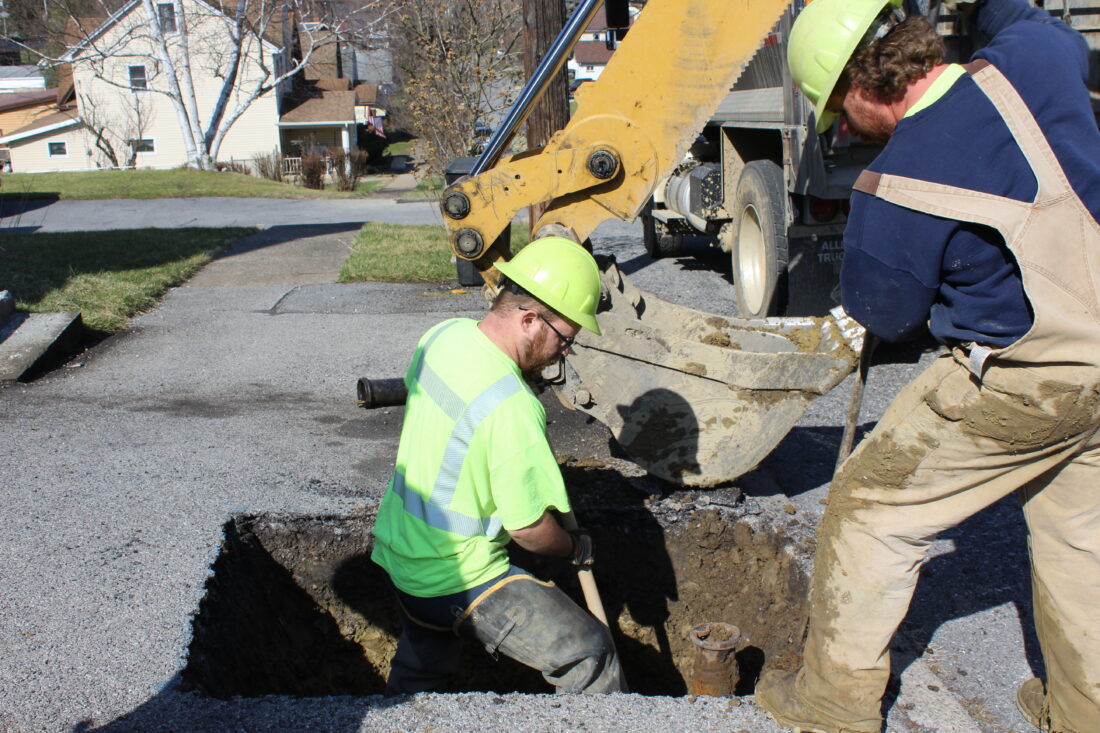
Mirror photo by Holly Claycomb Altoona Water Authority crew members Kurtis Gray (left) and Mitch Eshleman work to loosen a ..... box while working in the Garden Heights section of Altoona on Friday.
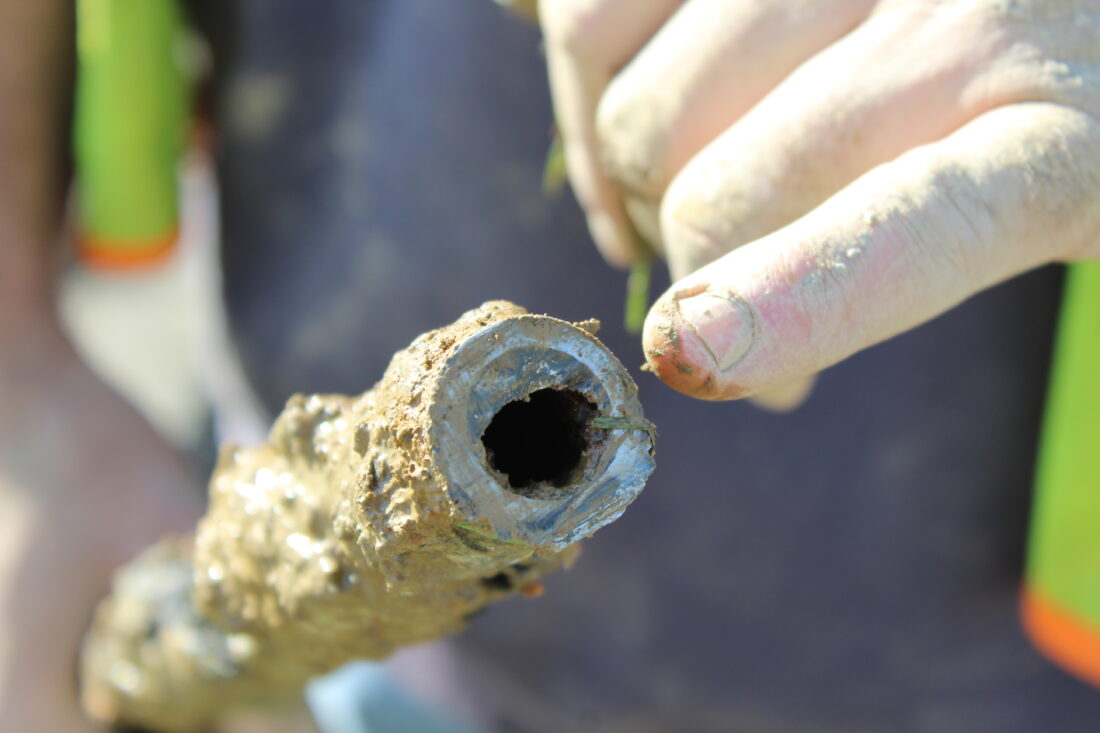
Mirror photo by Holly Claycomb Ryan McCartney shows the corrosion that narrowed a water pipe during ongoing work in the Garden Heights section of Altoona.
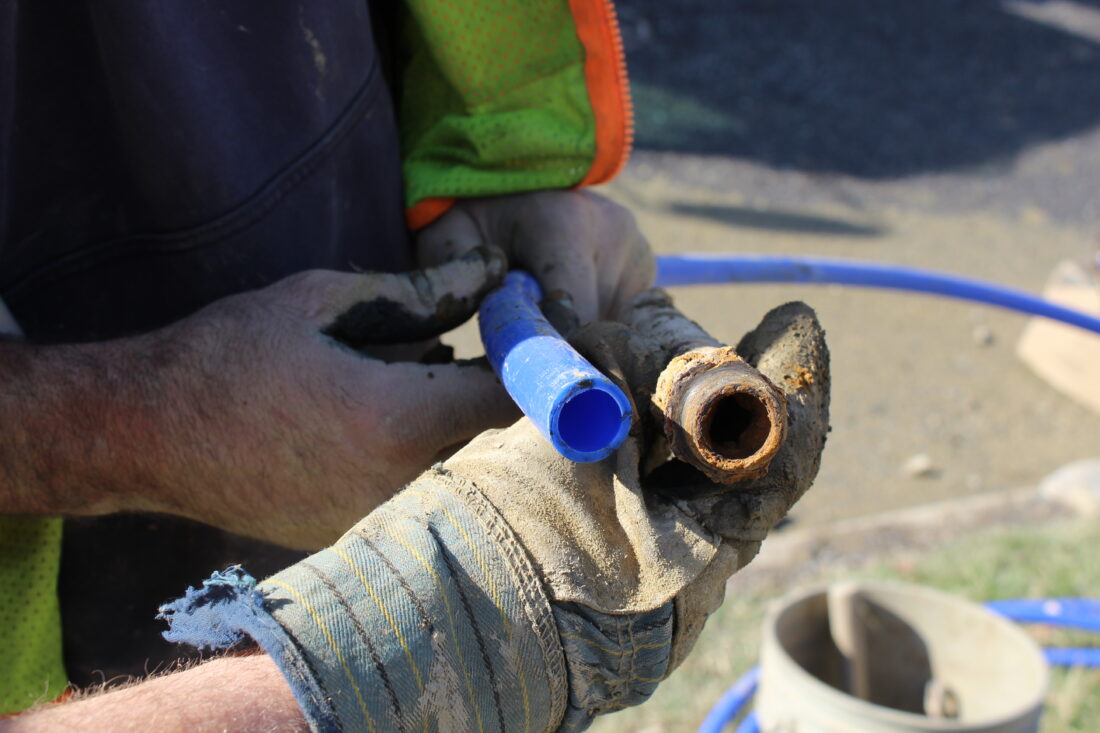
Mirror photo by Holly Claycomb New pastic piping is shown beside an old pipe being replaced in the Garden Heights section of Altoona.
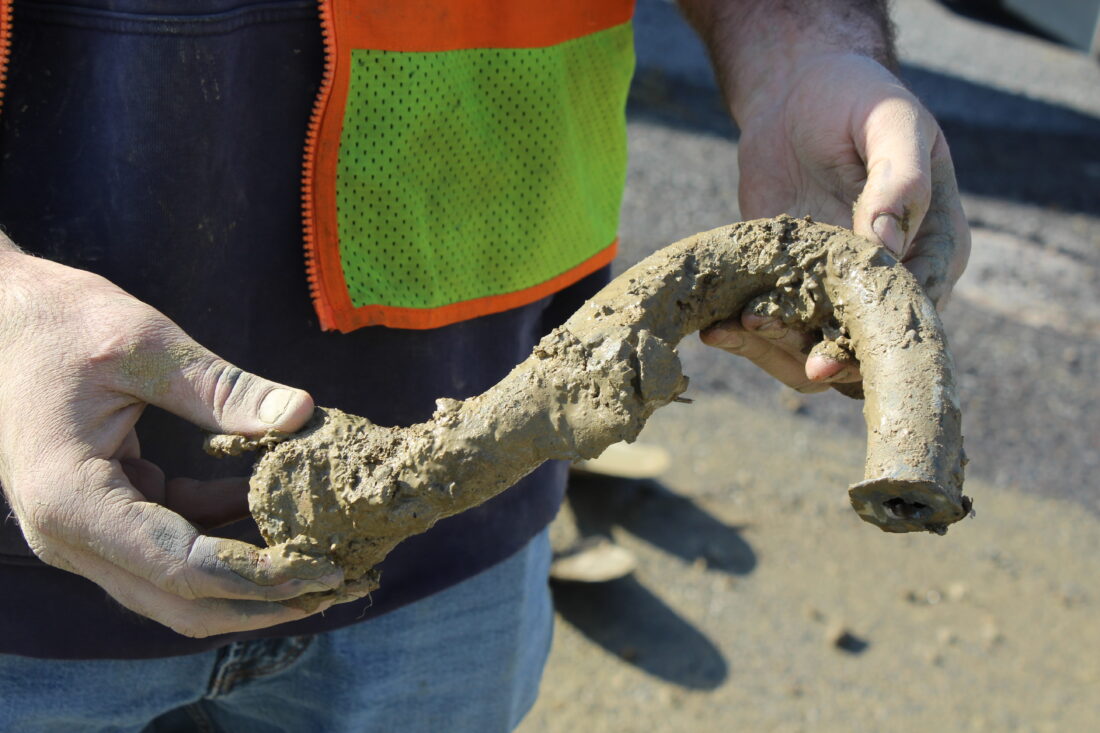
Mirror photo by Holly Claycomb Ryan McCartney holds a pipe that was replaced Friday in the Garden Heights section of Altoona.
Mirror photo by Holly Claycomb Dennis Newberry, assistant pipe fitter, and Darin Claar, check on water valves Friday in the Garden Heights section of Altoona.
Mirror photo by Holly Claycomb Altoona Water Authority employee Ryan McCartney works to uncover the water main connections in the Garden Heights section of Altoona on Friday.
Mirror photo by Holly Claycomb Altoona Water Authority crew members Kurtis Gray (left) and Mitch Eshleman work to loosen a ..... box while working in the Garden Heights section of Altoona on Friday.
Mirror photo by Holly Claycomb Ryan McCartney shows the corrosion that narrowed a water pipe during ongoing work in the Garden Heights section of Altoona.
Mirror photo by Holly Claycomb New pastic piping is shown beside an old pipe being replaced in the Garden Heights section of Altoona.
Mirror photo by Holly Claycomb Ryan McCartney holds a pipe that was replaced Friday in the Garden Heights section of Altoona.
Trending
All over the country, including Blair County, public water systems are struggling to comply with a federal requirement to inventory all their service lines -- the ones that connect the mains in the streets to homes -- by October, to ensure they don't create a danger for lead poisoning.
The lead crisis in Flint, Mich., several years ago led the Environmental Protection Agency to devise the Lead and Copper Rule update. Unlike some areas, Blair doesn't have a significant number of actual lead service lines -- nor are the mains made of lead.
But there are significant numbers of lead "goosenecks" connecting mains with utility-owned service lines that run a far as the curb, and that's a problem -- if either those utility service lines or the customer lines that run the rest of the way are made of galvanized steel, according to the EPA's latest version of the Lead and Copper Rule.
It's a problem because galvanized pipes exposed to lead can "capture" some of that lead and release it over time.
The presence of galvanized service lines downstream from lead goosenecks doesn't necessarily mean that lead is getting into the water of households served by those lines, unless system operators don't properly add corrosion inhibiting chemicals to the water to seal the lead from leaching.
The Lead and Copper Rule inventory requirement means local water utilities are examining records and completing a variety of fieldwork -- efforts that are time-consuming, labor-intensive and costly, according to local officials.
In addition to creating the inventory, water companies must develop a lead service line replacement plan and the goosenecks must be replaced when found during any water system infrastructure work.
A proposed followup replacement rule from EPA calls for all problematic lines in almost all public water systems to be replaced within 10 years.
That can be accomplished if systems do 10% per year, according to Tobias Nagle, senior environmental scientist with Stiffler McGraw, speaking at a recent meeting in Bellwood.
Creating an inventory
The fieldwork required to create the necessary inventory may mean some municipalities will have to dig down to lines buried as deep as four feet to get a clear look at pipes at least 18 inches from their curbside shutoffs, to ensure that workers can see the service line itself -- and not a connector that may be made of harmless material.
The fieldwork also includes viewing or obtaining pictures of the ends of customer service lines to get a second view of the customer sections of the service lines.
In creating the inventory, local officials are taking advantage of as much information they can get about service line composition during routine operations, during their own line replacement projects, from projects undertaken by plumbers and sometimes from their customers.
To get at the connectors, some municipalities will be using hydro excavating equipment, which uses a stream of water under pressure to create a soup of dirt and stone that is then sucked out. The resulting hole allows workers to access the lines around the curb boxes.
The hydro excavations take five or 10 minutes if there aren't rocks, longer if rocks are present, said Hope Ray of the Bellwood Borough Authority.
Requirements questioned
There seems to be differing interpretations of some of the requirements, along with counter-intuitive distinctions and instances where doing what's technically correct might seem excessive, according to officials.
While lead goosenecks that have galvanized service lines downstream will generally need to be removed, goosenecks that are shorter than a certain length won't need to go, according to one official.
The lead in lead joints that connect cast iron sections of water mains doesn't come into contact with the water flowing through those mains, so they might not need to be replaced, but local officials differ on their views in that case.
A local hydrovac operation recently involved digging in a grassy strip that was only two feet wide between the curb and sidewalk -- making it impossible to view the customer service line the required 18-inch distance from the curb box connection. But getting the technically correct view would have required breaking up the sidewalk, the crew leader said.
It's all "very convoluted," said Mike Bianconi, the water operations director for the Altoona Water Authority.
Below is a look at how local authorities are handling the new requirements.
AWA working for months
Bianconi said the Altoona Water Authority has been collecting data and creating its inventory for months.
It's using old "line cards," shop drawings that preceded improvement projects, utility permits for upgrades after the 1991 lead ban and building permits pulled after the lead ban.
"We have all that squared away," Bianconi said recently.
Basement inspections are coming next, so authority workers can inventory that end of the customer service lines, he said.
The authority has prepared an iPad application that workers can use when they visit homes to take pictures and record the necessary information. After that will come hydro excavation at the curb boxes, wherever the authority can't demonstrate through records that the service lines are harmless, Bianconi said.
There are lead goosenecks in the Altoona system, and there are galvanized service lines, he said.
He doesn't know if customers will be required to replace their service lines if they're shown to be problematic, nor does he know if the authority would need to pay for such replacements if they become mandatory.
Those questions are among the most pressing ones connected with the Lead and Copper Rule issues, he said.
Corrosion control is actually the main tool for protection against lead in the water, according to Altoona Water Authority consulting engineer Mark Glenn.
The AWA has used corrosion control for decades, and has never been out of compliance with lead levels, Glenn said.
Part of the EPA's Lead and Copper Rule effort will be an increase in the amount of lead testing that will need to be done, along with a lower permissible action level, Bianconi said, noting the current action level is 15 parts per billion.
The AWA tests monthly in its system at about 70 locations and tests at specific households every three years, he said. The authority last tested at the household level last year.
Hollidaysburg documenting lines
Hollidaysburg Borough workers are documenting the composition of service lines with the help of pictures they take when they install new meters or do other work that gives them a view of those lines, borough Public Works Director Rick Pope said.
The borough has also asked plumbers to provide documentation with pictures when their jobs bring them into contact with service lines, he added.
Pope said the borough has about 3,200 water customers, with about 2,500 of those living in homes old enough to require investigation.
Service lines in the newer sections of the borough like Holliday Hills and Deer Meadows were built after the early 1990s lead ban took effect, and thus are all lead-free, Pope said.
All that's needed is documentation for those, he said. "That's reduced our load by a lot."
During the 23 years Pope has worked for the borough, he's never encountered an actual lead service line, and he's only seen one lead gooseneck -- connected to a line that went to a vacant property.
"We're in better shape than a lot of (municipalities)," Pope said.
There are lead-poured joints in the system, but in theory, the water running through the pipe doesn't touch that lead, Pope said.
Currently, those lead-poured joints aren't targeted in the current regulations, but may be in the future, he said.
Ideally, when there's doubt about the composition of service lines, the EPA wants four visuals, he said.
The borough expects to use a hydro excavating machine in the spring to help document the lines.
This year, the borough will be working to obtain three visuals: on either side of the curb box and in the basement.
Getting a view of the utility side service lines close to where they connect to the mains in the street will be more challenging, he said, noting eventually that may be required.
If required, workers would have to auger through the pavement and hydro excavate to the piping. There are several problems with that scenario due to uncertainty of the locations of those connection points, along with the potential to come across other utility lines, such as gas pipes, he said.
Another problem with digging up the road surface is that blacktop can vary in thickness from four to 16 inches, and on state roads, it can be six inches thick on top of a foot of concrete, Pope said.
Under pavement, there may be rock fill, adding another complication.
Absent clear documentation, though, the only way to be sure there aren't lead goosenecks connecting mains with utility service lines is to dig up those connections, he said.
Borough officials asked whether they could use a scope coupled with a camera to view the lines, but were told that wouldn't work as observers would only see the interior of the pipes for a couple of inches past the connection points, he said.
That's not long enough to ensure there isn't a harmless stub connected to a service line made of objectionable material, he said.
The camera would be simple and easy, Pope said. "But (it doesn't go in) far enough."
The borough has had no issues with lead in the water, he said, and completes the required testing every three years.
The findings don't rise to action levels, except for one hit in 2019, when a homeowner drew a sample from an outdoor spigot that hadn't been used in 30 years, he said.
The borough buys water from the Altoona Water Authority, which uses a corrosion inhibitor that protects against the leaching of lead, Pope said.
Tyrone expects to excavate
Tyrone expects to spend about $250,000 this year on fulfilling the requirements of the inventory regulations, according to Borough Manager Ardean Latchford.
The borough will probably need to excavate at the curb to get a look at about 40% of the borough's 2,230 utility owned service lines -- those for which there are not reliable tap cards, Latchford said.
The tap cards date back to the 1930s, but they show only the composition of the utility-owned service lines.
The borough will likely need to excavate to expose all the lines on the customer side, if customers permit, he said.
Tyrone has ordered a hydrovac to make the digging easier, but it costs $143,000, Latchford said.
The regulations do allow utilities to make presumptions about customer service lines, if a customer refuses permission to excavate, he said. If as few as two out of 10 households on a block where there is uniform construction, a utility may presume the rest are similar, he said.
In discussing the lead issue, Latchford said there are probably a few lead goosenecks in the borough, and some are likely upstream from galvanized service lines. He noted that galvanized service lines were found and replaced during a 2021 water main project on 15th Street and Pennsylvania Avenue.
About 20% of the service lines they encountered were galvanized, and some of those connected to the mains with lead goosenecks, he said.
That is an older area of the borough, and the age of galvanized lines was probably higher than in newer areas of town, he said.
Latchford suspects that residents with problematic service lines won't be required to replace them, but it could come down to court decisions.
A customer would probably need to pay a plumber at least $2,000 to replace a service line, he guessed.
Borough officials knew of only one or maybe two households that have had an actual lead service line, Latchford said, and samples taken for one of those found no lead in the water due to the corrosion inhibitor the borough places in the water.
Other samples of borough water since testing began in 1994 have had findings of some lead, but none past the action limit, he said.
Tyrone is required to test 20 samples for lead every three years, and for the past nine years, there has been no lead detected, Latchford said.
Bellwood had a head start
The Bellwood Borough Authority has been working on its inventory for almost a year, and has found utility-side service lines of galvanized, copper and plastic, according to Ray, noting that some galvanized lines are downstream from lead goosenecks.
A two-phase 2021-22 water main project helped give the authority a head start on the inventory and on likely future replacement requirements.
During that project, the authority replaced any galvanized lines it encountered, Ray said.
The old cast iron mains are pieced together with lead-filled joints, according to Brian Shura, a consulting engineer with Stiffler McGraw.
There are also lead goosenecks connecting the mains with the utility service lines.
The borough is planning the third phase of the main replacement project for this year and next, and that will include free replacement of the customer service lines, Shura said at a recent meeting in the borough.
The authority will own the new customer service lines it installs under the project due to conditions on the loan that is paying for it, according to Shura.
The overall inventory is 35% to 40% finished, Ray said, and the borough has a hydrovac trailer for the curbside excavations.
The hydrovac includes a wand that sprays water from a tank on the trailer at 3,000 pounds per square inch, at a rate of five gallons per minute, to create a slurry, along with a boom-mounted tube that can suck up to 1,000 cubic feet of slurry per minute into another tank on the trailer, according to Rick Caswell, lead operator for the authority's water distribution system.
The crew carries a magnet on a pole to check whether the pipes they encounter are galvanized.
If the magnet draws, the pipe is galvanized, said operator Tom Whiteford.
If it doesn't, it's either copper or plastic, he said.
Roaring Spring will 'get there'
The inventory requirement has created "a lot of work for a small municipality," said Roaring Spring Borough Manager Lisa Peel. "(But) we'll get there."
Borough employees have been combing through records, including a significant number of service line documents based on prior upgrades, including a project in 1997 and a more recent project, Peel said.
They have also found records of housing developments constructed after the early 1990s lead ban, along with "as-built" maps and inspection reports.
All those will reduce the amount of digging and home visits that will be needed.
The more recent water main replacement project included installation of new service lines on the utility side, according to Wyatt Simington, authority maintenance supervisor.
Some of those utility service lines were galvanized.
The borough doesn't have a hydrovac, but could use a backhoe with a small bucket to dig around curb boxes where there is a question about the composition of the service lines, Simington said.
It could also hire a contractor to do that sort of work.
Simington has never encountered an actual lead service line during his nine years at the borough nor has he encountered any lead goosenecks, he said.
There are some leaded joints connecting cast iron piping sections, but they don't figure in the EPA's removal rules, Simington said, adding that there have been no lead findings above the permitted levels in the water samples that are taken every third year.
Williamsburg 'fortunate'
Williamsburg Borough has asked its water customers to send pictures of their service lines where they enter their basements in the hopes that will minimize the need for digging on the customer side of curb boxes, said Borough Manager Joe Lansbury.
To encourage cooperation, the borough has raffled off a free month of water service for two participating customers, he said.
The borough's entire water system has been redone since the lead ban took effect, part of it in 1997 and 1998 and part of it in 2019, Lansbury said, stating there were no lead goosenecks found during those projects that would have compromised any galvanized customer lines that remain.
Thus, there won't be a need for eventual removal of any galvanized customer service lines they may find now, he said.
"We're fortunate that way," Lansbury said about the previous projects.
Martinsburg records date to the 1970s
Martinsburg Borough Manager Richard Brantner Jr. doesn't think there are any goosenecks in his system, as he's never seen any.
The borough has water distribution system records dating to the 1970s, which is helpful, Brantner said.
While most of the service lines are copper or plastic, there are still some galvanized, he said, and there are about 100 sets of service lines he's unsure about.
Those will require excavations around the curb, he said.
The inventory requirement is making a lot more work for the borough, Brantner said, adding it's possible the borough will hire a contractor to do some of the work.
Blair Township using documents
The Blair Township Water and Sewer Authority will be able to comply with the inventory requirement almost exclusively through documentation, according to authority Manager Tim McGaw.
Much of the water system in the township was built after the time when lead was no longer being used, and much of the rest has been replaced after that time, McGaw said.
If documentation doesn't suffice to determine the composition of service lines for particular properties, a look into the meter pits in residents' front yards, where the ends of the service lines are visible, will do, McGaw said.
He said there are no lead goosenecks in the system because main to service line connections are mainly made with "saddles," which provide a flexible, lead-free tie.
He's only ever seen one galvanized service line during the nine years he's worked for the township, he said.
Any lead that shows up in water used by Blair Township customers is from lead solder joints in the copper piping inside the home, McGaw said, stating the environmental agencies aren't addressing that issue.
The township buys its water in bulk from the Altoona Water Authority, which does a good job with corrosion inhibitors, he said.
No digging needed in Freedom Township
The 500-customer water distribution system operated by the Freedom Township Water and Sewer Authority was installed in 2005, after the 1991 lead ban for water distribution lines, according to sewer plant operator Richard Miller.
The authority has good records for that installation, he said, so no digging is needed as there's no lead in the system.
The only requirement is to complete the nearly finished documentation and then to send it in, Miller said.
"We know we're in good shape," Miller said.
The authority has no water treatment plants, but buys finished water in bulk from the Altoona Water Authority.
While complying with the inventory and new rules can be costly and time consuming, McGraw said he understands.
"They want to keep people safe," he said.
Older cities, including Altoona, are having a much harder time with compliance, McGaw said.
The task is monumental in bigger cities like New York, he added.
Mirror Staff Writer William Kibler is at 814-949-7038.