
Carving masterpieces
Altoona grad perfecting pumpkin art
Trending
When Anthony Pater was a kid, he was not supposed to watch the shows on Cartoon Network -- the only exception being "Scooby Doo." But when visiting his grandparents, Pater found a TV in a spare bedroom where he would turn on Channel 64 and watch "forbidden" cartoons like "Courage the Cowardly Dog," described as an animated comedy horror television series.
Pater said he remembers thinking, "This is good stuff."
Now 20, Pater is a sophomore animation student at Edinboro University with a passion for art and animation, and his Etsy, Instagram and TikTok accounts pay homage to his vivid imagination.
Whether he's depicting a green, three-eyed monster eating an Earth sandwich or "Sinister Street" characters or creating a carved masterpiece, Pater is constantly honing his skills and having fun.
The 2020 Altoona Area High School graduate is known as AnthonyTheArtNerd on Etsy, where prints of his artwork can be purchased.
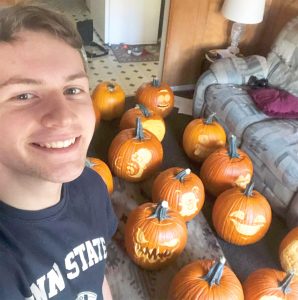
But it's on Instagram and TikTok that he has gained thousands of followers as he creates detailed, intricate artwork on an unlikely canvas -- pumpkins.
While his spooky, yet realistic designs can take hours to carve, he said, they all start out the same -- in a field.
Off to the pumpkin patch
Pater's carving skills grew out of his fascination with "Halloween Wars," an annual competition where teams of cake decorators, candy makers and pumpkin carvers come together to create unique works of art.
He was always in awe of the outrageous pumpkin carvings the contestants created.
"I was so mesmerized by what they could do. I couldn't believe they made these amazing pieces of art with pumpkins," he said. "So, I spent the next 10 years trying to figure out how they did it."
He's won online contests and even received recognition at Penn State's annual carving contest. His carving videos have also gone viral.
Pater's goal is to add his own twist to the craft while bringing joy to others through the "magic" of creating art out of food.
The carving process begins with a trip to the pumpkin patch, his self-described favorite place in the whole world. He begins by wandering the plot of land, searching among the vines for a large, heavy and orange "canvas."
"Heavier pumpkins generally indicate a thicker skin and a thicker rind," Pater said. "And when you have that, you have more surface area to work. You're taking off the skin and carving the meat of it (the pumpkin)."
Pater said pumpkins are surprisingly like other mediums commonly found in art studios like clay and wood. Once the hard, rigid outer skin of the pumpkin is removed, he uses ceramic loop tools and X-Acto knives to create his work.
But first, he has to pick an expression to portray on the "face" of the pumpkin.
"Do I want to carve a happy face, a sad face or a scary face? And if so, how can I portray that in the most detailed, yet believable fashion," Pater asks himself.
Once a decision is made, he begins carving, meticulously chiseling details into the gourd. Pater's pieces take anywhere from an hour to six hours, with an average of about 2.5 hours.
"That's the quickest I can get a masterpiece done, I suppose," Pater said.
He carves for live audiences and at home, filming content for his social media pages. He said he enjoys carving at live venues because people will talk with him about the art.
"People will come up and say, 'Wow, that's pretty neat,' and in that time, I have the opportunity to talk to people, to let them know how I carve or what I'm carving," he said.
During the academic year, Pater lives alone at an off-campus apartment in Edinboro and said he is a little glad that he does not have roommates. Between balancing classes and other extracurriculars, carving has become a nocturnal hobby, he said.
"If I had roommates, they would hate me because usually the only time I have to carve pumpkins is very, very late at night. So that's when I make the most noise and am the most active," he said.
Once his creation is complete, Pater takes the pumpkin and poses it on his counter and stove top. He turns off all of the other lights, leaving the overhead stove light to illuminate his work.
"That's when you have the best glamor lighting," he said. Pater's Instagram, @Pater_Draws13 serves as a gallery of these photos, with knobs and burners adorning the background.
Sharing the 'magic'
After he takes photos, Pater finds a creative home for each of his works.
"Most people would just put it in the compost bin or maybe outside of their house. I don't want to throw it away, and it's not my house," Pater said of his rental housing status.
Instead, with a close proximity to campus and a large audience there, he -- under the cloak of darkness -- poses the pumpkins around campus for his peers to see.
One of his art professors, John Bavaro, said he often finds Pater's creations outside of the art building. Bavaro said Pater's huge senses of humor and curiosity are translated through his pumpkin carvings.
"I think he's so intelligent about art, that he's easily bored," Bavaro said. "I always say, 'You need to do more permanent things.' And he says, 'It's not supposed to be permanent.' It's his choice in medium."
Pater said he likes the sense of mystery. "It's like 'who did that?' I always like for there to be some element of surprise of who made these interesting creations. I like to toy around with people's imaginations and further add to that magic of pumpkin carving," he said. "And that really is what it is to me. It's a kind of magic in a sense."
Magic and imagination are present in all of Pater's artwork, even those where it isn't necessarily expected.
Bavaro said Pater took his drawing one and two classes and he would find "creatures" in Pater's still-life assignments. Bavaro said Pater was an excellent student, but his abundance of talent presented a challenge, as Bavaro felt he couldn't teach him anything he did not already know. He instead decided to challenge Pater to compete with himself to "be better."
"I tried to say, 'OK, this is good, but it could be better.' And the thing about him is that he would say, 'I'm going to be better,'" Bavaro said. And Pater would come back with another version or two of the work with different aspects.
"It's really unusual to see a student of that caliber," he said of Pater. "He's very curious. It's very rare to have a student of his quality."
Pater said he hopes to continue pumpkin carving and to branch out and network as much as possible across the United States and even in other countries. He wants to continue the passion by improving his skills and meeting new people.
"That's all I could really ask for. ... It's just to be a better artist," Pater said.
Altoona roots leading to a big future
Pater keeps involved with art at home and the community through ArtsAltoona, where he's participated in art shows and showcased his skills in live food carvings and chalk drawings. He also helps the AAHS Drama Department with advertisements for high school productions.
He credits his success in his artistic career to his family and Altoona high school teachers.
"My parents and sister have been the most positive and steadfast people I have ever had in my life," Pater said. "In terms of fostering my creative and technical potential, I have Mr. Eric Hoover and Mr. Ron Bowser to thank."
The AAHS teachers guided Pater on improving his artistic skills and networking abilities.
"Without them, I guarantee I would not be taking art seriously," Pater said.
Hoover and Bowser credit Pater and his own talent and yearning to learn for the young artist's success.
"He's probably one of the most artful-minded students I've ever had," Hoover said. "You can have an intelligent conversation with him about art that you cannot have with most people his age."
"He came to us with a professional drawing ability," Bowser said. "It's hard to take a kid like that -- who in most cases is more talented in drawing than any teacher is going to be. We had to learn to just cultivate his understanding of different media and movements."
Bowser said Pater would often tell him and Hoover about what he was interested in and the techniques or history he would learn about outside of the classroom.
Hoover recalled how impressed he was of Pater, who created a YouTube channel in junior high where he would post brief videos on how to draw cartoon characters. He said teenagers sometimes have a problem expressing themselves, let alone keeping up an online channel. Hoover said Pater really developed his artistic style during his junior year into his senior year. "You can recreate someone else's cartoon, that's one thing. But if you're able to come up with your own ideas and find ways to express how you feel through your projects, that's another."
What's next
When asked where they saw Pater in the future, all three educators said it is up to him to decide where he wants to go.
Bavaro said Pater is already an illustrator working on a children's book and creating art on commission.
"I think he can do anything he wants," Bavaro said. "He's going to go far ... if he wants to."
Bowser said he could see Pater become the next Dr. Seuss, albeit a little darker.
"If there's really anything in the art world that he wants to do, he can probably do it," Bowser said.
Hoover said Pater's love of animation and creativity could translate into producing his own animated series.
That's what Pater is aiming for, to work in the highly competitive animation field, with his ultimate goal to start his own animated series project.
"I truly believe that animation is the highest form of art that there is. And I think people are quick to disagree because people stereotype it is just a cartoon. It's just something made for children," he said, noting that not all animations are over-the-top hyperbolic characters.
Pater said short cartoons like the 11-minute-long episodes of "Spongebob Squarepants" can take anywhere from nine months to a year of work.
"Some animations are incredibly detailed and well-composed with great color palettes and great compositions in the shot and great soundtracks and effects. It's a skill of composing and making a painting with the foresight to piece said subsequent paintings over and over again like a cinematographer would," Pater said. "But you have to do that all with your hands, you don't have the leisure of looking at real life and recreating real life, you essentially have to work reality into your own -- whether it is reality or not -- into the animated masterpiece. I think that's the beauty."
"The best advice I have for Anthony is keep being Anthony," Hoover said. "Don't let anybody stop you."