
Written in stone
Walking to trace part of Loysburg history
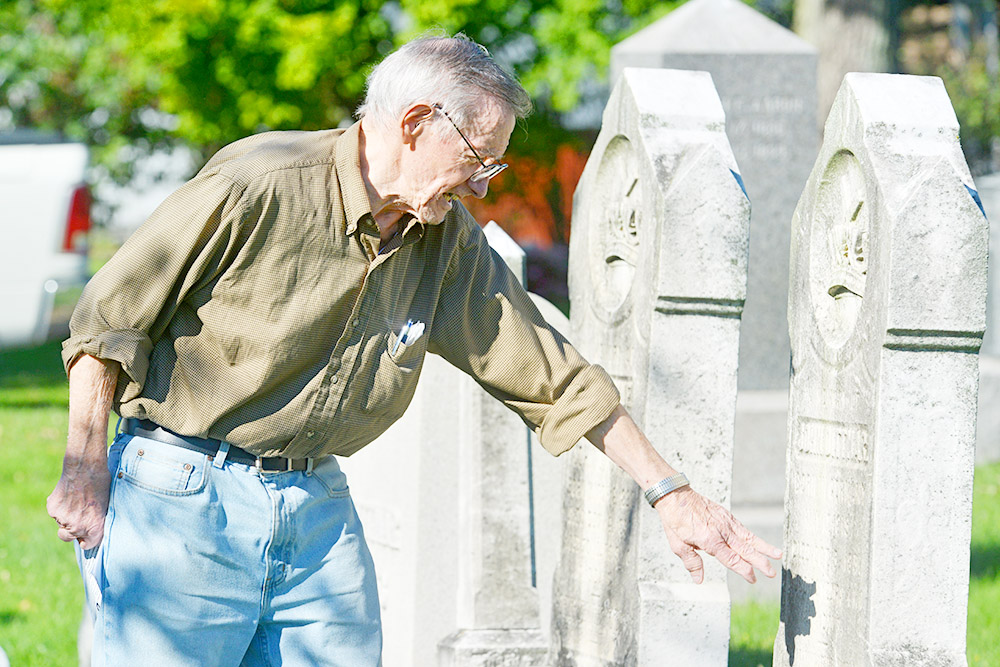
Mirror photo by Patrick Waksmunski / Photo Illustration by Nick Anna David Snyder points out the marker for John Dittmar, one of the charter members who founded St. John’s Reformed Church in Loysburg. Mirror photo by Patrick Waksmunski
The cemetery next to St. John’s Reformed Church in Loysburg, a tiny town in northern Bedford County older than the United States itself, is steeped with the history of the area — if you know where to look.
That’s why, on Sunday, local historian and St. John’s Church member David Snyder will be leading a walk through the cemetery for anyone interested in learning more about those interred there and their contributions to the area. Snyder and his late wife led the last walk nearly 10 years ago.
“I think they enjoy hearing about it,” Snyder said. “The only reason I’m doing it again is because I’ve received a few requests from people who missed the first one.”
The church and its cemetery are located just south of Loysburg. The town was named after Martin Loy, a German immigrant who came to America in 1774, according to Mirror records. In 1795, he settled in Bedford County, on land originally owned by Charles Cox. It was there that he farmed, built a grist mill and kept a store as a small settlement, which would become Loysburg, grew around him.
While Snyder couldn’t say when exactly the first grave was dug in the cemetery or who was buried there, he thinks it probably started at about the same time the church was built in 1848. However, Mirror records state that “there is a marble slab covering the grave of Miss Mary Loy who died in 1800,” although in which cemetery she was buried was not specified. Martin Loy is also buried there.
For Winifred Eichelberger (nee Dittmar), her family has a deep connection to the cemetery and its church as well.
“Our family has been buried,” Eichelberger said. “I’ll be buried there.”
Eichelberger is a descendant of John Dittmar, a prominent member of the community, who immigrated from Germany at the age of 19 and worked in town as a saddlemaker. The Dittmars were instrumental in the development of Loysburg and St. John’s Reformed Church.
According to Snyder, Dittmar, using local clay, burned the brick that Snyder’s own great grandfather, William Snyder, would use to construct the church. By 1881, the community had outgrown that church, so it was torn down and rebuilt into a larger structure. Snyder’s grandfather, Buck Snyder, helped William lay the brick for the new church, which still stands today.
“There were eight charter member families,” Snyder said. “They’re memorialized in the stained glass windows of the church.”
While not much is known about many of those families, according to Snyder, he has information on some of the other people buried there.
One corner of the cemetery has been designated the potter’s field, and buried there is an unnamed Italian immigrant. According to Snyder, after a day of working on the railroad, the young man went swimming with his friends in Yellow Creek, despite not knowing how to swim. Unfortunately, he drowned in a deep hole. Assuming he was Catholic since he was from Italy, an iron cross, still standing today, was used to mark his grave.
A significant Civil War veteran is also buried there, Snyder said. Benjamin Jamison, a father of 10, volunteered to serve in the Union Army in 1862, according to the U.S. National Archives. Although he survived the Battle of Antietam, he was shot in the left thigh and had to be taken to a hospital in Chambersburg, before being moved to Harrisburg. He was discharged from the Army in 1863.
After months spent recuperating, he reenlisted in 1864 only to be captured by Confederate soldiers. Jamison was taken with other POWs to the prison camp in Andersonville, Georgia, which, according to the National Park Service, was the deadliest military prison camp of the Civil War.
Jamison was only released when the war ended a year later. He then traveled back to Loysburg to be a school teacher and, later, a justice of the peace, according to Snyder.
Then there are the two victims of the 1889 Johnstown Flood. Nannie Aaron, 30, and her daughter Flora, 10, were visiting relatives in Johnstown when the dam broke.
While many victims of the flood were never identified, Nannie and Flora’s bodies were able to be brought back to Loysburg and buried. They were survived by their husband and father, William H. Aaron, a prominent businessman in Loysburg.
Years later, he and other members of his family would establish the Aaron Department Store in downtown Altoona.
“It’s an older cemetery with a lot of Loysburg ancestors in it,” Snyder said.
Maintaining such a cemetery hasn’t always been easy. When Snyder was a kid, he helped mow the grass on his grandparent’s lot and would notice how long the grass would become on some of the older plots. Then, in the 1950s, a pastor in the area organized a nonprofit organization to take care of the cemetery.
“The Loysburg Cemetery Association maintains the cemeteries,” Snyder said. “It’s supposed to be when someone buys a lot it’s supposed to be preserved and taken care of.”
For a while they were doing well financially due to investments, but they always need to be raising money, Snyder said. During the walk he plans to ask people to donate to the cemetery association if they can.
Mirror Staff Writer Rachel Foor is at 814-946-7458.
Local News
Blair County Children, Youth & Families has full license restored
The state Department of Human Services has restored the operating license for Blair County Children, Youth & ...
Claysburg-Kimmel School Board weighs tax increase
CLAYSBURG — Claysburg-Kimmel School Board members took a closer look at their 2026-27 preliminary budget on ...

Ground control
Claysburg-Kimmel School Board weighs tax increase
CLAYSBURG — Claysburg-Kimmel School Board members took a closer look at their 2026-27 preliminary budget on ...
Altoona Area School District enacts stay-put alert after bomb threat
The Altoona Area School District enacted a stay-put alert Wednesday morning after receiving a bomb threat that was ...
Blair County Federation of Democratic Women set annual spring tea
The Blair County Federation of Democratic Women will host its annual spring tea from 1 to 4 p.m. Sunday, April 19, ...