Railroaders Memorial Museum, Horseshoe Curve feature new events
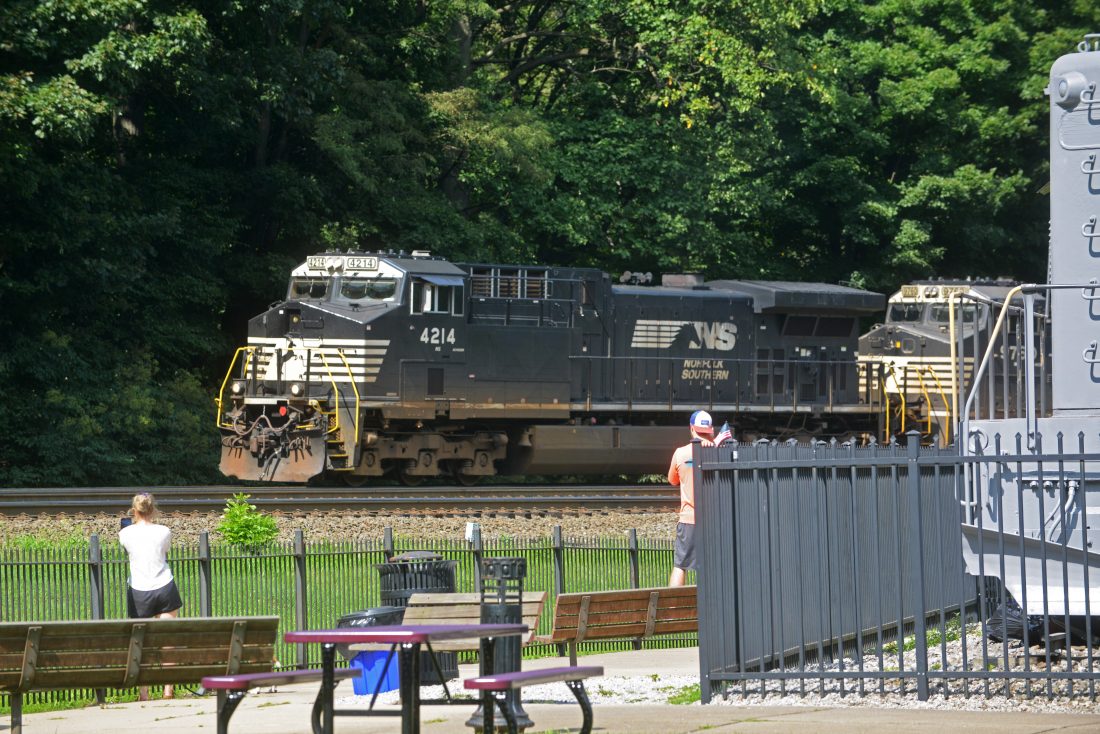
For perhaps the first time in its history, the Horseshoe Curve National Historic Landmark will feature 19th century interpreters, who will bring to life the engineering marvel and the sheer physical effort required to conquer the Allegheny Ridge.
It’s part of a broader plan to reinvigorate not only the “World Famous Horseshoe Curve” but the Railroaders Memorial Museum, too, organizers said.
A slate of new events have been planned for this fall at the museum’s Ninth Street location and at the Horseshoe Curve. The plans reflect the museum’s investment in staff with diverse skill sets, museum degrees, a shared love of railroad history and a passion for preserving railroaders’ legacy.
Local amateur historian Elaine Conrad is thrilled with the idea of having interpreters on hand because she said many people may not understand the herculean feat early railroad workers faced. Armed with just picks, shovels and mule power, these early railroaders set out to fill in the valleys to create a steady grade for trains to climb up and over the ridge.
Her grandsons Thomas Conrad, 10, and Alex Conrad, 8, had the chance to stop at the museum and the Curve when they recently visited from out-of-state.
“They still love to go and see the trains,” Conrad said.
“They learned real fast that if you go like this,” Conrad said while making a fist and pulling an invisible horn string, “that the conductor blows the whistle for you. It’s still a treat.”
New programs and staff members are all part of the plan to reinvigorate the museum and the Curve’s appeal, said Executive Director Joseph DeFrancesco.
Curator Andrew Brumbaugh was hired in the spring and follows the addition of Museum Services Director Miranda Harkins earlier in the year. They join DeFrancesco and Director of Digital Outreach Mark Frederick.
“Our new and enthusiastic staff of historians, Andrew, Mark and Miranda, have all boosted this organization’s ability to interpret and maintain the historic treasures that encapsulate Altoona’s railroading and cultural heritage,” DeFrancesco said. “Their hard work, along with those of our volunteers, is the same type of hard work that built our World Famous Horseshoe Curve.”
Brumbaugh, who started his career in public history at Blair County’s Fort Roberdeau as an interpreter, moved to Philadelphia to be an educator in the Museum of the American Revolution. He returned to Altoona in 2020.
He said the plan for the railroaders museum is to emphasize the mission of “preserving, interpreting and memorializing the legacy of the railroaders who built our community.”
Brumbaugh said that in the past, the museum put too much focus on events that didn’t pertain to the organization’s mission.
“When many people think of the PRR and Altoona, they think of the heyday of the early 1900s to WWII,” he said. “Those days would have been very different if the railroad chose a different route over the Allegheny Mountains.”
When complete, the Horseshoe Curve revolutionized travel, Brumbaugh said.
“It slashed the time needed to travel across the commonwealth and quickly became one of the most important trade routes in America, if not the world,” he said.
It’s that story the museum wants to emphasize, along with how the many generations of railroaders shaped the community.
Other areas of focus include worker strikes and activism.
Mirror political columnist Ryan Brown wrote “Pittsburgh and the Great Steel Strike of 1919,” because many people were unaware of the circumstances that led to the event, he said.
Brown, of Pittsburgh, will present a talk Sept. 2 at the museum that will focus on when railroaders organized strikes to stop pay cuts and layoffs in the late 19th and 20th centuries, including in Altoona.
“They didn’t always succeed,” Brown said, “but they helped launch a movement where workers of all professions and skill levels joined together for the same goals, instead of being divided by skill and trade as they were before.”
Those lessons can be applied to today’s movements, Brown said.
“That idea is still important today, especially when fewer Americans work in factories and railroads and more work in what some might call ‘low-skill’ service jobs,” he said. “We’re seeing a lot more interest in those service workers organizing big, broad unions to fight low pay and poor job security, just as railroad workers did a century ago.”
It seems that local residents often overlook the museum and the importance of the Curve, but a recent History After Hours held at the museum attracted 35 attendees with very little publicity.
Frederick said that based on the interest the event generated, more are planned. The museum has also partnered with — fittingly enough — Railroad City Brewing Co. to provide some of its hand-crafted ales at the museum’s evening events.
There will also be heritage talks at the Curve that present a comprehensive history of the engineering landmark, including details about its strenuous construction, monumental events of its past and its status as a world-renowned tourist destination, Frederick said.
“Reenactors will provide hands-on interpretation and educational programs throughout the day by portraying the hardworking immigrants who built the Curve in the early 1850s,” he said of the talks. The next heritage talk is set for Sunday, Sept. 5, at the Curve and will include reenactment displays, presentations and talks trackside all for the price of regular admission, which is $5 for adults.
For train buffs or those looking for a unique adventure, the “Twilight at the Curve: Extended Night Hours” offers visitors an opportunity to visit until 10 p.m. — well past its usual 5 p.m. closing.
Visitors may bring picnic dinners, stargaze with telescopes and snap photos of passing trains, including Amtrak, Frederick said. The trackside observation area will close at 9:30 p.m. while the visitor center and museum store will close at 10 p.m. on those nights — scheduled for Sept. 3 and Sept. 17. The steps to the Curve are illuminated, but visitors are encouraged to bring flashlights, he said.
Among the upcoming events is the Robert F. Koehle Memorial Golf Outing. The special fundraising event will be held Oct. 1 at the Sinking Valley Country Club and is a way of remembering Koehle, a local railroader and golfer.
Koehle, also Frederick’s uncle, was employed at the Juniata Locomotive Shop in Altoona from 1974 until 2006, where he worked as a sheet metal worker and welder for Penn Central, Conrail and Norfolk Southern. As a golfer, Koehle joined several country clubs including Sinking Valley, Iron Masters and Huntingdon. He died in December due to COVID-19. Proceeds from the golf outing will go to preserving and interpreting the legacy of Central Pennsylvania railroaders, Frederick said.
The Railroaders Memorial Museum, 1200 Ninth Ave., and the World Famous Horseshoe Curve, 2400 Veterans Memorial Highway, are both open from 10 a.m. to 5 p.m. Wednesday through Sunday.
The Curve’s funicular is unavailable due to maintenance upgrades. Rates are currently discounted.
For more information, visit railroadcity.org/, call the museum at 814-946-0834 or call the Horseshoe Curve at 814-941-7743. For History After Hours events, online ticket purchases are strongly encouraged.
Local News
Senate boosts penalties for illegal trucking schools
The state Senate approved legislation Wednesday stiffening the penalties for illegal trucking schools but only ...

Jury: South Fork man guilty on all charges in Altoona landscaper’s killing
Jury deliberating on homicide suspect’s fate
Logan Township mourns loss of longtime supervisor Metzgar

Oeschle found guilty of prison assaults