
Music gives students an outlet
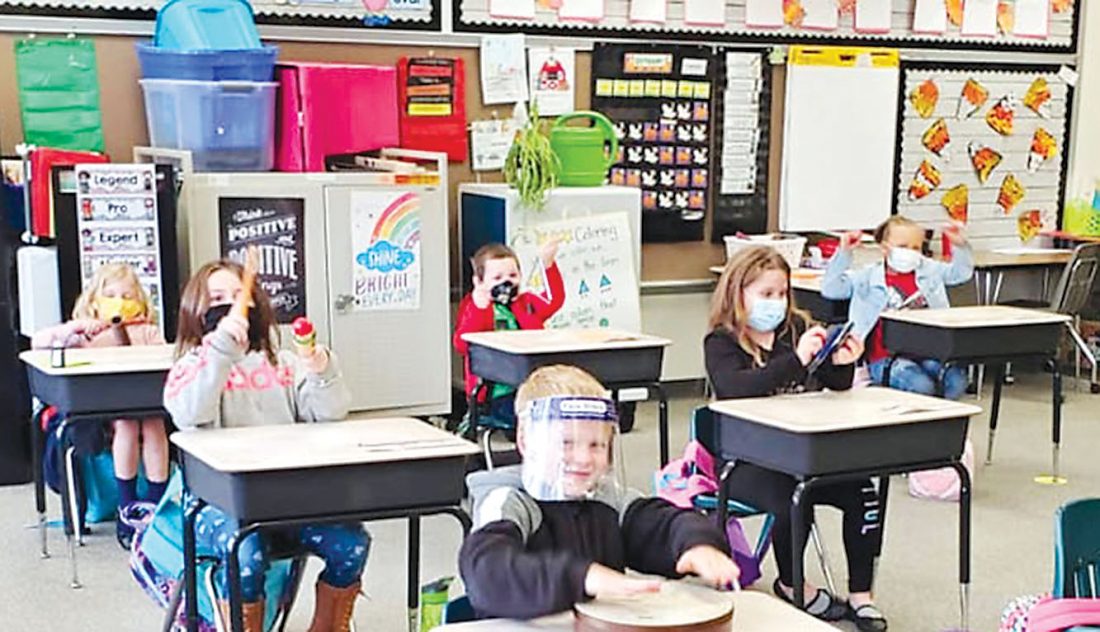
First-graders at Penn-Lincoln Elementary School use instruments to make the sounds of fixing wagons while they sing “Little Red Wagon” in October.
Editor’s note: This is part two of a two-part series on local music education throughout the pandemic.
With all of the changes forced upon students, music has been their outlet, said Scott Sheehan, Hollidaysburg Area High School director of bands.
As schools launched the year with in-person or hybrid models, music educators reworked their curriculum and delivery to keep giving students that outlet. Sheehan, who also is the music department chairman, said a critical element of continuing music with reduced class sizes of the hybrid model was using redesigned compositions.
“Because of the pandemic, composers all over the country have adapted new music or rearranged older music,” he said.
While compositions usually incorporate 15 to 18 musical parts, he said composers have rewritten pieces to have five to seven parts to accommodate smaller groups. Themes from “Star Wars” and “Jurassic Park” are two examples of these modified pieces his students worked on.
Teri Myers, Altoona Area elementary music teacher, said she had to make adjustments to decrease the amount of social interaction in her classes.
“They couldn’t dance together,” she said. “Also, the choices of repertoire had to change because of smaller class sizes — with smaller numbers, it’s harder to harmonize.”
Myers, however, said the positive of being in-person was the students could still make music together. Altoona elementary students did in-person learning until early November.
A study by the National Federation of State High School Associations that examined the risk of spreading COVID-19 through wind instruments and singing made it possible for schools to continue music education while in hybrid or in-person models, according to Sheehan.
The study suggested the standard preventive tips of maintaining 6 feet of distance, that teachers and students wear masks, everyone practice good hygiene and, if indoors, there be good air ventilation. A unique addition, however, was the introduction of “instrument bell covers,” or cloth to cover the part of the instrument where sound escapes.
Dawn Summerville, HASD data management administrator, said in an email the district invested in numerous items for the music program including the bell covers, plexiglass for outdoor rehearsals, wireless voice amplifiers and pleated performance masks (i.e. face covers designed for playing an instrument).
However, before the release of that study in the summer and with the initial uncertainty of the virus, nearly all in-person playing halted.
Elizabeth Sheehan, HAHS student and Scott Sheehan’s daughter, called last spring’s school shutdowns a “shock to everyone.”
“Especially for those in music classes, we are so used to being together and making music together,” she said.
Elizabeth is the band president and drum major for the Golden Tiger Marching Blue Band. She said the marching band season “got normal at the end, but did not start well.”
The band missed its first camp in June, and had to make up for lost practice in a short period of time through July and August — as Elizabeth said, “cramming in an entire half-time show, not knowing if there would be a football season.”
At first, the band was only allowed to play as the sports teams went into the stadium. Finally, the students were able to play during the school’s homecoming night.
“Whenever we got together for marching band, that was so special to me,” she said. “That was an outlet for me.”
Scott Sheehan said there is a “bigger picture” for music during this time.
“Kids are looking for a creative outlet; they are looking for a ‘band family,'” he said. “They need that for their social and emotional well-being more than anything.”
Mirror Staff Writer Dom Cuzzolina is at 814-946-7428.
Local News
Splashdown
Debate continues over Shapiro security upgrades
The flap over spending on Democratic Gov. Josh Shapiro’s security deepened on Monday when former governors ...
VA unveils new combined pharmacy/support center
The Van Zandt VA Medical Center has opened a first floor space that contains the hospital’s relocated pharmacy ...
Ebensburg fills council seat
From Mirror staff reports The Ebensburg Borough Council appointed resident Bill Link to fill a council vacancy ...
SAEMS to show off new training trailer
The Southern Alleghenies EMS Council has obtained an EMS training trailer that it will display at the EMS Night Out ...
Man accused of sexual assault of children in Bedford County
From Mirror staff reports A former Bedford County resident faces more than 120 charges related to the sexual ...