
Breath analyzer to help Blair police, prosecutors with drunken drivers
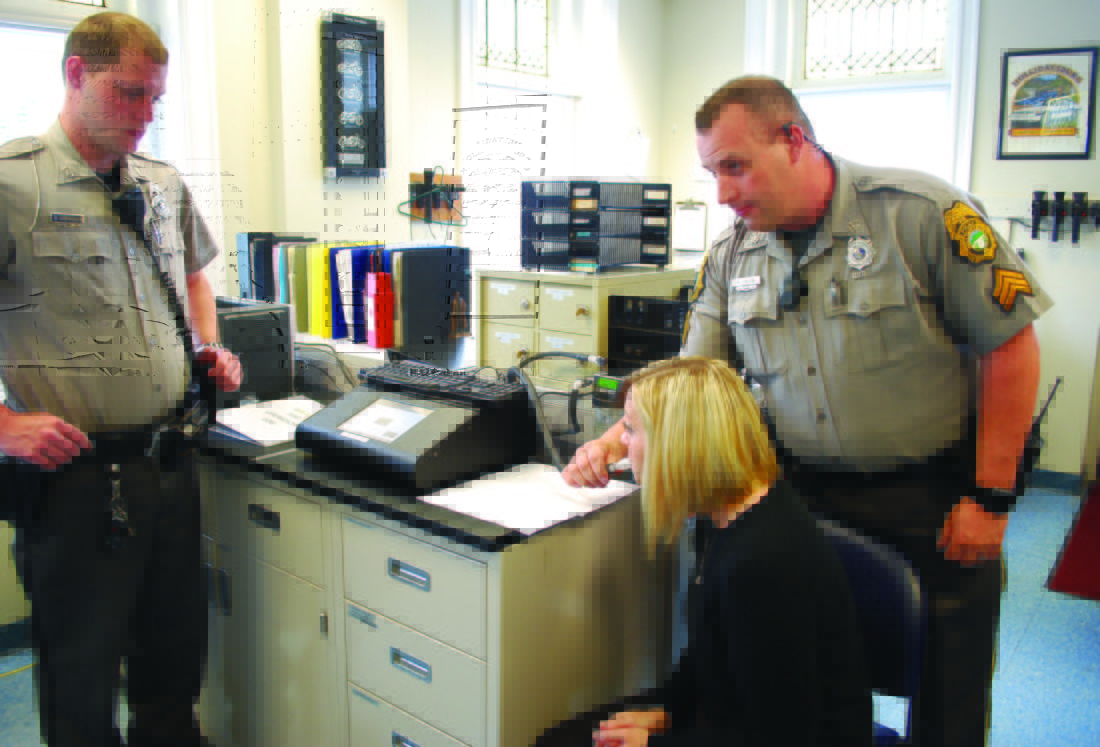
Mirror photo by Greg Bock Hollidaysburg Borough police officer Sgt. Rodney Estep (right) demonstrates an Datamaster DMT breath-test device on Aleisha Albertson, assistant director of Blair County Drug & Alcohol Partnerships, with the help of Hollidaysburg officer Stephen Weyandt. The device was bought with private funds through a partnership with the Blair County District Attorney’s Office and Blair Drug & Alcohol Partnerships and will be available for police in Blair County in making DUI arrests.
Blair County police and prosecutors have a new tool for going after and convicting drunken drivers.
A Datamaster DMT breath analyzer, bought with private funds, is now up and running at the Hollidaysburg Borough Police Department, where officers throughout the county will have access to it when making DUI arrests.
Blair County District Attorney Richard Consiglio said the device, which analyzes a suspected drunken driver’s breath and calculates a breath-alcohol level, was needed because of the U.S. Supreme Court’s Birchfield v. North Dakota ruling that held police couldn’t collect a blood sample from drivers arrested for DUI without a search warrant.
Consiglio said the search warrant requirement makes it difficult for officers to gather the evidence needed for a DUI conviction because officers have only about two hours to get blood-alcohol evidence after an arrest.
“In that time, it’s very difficult to make the arrest, get back to the station, get paperwork done and get the search warrant,” Consiglio explained.
Consiglio said the Datamaster system, which measures the alcohol in a person’s lungs and analyzes it to produce a breath-alcohol level reading police can then use in court, cost $9,600 and was a partnership between the District Attorney’s Office and the Blair County Drug & Alcohol Partnership.
Hollidaysburg police Sgt. Rodney Estep, who along with Assistant District Attorney Emily Freed was instrumental in obtaining the Datamaster, said the device is hard to trick and requires suspects to blow deep lung air into it to get a reading, as opposed to measuring the alcohol vapor in a person’s mouth where it would give an inaccurate result.
Using infrared radiation, the device measures the alcohol vapor in a person’s breath and gives police a reading and is calibrated only for ethanol.
Demographic information about each person tested is entered into the machine, and after it analyzes the breath sample, the Datamaster prints out the results.
“So, they will know before they leave here if they were over the limit or under the limit,” Estep added.
Duncansville Police Chief Jim Ott, who heads up the Blair County DUI Task Force, said it’s a tool that will help police and help keep the streets of Blair County safer. The goal of police in arresting drunken drivers is safety, Ott stressed.
“This shows Blair County’s diligence in trying to keep the roadways safe and get impaired drivers off the road,” Ott said.
Consiglio said the device is effective and efficient, and in time, a second Datamaster for the northern part of the county will be added. While the device, which will be in use in the next couple of months, will remain at the Hollidaysburg Borough Police Department, it’s also movable and can be used for DUI checkpoints, Estep said.
The machine’s need arose after the U.S. Supreme Court’s decision in the 2016 case, Birchfield v. North Dakota, that held it was unconstitutional to use blood taken from a suspect without a search warrant in drunken driving cases as evidence. It also said it was unconstitutional to apply enhanced penalties for refusing a blood test. In Pennsylvania, that has meant the state’s implied consent law, where the law said drivers gave their implied consent by the act of driving, has had to undergo some changes as well.
“Consent given under duress or coercion is not true consent,” said defense attorney Thomas Dickey of the implied consent aspect of the Birchfield decision. Dickey pointed out the court found taking blood without a warrant was unconstitutional, but not breath because administering a breath test isn’t intrusive enough on a person to raise significant privacy concerns.
Dickey said one question he would have is whether the device meets the Frye standard, which is used to determine the admissibility of scientific evidence in court.
Defense attorney Steven Passarello pointed out the constitutionality of an update implied consent warning given by officers, called a DL-26, at the time of arrest — where the warning of enhanced penalties for refusing a blood test has been removed — is still working its way through the courts and suggested that if the new DL-26 form cures the problem caused by Birchfield, then the need for breath-test equipment seems questionable given the problems breath-tests can bring into a DUI case.
“It’s not as infallible as they would like you to believe,” Passarello said, pointing out that a preliminary breath-test administered on the side of the road by police is inadmissible in Pennsylvania and can only be used to give an officer probable cause. It’s because of problems with the accuracy of those particular devices, he said.
Defense attorney Dan Kiss pointed out that when equipment is brought in to use involving evidence, there will be issues with certifications, maintenance and other technical issues.
“Otherwise, the results could be questionable,” Kiss said.
Mirror Staff Writer Greg Bock is at 946-7458.
Local News
Blair County Commissioners mull ways to cut inmate population
HOLLIDAYSBURG — Some Blair County inmates may soon have the option of being released if they’re willing to ...
Deputy warden denies shooting inmate with pepper paint ball at Blair County Prison
A deputy warden of the Blair County Prison has denied that he shot an inmate with pepper paint balls during a ...
Cambria’s Firefighter’s Memorial Trail project on track

In bloom
South Fork man guilty of first-degree homicide
Blair County Commissioners mull ways to cut inmate population
HOLLIDAYSBURG — Some Blair County inmates may soon have the option of being released if they’re willing to ...