
Preserving Plummer’s Hollow: Naturalist and family thrive in central PA mountain
TYRONE – Marcia Bonta paused under the Norway spruce, pursed her lips and mimicked a whippoorwill. She had been concerned, hearing its call only occasionally in recent years. But the birds came back this spring.
“We would hear them once in a while, but now there’s a lot of calling back and forth,” she said on the hot, July day.
That was a relief, considering that half the songbirds that once filled the area are gone, she added.
Tucked between the Laurel and Sapsucker ridges of Brush Mountain’s northeastern end near downtown Tyrone is a place called Plummer’s Hollow. Nobody thought Marcia and her husband Bruce, a librarian, would survive for very long in the 1870s farmhouse that previously had never been occupied year-around.
That was 45 years ago, and she has been busy since, walking these slopes almost daily and writing nine books and more to encourage others to understand and better appreciate nature so they might help protect it.
Marcia, now 76, had hoped for better.
“It’s sad,” she said more than once, the first time while leading a visitor down the wooded trail to the Far Field.
Fenced-in flora
To the right is a tall fence that surrounds three of their 648 acres. Its purpose is to protect old growth and allow new growth to flourish out of the reach of white-tail deer, a prolific species with few natural predators in this area since cougars and wolves were driven out by man’s development.
The exclosure is home to red and white oaks that date to 1812 and the first cutting of timber that was used to make charcoal to smelt iron, a burgeoning industry of the day. A number of young American chestnuts – a tree decimated by a blight in the Eastern United States after the turn of the 19th century – also can be spotted.
Erected 15 years ago, the cage provides a perfect lesson on the forest, specifically its understory.
“On this side, you can see black gum, all kinds of things coming up,” Marcia said. “But over here, there’s no new growth, except for a few huckleberry and blueberry sprouts,” along with some non-native plants that deer don’t eat and that choke out native plants.
“We can’t fence the whole state,” she said, suggesting it is a widespread problem.
Some hunting allowed
Hunters are allowed on the Bonta property with special permission, and they also help maintain the property. But they can’t take out enough deer to suit Marcia’s desire for a more natural biodiversity.
“What are you eating?” she yelled at a doe later on another trail. Someone else might have fawned over the deer and its proximity, but Marcia effectively shooed it away before investigating its source of lunch.
It wasn’t mountain laurels. That evergreen shrub with showy blooms – the state flower of Pennsylvania – are in decline in the hollow. But not because of the deer, which won’t eat it unless they’re starving. This culprit is a fungus.
“It breaks my heart,” Marcia said. “Laurel Ridge is becoming a misnomer.”
But don’t mistake her disappointments for any regrets.
“We’re just ahead of our time,” she said. “I’ve had a pretty happy life. And, I’ve been very lucky,” she added, pointing to Bruce.
Childhood memories
Growing up in Woodbury, N.J., Marcia’s father often took her to explore the streams and woods near their neighborhood, memories she still cherishes.
The beauty of central Pennsylvania lured her to Bucknell University where she earned her bachelor’s degree and met her future husband. When she learned that the wilds of her childhood neighborhood were destroyed for development, she mourned, and her life took on new purpose.
After they married in 1962, Bruce’s work took the couple to Washington, D.C., and then to Maine for five years.
Their dream of living in a remote, natural environment came true shortly after he got a job as a reference librarian at Penn State University’s main campus. By then, they had three boys, and the family headed to Plummer’s Hollow, named after earlier owners.
They reached the old farmhouse by crossing a one-lane bridge over the Little Juniata River and several railroad tracks and winding up a 1 1/2 mile mountain road. They bought it in 1971, even though it lacked central heating or insulation, the roof leaked and almost every room needed work.
“That professor won’t last a year,” Marcia said, explaining the teasing Bruce took from his colleagues.
It wasn’t easy, especially Bruce’s winter commute to campus 26 miles away.
In the details
But they made it that first year and many more, the details of which Marcia kept in a journal. Within two years, she started writing a column for the Tyrone Herald and later, from 1978 to 1986, for the Altoona Mirror.
She wrote her first book, “Escape to the Mountain: A Family’s Adventure in the Wilderness,” which was published in 1980.
When she realized there was no current resource devoted to Pennsylvania’s natural world, she wrote “Outbound Journeys in Pennsylvania,” which was published in 1988.
“Pennsylvania is beautiful and I wanted people to come here,”she said.”I could not believe nobody knew about Ricketts Glen (State Park). It has 27 waterfalls over eight miles.”
Book award
For that effort, Marcia won the Book of the Year Award from Pennsylvania Outdoor Writers Association in 1989.
In 1991, her “Appalachian Spring” was published, detailing the “coming of spring to the woods and the fields” she observed.
Marcia then realized that there were few other naturalists her age, and she wanted to inspire others with “Women in the Field: America’s Pioneering Women Naturalists,” including Rachel Carson, published in 1991.
“Appalachian Autumn” came in 1994, followed by “American Women Afield: Writings by Pioneering Women Naturalists,” which includes actual writings, not just biographical information.
She wrote “More Outbound Journeys in Pennsylvania,” published in 1995, because she discovered more places, she said.
“These were not updates on my first book; these are all new places,” she emphasized.
“Appalachian Summer” was published in 1999 and “Appalachian Winter” closed out that series in 2005.
She expanded “Escape to the Mountain” in 2008 with a new epilogue.
When she wasn’t writing books, she was freelancing for magazines, having more than 300 articles published, and contributing to works such as Birdwatchers Digest. She still writes a monthly article in the Pennsylvania Game News Magazine, called the Naturalist’s Eye.
“I was a history and English major and was basically self taught like most nature writers,” she said.
Close encounters
Marcia’s readers get to learn about her close encounters, which would frighten most.
One morning, she sat on one of the benches that dot their trails, sipped coffee and listened to a blue-headed vireo sing. She was distracted by news of her father’s health.
“Coyote sensed me at the same moment that I sensed him,” she wrote. “He was less than 10 feet from the bench and had evidently been moseying along the old woods road as inattentive to his surroundings as I had been to mine.
“He was a magnificent, full-grown male who looked me fully in the face for several seconds before turning around and loping slowly away. I don’t have a mystic bone in my body. Yet when Coyote appeared so unexpectedly, I felt as if I had been blessed by an unseen hand.”
She understands but laments the eagerness of humans to kill coyotes, which she and some researchers believe moved back East from Minnesota and likely mated with wolves along the way. But she also believes coyotes can help control the deer population – they prey on fawns – and that mountain lions may return east because of the bounty of deer.
Bear glimpses
Another morning, as a hawk dive-bombed her head, she ducked into the woods near the vernal pond. She looked up to see a black bear emerge from the water and shake himself off. She watched him for a while before he turned toward deeper woods. Another time, a bear came within 15 feet of her and, realizing that bears don’t like to be startled, she spoke to him.
“You don’t want to come this way,” she said, convincing the animal to turn away. “I get two or three sightings a year, at least,” she said.
One evening, a sow and her cubs tried to come through their screen door off of the kitchen, and the couple had to start closing the doors, no matter the temperature.
They had to start locking them at night a couple of years ago when a human invaded their house while they slept upstairs.
That break-in – plus vandals destroyed markers they had erected on their 10 miles of trails – makes them no longer eager to let strangers onto their preserve, although Marcia still does educational tours with familiar groups.
Adjustments
The Bontas had to adjust their plans through the years. Keeping animals out of their garden and chicken yard became impossible, so they gave up farming in the 1980s when Amish produce growers moved into Sinking Valley.
They had to forgo luxuries such as eating out, and they often did their own work, even with caretakers; Bruce re-roofed the barn once.
Marcia, who for years spent most of July canning food for the winter, scaled back to only freezing berries grown wild on their land. She recently served a tasty cold soup, made from her berries and other fruit, along with sandwiches using bread made by her middle son, Dave, who lives on the property in the guesthouse.
“I told her that the real priority in her life is as a naturalist, not a homesteader,” Bruce said.
Plus they enjoyed traveling, including trips to Australia, Japan, Sweden and a three-month jaunt through Peru where Marcia picked up a parasitic worm that Bruce patiently had to tweeze out of her arm.
Bruce dropped back to a three-quarter schedule in the 1990s to avoid the icy commute in winters. He retired in 2000, spending his days helping Marcia with research and working on his own project, called Peaceful Societies. He writes at least two articles a week and curates a website, now under the auspices of the University of Alabama at Birmingham, for which he is an emeritus faculty member. It is becoming an authority on nonviolent societies and alternatives to violence and war.
Pleased parents
Bruce likes how things have turned out so far.
“We wanted a place for our children to thrive,” and they have,” he said.
The oldest son, Steve, is a linguist and currently lives in Arizona. The youngest son, Mark, a geographer, currently lives in Mexico; and Dave, who helps take care of the property, is a poet (check out www .DaveBonta.com). They are avid bird watchers and “still love to be out in the woods,” Bruce said.
Marcia continues filling journals for the sake of her grandchildren and the future of the planet. She appreciates the “bright lights,” such as the banning of DDT that allowed raptors to return from near-extinction. She also credits the Pennsylvania Game Commission for efforts that have led to the return of a greater diversity of mammals, including fishers and shrews, on the mountain.
“I continue my record-keeping and writing about what is here now so that future generations will know what the natural world of a Pennsylvania mountain was like from 1971, when we arrived here, until the end of my life,” Marcia wrote in the new epilogue of her first book.
At that point, she will be buried in the grove of the Norway spruces where she recently whistled “whip-poor-will.” The trees – just steps from a vista that includes the water tower in State College on a clear day – are the only non-native species intentionally planted here.
“We came from Europe, too,” she said with a grin, referring to her and Bruce’s ancestors.
Before they go, they will ensure that their work on Plummer’s Hollow is preserved.
“There’s no question,” he said. “This will be protected from any kind of development.”
Mirror Life Writer Cherie Hicks is at 949-7030.
Area Life

Today’s puzzles: May 8, 2026

All aboard!

Today’s puzzles: May 7, 2026
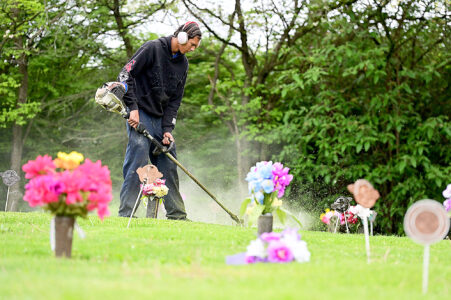
Perpetual care

Today’s puzzles: May 6, 2026
Compose your salad to inspire
This version of the classic French nicoise salad is a vibrant entree for a Mother’s Day brunch or al fresco ...