
NTSB: Ice led to plane crash
Preliminary report indicates pilot was attempting to land due to ice buildup
Trending
A preliminary National Transportation Safety Board report indicates ice buildup played a role in the fatal crash of single-engine plane near Williamsburg last week.
The three-page report released by the NTSB noted the Cirrus SR22 crashed about 8:45 a.m. Thursday in Woodbury Township as the pilot was attempting to approach the Altoona-Blair County Airport because ice had accumulated on the small plane.
The plane crashed in the backyard of a home on the 800 block of Larke Road, killing pilot James Durkin, a Lancaster businessman, and his sole passenger, Stephen Grady, a dentist from Camp Hill.
Grady was the president of The Harrisburg Club of the Notre Dame Alumni Association and Durkin was the club's treasurer.
The pair were on their way to South Bend, Ind., for an Alumni Association Leadership Conference on the university's campus.
According to the NTSB report, the plane took off from Lancaster at 7:43 a.m. Thursday, flying at 6,000 feet en route to South Bend, Ind.
At 8:28 a.m., Durkin radioed air traffic controllers to request landing at the John Murtha-Cambria County Airport because ice was building up on the plane.
The pilot was told to divert to Altoona-Blair County Airport because cloud cover was higher at that airport than in Cambria County, the report stated.
At 8:30 a.m., Durkin asked for the appropriate vectors in order to make an instrument approach to the Altoona-Blair County Airport and also requested permission to descend to 4,000 feet.
Air traffic control cleared Durkin to bring the plane down to 4,500 feet, the lowest altitude permitted in that area, and at 8:42 a.m. air traffic control told Durkin that he had passed through the localizer -- the ground-based guidance system at the airport used when planes are making an approach using instruments as opposed to sight -- for runway 21 at the airport.
Durkin then requested the vectors again so he could intercept the localizer again, but "at 8:43 a.m., communication was lost and there was no additional communications from the pilot," the report indicates.
The report noted the temperature at the time was 42.8 degrees Fahrenheit and visibility was 2 miles.
According to the National Weather Service last Friday, the freezing level in the area of the airport was between 2,000-3,0000 feet.
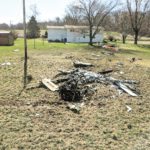
The plane crashed 9.5 miles from the airport and burst into flames after impact, the report noted.
The crash left a 200-foot-long debris field in the backyard of the home.
The report pointed out the plane was equipped with a rocket-propelled parachute system that Cirrus has pioneered to deploy in certain situations to bring a disabled plane down by parachute.
"The Cirrus Airframe parachute System (CAPS) activation handle remained in its holder with the safety pin installed, and the CAPS rockets had fired after impact," the report stated. "The parachute was found deployed from the airplane and extended along the debris path. A majority of the CAPS that remained within the main wreckage was consumed by fire."
Durkin had filed a flight plan and at the time of the crash, moderate icing, information on mountainous terrain and low-level turbulence had been noted in active AIRMETS, an abbreviation for Airmen's Meteorological Information.
A spokesman for the NTSB said Friday a full report of the investigation into the crash is likely to take 12 to 18 months.
Mirror Staff Writer Greg Bock is at 946-7458.