
Court: Myanmar committed genocide
UN’s highest court finds country responsible for genocide for the first time
Trending
THE HAGUE, Netherlands -- In a landmark judgment, the United Nations' top court ruled Thursday that Myanmar committed genocide against the Rohingya minority in a brutal 2017 military operation and ordered the Southeast Asian nation to allow people who fled the violence to return home.
The decision marks the first time the court has ruled that a state committed genocide and comes as the World Court also is handling genocide allegations linked to the Gaza conflict and the war in Ukraine.
But it remains to be seen how much of the ruling can be implemented. The court's rulings are final and legally binding, but it has no way to enforce them beyond reporting noncompliance to the U.N. Security Council.
International Court of Justice President Yuji Iwasawa said the court, in a 9-6 decision, found that Myanmar "has committed genocide against the Rohingya group in northern Rakhine state, in violation of its obligations under the Genocide Convention."
The 15-judge panel of the World Court, which included Navi Pillay, the respected international jurist who won the Nobel Peace Prize last month, rejected Myanmar's defense that the 2017 campaign was a legitimate operation against insurgents.
Iwasawa said that "the court finds that Myanmar's security forces killed thousands of Rohingya civilians, perpetrated widespread acts of sexual violence, as well as acts of extreme violence against children, and attacked fleeing Rohingya as they sought to flee in large numbers."
Rohingya say the ruling validates the suffering of their community
The atmosphere following the hearing was electric, with lawyers and members of the Rohingya, some of whom had traveled thousands of miles to attend the reading, hugging and crying.
"I'm beyond ecstatic today, hearing the judgment, being read out in detail. A lot of those moments and instances that the judges really went into detail, it really validates the kind of experience that Rohingya have," said Yasmin Ullah, a Rohingya rights activist who sat in the court's ornate, wood-paneled Great Hall of Justice for the nearly three-hour reading of the ruling.
In Cox's Bazar, Bangladesh, refugee Mohammad Rofik welcomed the recognition of the plight of the Rohingya.
"Today, the world could recognize and give the victory to the Rohingya community, not only the Rohingya community. It is the victory of the whole community of … Myanmar," he said.
There was no immediate reaction from the Myanmar delegation in The Hague or from the government in Myanmar.
The court also ordered Myanmar to commit to reparations including allowing Rohingya "safe, voluntary and dignified return to their place of residence." It ordered Myanmar to investigate, prosecute and punish people found to have committed genocidal acts and to pay compensation to Rohingya. The amount will be decided in later court proceedings.
An umbrella organization of Myanmar opposition groups said in a statement that "the struggle for justice will continue, and this judgment must now be enforced," calling on the international community to ensure it is fully implemented.
U.N. Secretary-General Antonio Guterres called the ruling "a demonstration of international justice and a reaffirmation that impunity for such horrific acts must not stand."
Shortly after the ruling was read, U.K. Foreign Secretary Ed Miliband said his government was expelling Myanmar's defense attache from the U.K. and "calling urgently for a U.N. Security Council session to discuss the judgment."
The Trump administration, meanwhile, said it is withholding judgment on the verdict. The president has taken a dim view of international law.
The U.S. State Department said Thursday that it was "studying the decision to fully assess its implications" before weighing in with an opinion.
Counterinsurgency campaign
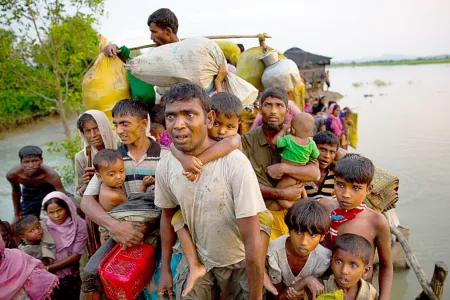
In August 2017, Myanmar's military launched what it called a clearance campaign in Rakhine state in response to an attack by a Rohingya insurgent group. The campaign led to accusations that security forces committed mass rapes and killings and burned thousands of homes.
The court said that evidence showed Myanmar forces killed about 10,000 Rohingya.
Under the 1948 convention, to establish that genocide occurred, the court had to find that there was an intent to destroy the Rohingya "in whole or in part."