
Controversial campaign: US deep-sea mining auctions spark environmental concerns
US deep-sea mining auctions spark environmental concerns
Trending
PAGO PAGO, American Samoa -- Sabrina Suluai-Mahuka sat in the shallows at Fatumafuti Beach as her 4-year-old daughter, Erhys, splashed through the clear water on a Little Mermaid kickboard. Below, iridescent blue and rainbow-streaked fish wove through fields of coral.
It was a rare moment of calm before a long journey. Soon, Suluai-Mahuka would travel from American Samoa to California to protest the Trump administration's efforts to lease areas near her island for deep-sea mining. She planned to pack a bottle of seawater that would give members of the Samoan diaspora a chance to touch and connect with the waters she's fighting to protect.
The administration has taken a major step forward this year in promoting deep-sea mining by scheduling a series of auctions of the U.S. seafloor. The first waters it is targeting are some of the most pristine areas of the Pacific Ocean near American Samoa and the Northern Mariana Islands, two U.S. territories thousands of miles from where decisions for their islands are being made.
Despite its status as an experimental and controversial industry, deep-sea mining has become a pillar of President Donald Trump's campaign to expand U.S. control over minerals critical to the technology and defense industries. In April last year, the president directed his administration to expedite the search for those metals on the ocean floor, both within and beyond U.S. borders. Auctions for the seabed near Virginia and Alaska could take place next year, while the National Oceanic and Atmospheric Administration is reviewing permit applications from companies that seek to mine in international waters.
The minerals companies are after include nickel, cobalt, manganese and copper -- useful to making everything from smartphones to electric vehicles -- that have concentrated over millions of years along the ocean floor and the volcanic crusts of seamounts. It's unclear how abundant they are near American Samoa and the Northern Marianas.
In granting a lease, the U.S. would be joining a handful of other countries that have allowed companies to start exploring their waters for deep-sea minerals. Most mining techniques involve deploying underwater vehicles thousands of feet deep to vacuum up rocks and sediment from the ocean floor. Under most proposals, those rocks are filtered and returned to a mining ship, with unwanted debris released back into the ocean.
Suluai-Mahuka and other opponents have tried to stall the auctions of the nearby ocean, rallying public comments criticizing the move. They are prepared to work against the obstacles that come with living in territories dependent on federal aid, where residents have neither a voting representative in Congress nor the right to vote for president.
"When they ask us for public comments, it always feels like we're just screaming at a moving train," said David Cabrera, who leads a group seeking to revive Indigenous forms of fishing in Saipan, the main island of the Northern Marianas.
Located in the Pacific Ocean between Hawaii and Australia, American Samoa and the Northern Mariana Islands are two separate chains of volcanic islands that both endured occupations by colonial powers before becoming U.S. territories.
Despite economic challenges and a diaspora that is slowly shrinking their populations of 50,000 people, the territories have kept alive traditions that tie them to the ocean and remain sacred to the Indigenous peoples who first made the region's islands home.
The U.S. waters surrounding American Samoa include Rose Atoll, an uninhabited island named for the pinkish hue of its coral reefs that is an important habitat for seabirds. The U.S. waters around the Northern Marianas include parts of the Mariana Trench, the deepest place on earth. Both are protected by marine monuments that now border the proposed mining areas.
If a lease is granted, it will be difficult to undo under a different administration, said former Bureau of Ocean Energy Management Director Elizabeth Klein. The government would have to justify the cancellation at a hearing and face potential litigation.
In response to the mounting opposition, the newly formed Marine Minerals Administration has emphasized that the upcoming auctions will only grant companies the right to take initial steps to explore for seafloor minerals. Any testing or commercial mining proposals will go through further public comment and a more intensive environmental review.
"It's cold comfort," said Zeno Camacho Deleon Guerrero Jr., a resident of the Northern Mariana Islands and a board member of the Micronesia Climate Change Alliance, a nonprofit focused on protecting the region's environment and people. "Once you find what you want, you're going to get it. You're going to start mining."
American Samoans fear way of life losses
The first auction for deep-sea mining -- in waters near American Samoa -- was scheduled to take place Thursday in the Southern California city of Thousand Oaks.
Suluai-Mahuka had decided to be in California, despite the long hours it would take to get there. She and her team at Finafinau, the environmental group she founded, were working to bring people from across the Pacific community to protest alongside them.
"If these people are going to be selling our ocean, they're going to see our faces when they do these bids," she said.
A legal battle now makes it unclear whether the auction will proceed. On Monday, a judge ruled the government violated the Endangered Species Act by failing to consider the full impacts of a deep-sea mining lease. By Wednesday morning, the Trump administration had yet to delay the auction. Two other lawsuits are pending.
For an opening bid of $3 million, the administration was offering companies the chance to vie for 20-year leases granting them the exclusive right to mine commercially if approved in further environmental reviews. Two areas of the seafloor, each more than 15 million acres in size, were available for bidding.
The administration has proposed another auction for five parcels of the seafloor near the Northern Mariana Islands in December.
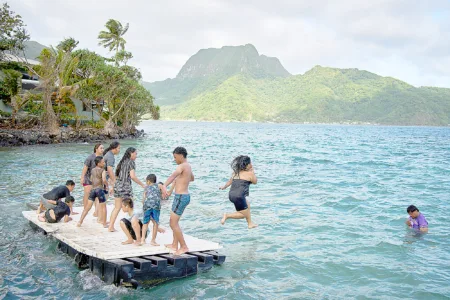
Deep-sea mining goes against everything Suluai-Mahuka stands for, she said, and against the Samoan way of life that revolves around the ocean -- whether it's diving among corals, swimming and relaxing, fishing for local delicacies, or the commercial tuna industry that sustains the local economy. All of that, to her, is at risk.
"We would be giving up a piece of ourselves that we cannot get back," she said. Her group, Finafinau, takes its name from the Samoan word for resilience.
In Samoan legend, the world began as only the heavens and the ocean. "The ocean is life. It's sacred to us," said Malouamaua Tuiolosega. "We lose the ocean, we lose life."
Tuiolosega represents the ancient governing council of Manu'a, a district of American Samoa that makes up the closest inhabited areas to where deep-sea mining leases could be granted, about 100 nautical miles from its shores. Populated by just 800 people across three islands, and isolated by infrequent transportation to the capital city of Pago Pago, Manu'a residents depend even more heavily on the environment for survival.
Since long before American Samoa became part of the United States, the council's chiefs have overseen the islands' resources, which they understand are in delicate balance with people.
If more is taken from the islands than is needed to survive, Tuiolosega said, "you violate the relationship and the trust between the people and its resource, and then it disappears."