
Sandusky request for retrial rejected
Latest appeal by former PSU coach based on claim of new evidence
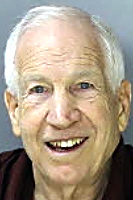
Sandusky
Jerry Sandusky, the former Penn State assistant football coach serving a minimum prison term of 30 years after being convicted of the sexual abuse of 10 young boys, has been denied a new trial, according to a ruling handed down Thursday afternoon by the Pennsylvania Superior Court.
Sandusky, now 80 years old and an inmate in the State Correctional Institution Laurel Highlands, was convicted in 2012 of 45 sexual abuse charges that occurred between 1995 and 2008.
The victims of the abuse were boys who participated in programs sponsored by the Second Mile, a nonprofit enterprise created by Sandusky to address the issues experienced by at-risk children.
Since his conviction and 30-to-60-year prison sentence imposed by John M. Cleland, a senior judge from McKean County appointed to preside over the case, Sandusky has filed many appeals.
The issue addressed Thursday was Sandusky’s request for a new trial based on after-discovered evidence, or new evidence that likely would lead to a different verdict.
Sandusky, through Camp Hill attorneys James A. Salemme, Jerry Russo and Barbara Zemlock, argued that an interview between an alleged Sandusky victim, S.S., who did not testify during the Sandusky trial, and State College attorney Andrew Shubin cast doubt on the testimony by the victims.
The defense also cited information by a podcaster, A.J. Dillen, a Sandusky supporter who posed as a victim and went through three years of therapy by a psychologist who worked with Shubin, was also cited as supporting the defense theory that the victims’ testimony was not credible.
The judge who conducted the hearing into Sandusky’s post-conviction claims, Maureen Skerda of Warren County, rejected an evidentiary hearing concerning the new claims, and the defense appealed to the Superior Court contending she erred in her ruling.
The defense stated that the hearing judge in Centre County had denied Sandusky due process in her ruling that repressed memory therapy played no role in the testimony from the Sandusky victims.
A Superior Court panel that included Judges Alice B. Dubow, Jill Beck and Correale F. Stevens upheld the ruling by Skerda.
The ruling indicated the alleged new evidence did not show that therapy or suggestion by attorney Shubin and the psychologist who tended his clients swayed or discredited the victims.
The Superior Court opinion stated that “Sandusky points to no more than the fact that S.S., like other Second Miler accusers of Sandusky, denied sexual abuse before being represented by attorney Shubin and receiving therapy from (Psychologist Cynthia) MacNab, and then alleged sexual abuse after receiving therapy.
“This fact alone is not indicative of undue influence or suggestion, nor does it imply the use of a discredited repressed memory therapy by Shubin, MacNab, or anyone else,” the Superior Court panel stated.
It concluded: “To award an evidentiary hearing on nothing more than the occurrence of a common result of appropriate psychological therapy — a patient’s eventual acknowledgment of a difficult traumatic event, would unacceptably lower the standard for obtaining a hearing…” the opinion stated.
“The information and evidence presented in this matter do not raise an issue of material fact,” the opinion concluded.
The defense has the option of seeking a review of the decision by the state Supreme Court.