
Oil boom transforms Guyana
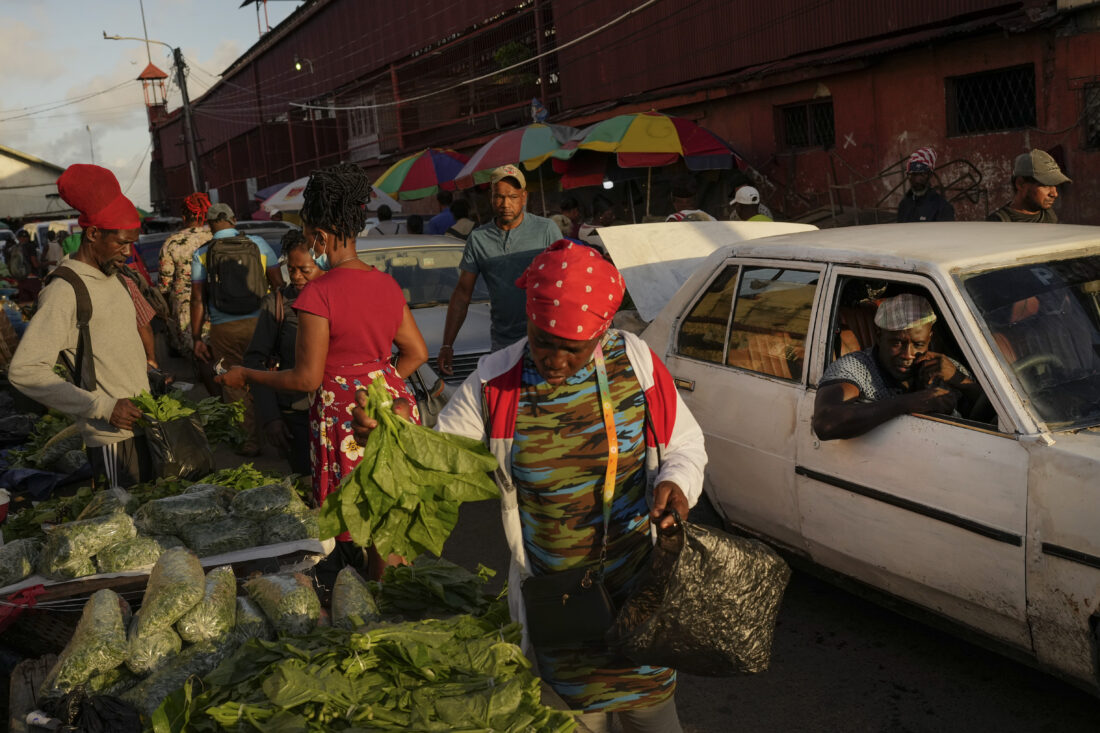
The Associated Press Shoppers look at vegetables at the Stabroek Market in Georgetown, Guyana, Thursday. More than 40% of the population lived on less than $5.50 a day when oil production began in December 2019.
ANN’S GROVE, Guyana — Guyana is poised to become the fourth-largest offshore oil producer in the world, placing it ahead of Qatar, the United States, Mexico and Norway.
But the list of needs is long in this South American country of 791,000 people. Many worry their lives won’t change even as the oil boom will generate billions of dollars for this largely impoverished nation. Bitter fights also are certain over how the wealth should be spent in a place where politics is sharply divided along ethnic lines.
Change is already visible in this country, which has a rich Caribbean culture and was once known as the “Venice of the West Indies.” Guyana is crisscrossed by canals and dotted with villages called “Now or Never” and “Free and Easy” that now co-exist with gated communities with names like “Windsor Estates.” In the capital, Georgetown, buildings made of glass, steel and concrete rise above colonial-era wooden structures, with shuttered sash windows, that are slowly decaying. Farmers are planting broccoli and other new crops, restaurants offer better cuts of meat, and the government has hired a European company to produce local sausages as foreign workers transform Guyana’s consumption profile.
With $1.6 billion in oil revenue so far, the government has launched infrastructure projects including the construction of 12 hospitals, seven hotels, scores of schools, two main highways, its first deep-water port and a $1.9 billion gas-to-energy project that Vice President Bharrat Jagdeo told The Associated Press will double Guyana’s energy output and slash high power bills by half.
A consortium led by ExxonMobil discovered the first major oil deposits in May 2015 more than 100 miles off Guyana, one of the poorest countries in South America despite its large reserves of gold, diamond and bauxite. Production began in December 2019, with some 380,000 barrels a day expected to soar to 1.2 million by 2027.
A single oil block of more than a dozen off Guyana’s coast is valued at $41 billion. Combined with additional oil deposits found nearby, that will generate an estimated $10 billion annually for the government, according to USAID. That figure is expected to jump to $157 billion by 2040, said Rystad Energy, a Norwegian-based independent energy consultancy.
Guyana now claims one of the world’s largest shares of oil per capita. It’s expected to have one of the world’s fastest-growing economies, too, according to a World Bank report.
Despite the oil boom, poverty is deepening for some as the cost of living soars, with goods such as sugar, oranges, cooking oil, peppers and plantains more than doubling in price while salaries have flatlined.
Many are still scraping by, like Samuel Arthur, who makes $100 a month selling large, heavy-duty plastic bags in Georgetown and other areas, hauling some 40 pounds of weight every day.
“All we live on is promises,” he said of the oil boom.