
2nd major storm hits north Europe

Waves crash against the sea wall and Porthcawl Lighthouse in Porthcawl, Bridgend, Wales, Britain, as Storm Eunice makes landfall on Friday. The Associated Press
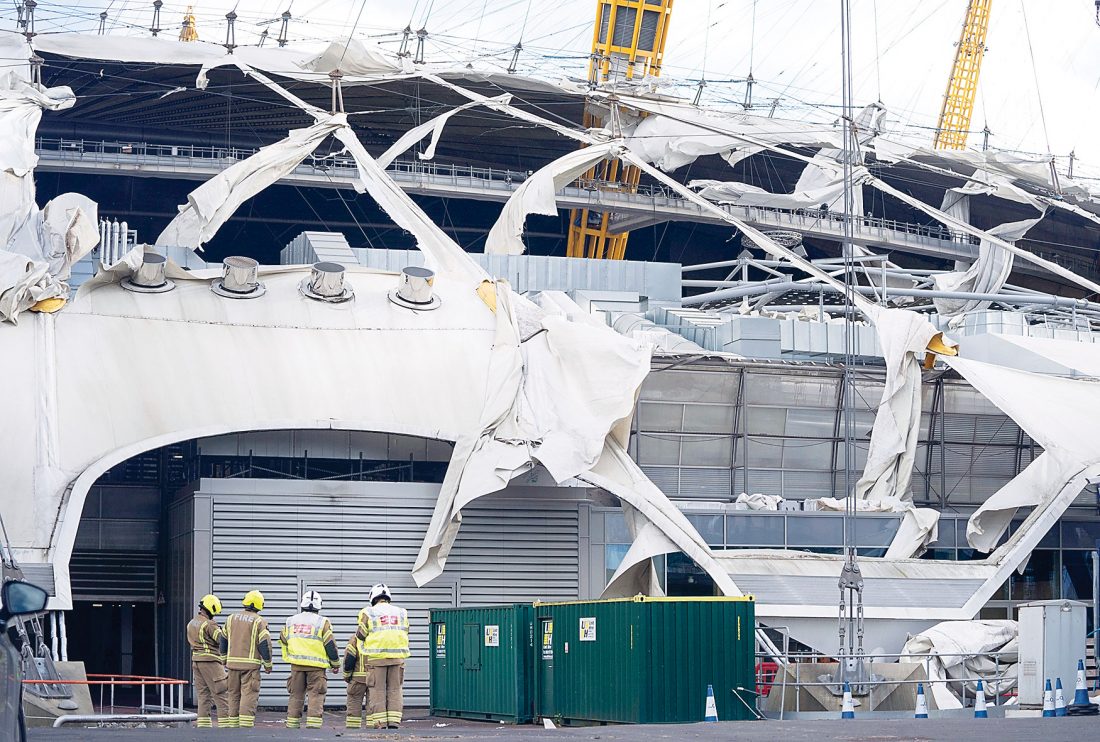
Firefighters inspect damage to the roof of the O2 Arena caused by Storm Eunice in southeast London on Friday. London Fire Brigade said that there were no reports of any injuries as about 1,000 people were evacuated from the building, which hosts major events including concerts and features restaurants, bars and shops. The Associated Press
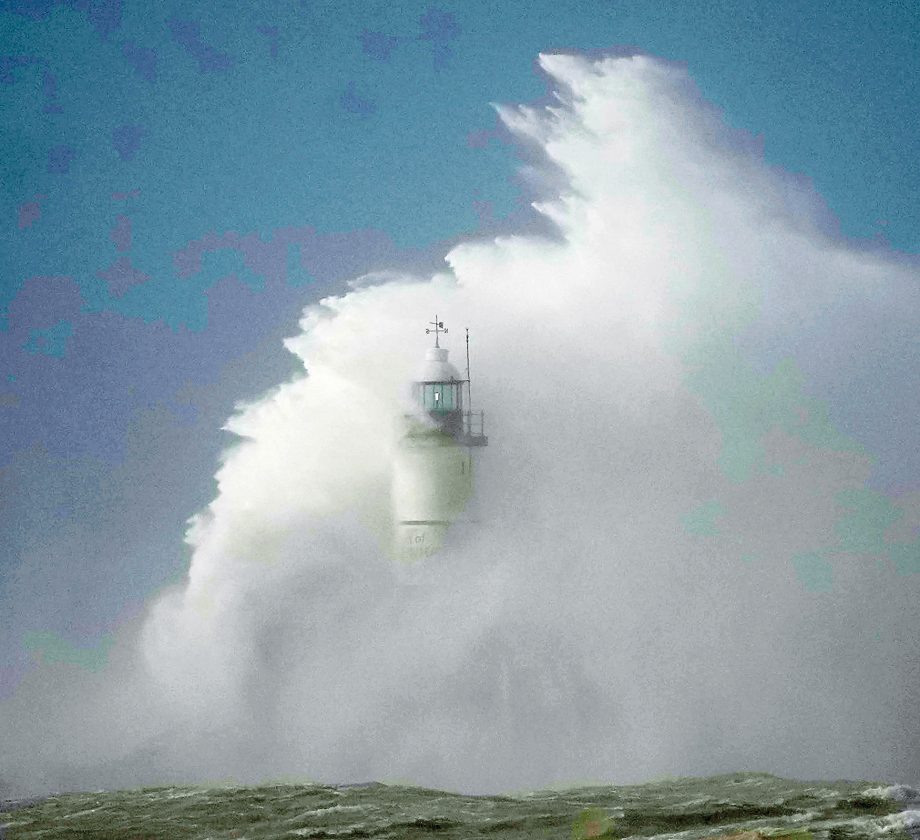
Waves crash over the Newhaven harbour breakwater and lighthouse as Storm Eunice hits Newhaven, on the south coast of England, on Friday. The Associated Press
Waves crash against the sea wall and Porthcawl Lighthouse in Porthcawl, Bridgend, Wales, Britain, as Storm Eunice makes landfall on Friday. The Associated Press
Firefighters inspect damage to the roof of the O2 Arena caused by Storm Eunice in southeast London on Friday. London Fire Brigade said that there were no reports of any injuries as about 1,000 people were evacuated from the building, which hosts major events including concerts and features restaurants, bars and shops. The Associated Press
Waves crash over the Newhaven harbour breakwater and lighthouse as Storm Eunice hits Newhaven, on the south coast of England, on Friday. The Associated Press
Trending
The second major storm in three days smashed through northern Europe on Friday, killing at least nine people as high winds felled trees, canceled train services and ripped sections off the roof of London's O2 Arena.
The U.K. weather service said a gust provisionally measured at 122 mph, thought to be the strongest ever in England was recorded on the Isle of Wight as Storm Eunice swept across the country's south. The weather system, known as Storm Zeynep in Germany, is now pushing into the European mainland, prompting high wind warnings in Belgium, the Netherlands, Denmark and Germany.
The storm caused mayhem with travel in Britain, shutting the English Channel port of Dover, closing bridges linking England and Wales and halting most trains in and out of London.
At least three people died in Britain, including a man in southern England killed when a car hit a tree, another man whose windshield was struck by debris in northwest England and a woman in her 30s who died in London when a tree fell on a car, police said,
In the Netherlands, firefighters said three people were killed by falling trees in and around Amsterdam, and a fourth died in the northern province of Groningen after driving his car into a fallen tree.
In neighboring Belgium an elderly man died when high winds pushed him into a canal in Ypres. In County Wexford, Ireland, a local government worker was killed as he responded to the scene of a fallen tree, the local council said.
Eunice is the second named storm to hit Europe this week, with the first storm killing at least five people in Germany and Poland. Peter Inness, a meteorologist at the University of Reading in England, attributed the storms to an unusually strong jet stream over the eastern Atlantic Ocean, with winds close to 200 mph at high altitudes.
"A strong jet stream like this can act like a production line for storms, generating a new storm every day or two," Inness said. "There have been many occasions in the recent past when two or more damaging storms have passed across the U.K. and other parts of Europe in the space of a few days."
The forecast led British authorities to take the unusual step of issuing "red'' weather warnings -- indicating a danger to life -- for parts of southern England, including London, and Wales that lasted through early afternoon. A lower level amber warning for gusts up to 80 mph covers the whole of England from 5 a.m. to 9 p.m.
Even before Britain was hit by the full force of the storm, Eunice disrupted travel across southern England and Wales with many train services interrupted and numerous flights and ferry services canceled. A number of tourist attractions in England, including the London Eye, Legoland and Warwick Castle, closed ahead of the storm, as were all of London's Royal Parks.
In the town of Wells in southwest England, the wind toppled the spire of a 19th-century church. In London, high winds ripped sections of roofing from the 02 Arena, a landmark on the south bank of the River Thames that was originally known as the Millennium Dome. Firefighters evacuated 1,000 people from the area.
"I urge all Londoners to stay at home, do not take risks, and do not travel unless it is absolutely essential," Mayor Sadiq Khan said before the storm.
The Environment Agency issued 10 severe flood warnings, another indicator of life-threatening weather conditions.
The storm was expected to hit northern Germany later Friday and sweep eastward overnight. A flood warning was issued for Germany's North Sea coast on Friday. Meteorologists warned Friday's storm could cause more damage than the earlier weather system, which triggered accidents that killed at least three people, toppled trees and damaged roofs and railroad tracks.
Germany's biggest rail operator, Deutsche Bahn, cancelled all train services in the north of the country on Friday due to the storm.