Horse racing economics growing in Japan
Kentucky Derby
Ando
LOUISVILLE, Ky. — As horse racing grapples with an uncertain future in the U.S. with tracks closing and legalized sports betting taking away something that made the sport unique, there is a place in the world where it’s getting increasingly popular and turning out significantly better competition.
Japan is pouring tons of money into everything from breeding to training and racing, with a turn to dirt-track runners over the past decade or so after turf was the focus for so long. Following a near miss with Forever Young in 2024, the investment could soon pay off in the form of a Kentucky Derby winner, with Danon Bourbon and homebred Wonder Dean the country’s hopes in the race this year.
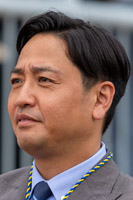
“We are getting closer,” racing manager Hiroshi Ando told The Associated Press outside the Japanese horses’ barn Thursday. “For Japan, I think we’re able to change Japanese racing history again, like we did with Forever Young in the Breeders’ Cup Classic. Our ambition is the Kentucky Derby right now, if possible.”
The ambition for a longer period of time has been the Arc De Triomphe on grass in Paris, because Japan’s roots in racing are on turf. The Japanese Racing Association launched the Japan Cup in 1981 to promote the sport and get more national interest in it, and it has become the richest turf race in the world with a purse of $8.2 million.
“We tried to learn a lot of things from the techniques and lots of things from foreign countries, not only U.S. — from European countries,” said Tom Hashimoto, general manager of the JRA’s New York Representative Office. “Developed not in a short period, (but) we make it. It took step by step and learn from other countries, and now we are very lucky to have so many good thoroughbreds.”
That history of quality thoroughbreds there dates to the early ’90s, when 1989 Kentucky Derby, Preakness and Breeders’ Cup Classic winner Sunday Silence drew little breeding interest in the U.S. and was exported to Japan to stand as a stallion. He was Japan’s leading sire for 13 consecutive years from 1995-2007, and his ancestors have won races all over the world.
Interest in mainstream dirt racing ramped up a little after that, around the time Victoire Pisa delivered Japan’s first Dubai World Cup championship in 2011. American Pharoah, who won the Derby, Preakness and Belmont Stakes in 2015 to end a 37-year Triple Crown drought, is in Japan breeding until July.
“Obviously he produced a lot of good horses in Japan, too, so Japanese people love American Pharoah babies,” Ando said. “I’m really interested to see how his babies perform because we have many good Japanese mares.”
While the result of his stay in Japan won’t be evident for a few years, the country is churning out strong horses on a regular basis, coming a long way from its debut Ski Captain finishing 14th in 1995. Master Fencer in 2019 and Derma Sotogake in ’23 each were sixth, and Forever Young was a very close third two years ago when Mystik Dan beat Sierra Leone by a nose.
The post time just before 7 p.m. at Churchill Downs makes the Kentucky Derby a first Sunday morning in May event in Japan, and all the horses coming from there running in it is making fans take notice.
“Last couple years, Japanese racing people understand the Kentucky Derby,” Ando said. “Even the public knows the Kentucky Derby now, which is great for betting, great for the industry.”
Ando just wants to keep experiencing the Derby, which he called the best atmosphere in racing — and addictive. The chance to have a Japanese presence almost annually is certainly no accident, given how intentional Japanese stakeholders have been about getting to the elite level of the sport.
“The important thing is, how does the money fund the horse racing industry as a whole?” Hashimoto said. “Not only the racing: breeding, training, training, training and racing and back to breeding. We have to invest the money to all the aspects of horse racing.”
Horse scratched
LOUISVILLE, Ky. — Fulleffort was scratched from Saturday’s big race because of a chip in his left hind ankle, the latest departure from the field of 20 horses roughly 24 hours after Silent Tactic was ruled out.
Race officials announced the change Thursday, and trainer Brad Cox told The Associated Press that Fulleffort will undergo surgery and is expected to recover and return to racing. Cox said an X-ray revealed fluid in the ankle and called it an easy decision because Fulleffort showed some lameness.
“That’s part of the game,” Cox said. “It was a problem that needed to be addressed.”
Fullefort’s exit means jockey Tyler Gaffalione will have to wait for another chance to win the race for the first time. Cox went into the week with three Derby horses and is now down to two: Commandment and Further Ado.
“I love ’em,” Cox said. “Both had a great morning. I’m excited about Saturday.”
With Fulleffort out, Ocelli draws in off the also-entered list.
Trainer Whit Beckman found out after the colt galloped at Churchill Downs around 7:15 a.m.
“I kind of had the expectation all along that if you’re within a couple spots that you have a chance,” Beckman said. “Especially in this day and age, it just seems there’s always a lot of changes from the time we draw to the time we run. We were kind of quietly confident that things would go our way.”
Beckman has been training Ocelli all along as though the colt would be participating in the Derby. Ocelli is coming off a third-place finish in the Wood Memorial at Aqueduct Race Track on April 4.
“He’s been training great since we got back here from New York after the Wood,” Beckman said. “Around the barn, he’s a very mature, easy-going horse. Sometimes he could be a little quirky on the track, but it seems like we’re getting a little bit close to perfection every time.”
Ocelli follows Great White into the field, who got in Wednesday when Silent Tactic was scratched because of a foot injury. Like Great White’s John Ennis, Beckman was unsure if he’d have a horse in the Derby but was unbothered by the situation.
“The certainty of it to me was more stressful because things can only go wrong,” Beckman said. “In this case, when things can only go right and if something did go wrong, well, it didn’t matter: We weren’t in the race anyway. … Coming in knowing you could — maybe, maybe not — go, you just kind of let the cards fall and let the universe do its thing.”
National Sports
FIFA: Iran will play for Cup
VANCOUVER, British Columbia — FIFA President Gianni Infantino opened his address at the FIFA Congress by ...
Texas Tech QB situation casting light on growing gambling addiction
Horse racing economics growing in Japan
New York Knicks, Boston Celtics chase clinchers
World Cup has heat plan
LOS ANGELES — The 2022 World Cup tournament in Qatar was moved from summer to winter because of the threat of ...