CFP sours some on bowl games
College football notes
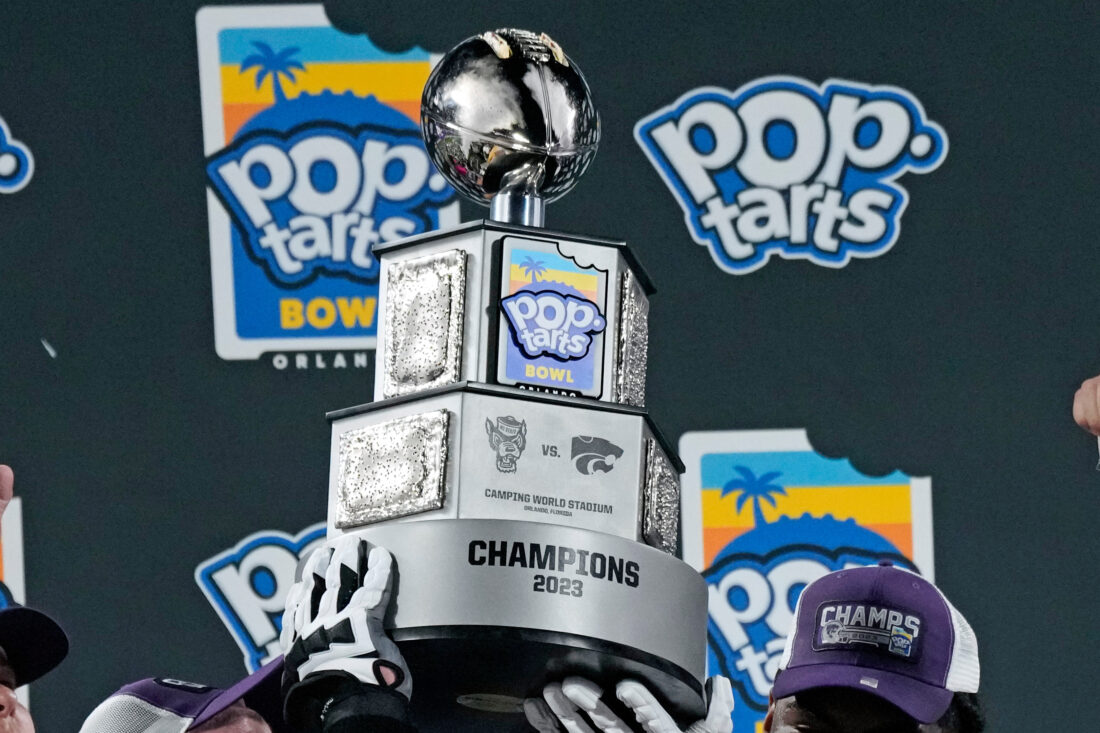
FILE - Kansas State players hold up the championship trophy after winning the Pop-Tarts Bowl NCAA college football game against North Carolina State, Dec. 28, 2023, in Orlando, Fla. (AP Photo/John Raoux, File)
The quest to fill all 35 bowl games outside the playoff expanded to teams with losing records this year, but the searching didn’t get much easier. At least 10 teams reportedly declined invitations, raising questions about the future of the postseason games that are one of college football’s most cherished traditions whose role has dramatically changed.
Notre Dame, Iowa State and Kansas State were the first to decide against bowl trips, with the two Big 12 teams drawing $500,000 fines for throwing a wrench into the league’s commitment to certain games. After Notre Dame was left out of the College Football Playoff bracket, the Fighting Irish rejected an appearance in the Pop-Tarts Bowl, one of 36 traditional bowl games.
In the second year of the 12-team playoff, some bowls — even established ones with long histories — are being reduced to optional status. The chance to hold more practices, get away to a warmer locale, give fans the chance to book a holiday trip with a little more football alongside fellow alumni doesn’t seem to hold the same appeal for every program.
Bowl organizers say there is no need to panic and note the sprawling schedule of bowls — they begin Saturday, within an hour of the Army-Navy game that signals the end of the regular season — remains valuable.
“College football needs bowl games as much as it needs the CFP,” the executive director of Coca-Cola Bowl Season, Nick Carparelli, told The Associated Press. “Bowl season is just as important, and to a greater number of institutions and student-athletes. College football needs postseason opportunities that serve the 130-plus FBS institutions who are all at different points in their development and evolution as football programs.”
Bowl value
Bowls were considered pretigious for many years in part because there were so few of them, with the Rose Bowl the only major game in the early 1930s. But the appeal grew. Sunny bowl locations in the early days of winter touted themselves to tourists and all-star-like games gave way to showdowns between top programs. By 1980, there were more than a dozen bowl games and there were 35 by 2010, with sponsors getting their names on them to help foot the bill. TV deals meant wall-to-wall bowl games for three weeks.
Recent changes in college athletics have lessened the value for some. Quarterback Beau Pribula drew outsized attention a year ago when he left playoff-bound Penn State for the transfer portal. This year, Ole Miss balked at letting coach Lane Kiffin stay for the the CFP after he took the job at LSU.
Players deciding they don’t want to do a bowl game doesn’t surprise Ramogi Huma, the executive director of the National College Players Association.
“I don’t think you can hold players to a standard where they should absolutely be playing every bowl game offered when you have examples of schools and coaches not doing that,” Huma said.
Huma argued the lack of enthusiasm toward bowl games goes hand-in-hand with a 12-team playoff. With room in the playoff for eight additional teams, the mission becomes CFP-or-bust for top programs.
“The emergence of a wider and larger College Football Playoff is another factor when you look at it,” Huma said. “If the gold standard for these teams is now making an expanded playoff and everything else falls short, that may be a deterrent for a team like Notre Dame. … They might not want to play in another bowl, and that alone could decrease, kind of water down, the prominence of the bowls that are outside the playoff.”
Elsewhere in college football:
n Fernando Mendoza was named Associated Press player of the year after leading unbeaten and top-ranked Indiana to its first Big Ten championship since 1967 and the No. 1 seed in the College Football Playoff. The redshirt junior quarterback was the overwhelming choice over fellow Heisman Trophy finalists Diego Pavia of Vanderbilt, Jeremiah Love of Notre Dame and Julian Sayin of Ohio State. Mendoza received 32 of 51 first-place votes from a nationwide panel of media members who cover college football. The Hoosiers’ first-year starter transferred from California after last season and is the triggerman for Indiana’s record-setting offense.
n Texas Tech linebacker Jacob Rodriguez is The Associated Press Big 12 defensive player of the year. He is also among seven first-team picks on the AP all-league team from the playoff-bound Red Raiders. BYU’s Kalani Sitake is the Big 12’s top coach, and Cougars running back LJ Martin is the top offensive player. Texas Tech won its first Big 12 title and has a first-round bye in the College Football Playoff. Rodriguez and defensive end David Bailey, the league’s top first-year transfer, were unanimous picks and among five Red Raiders on the first-team defense. BYU quarterback Bear Bachmeier is the league’s top freshman.
n Tennessee coach Josh Heupel officially hired Jim Knowles as the Volunteers’ new defensive coordinator. Heupel moved quickly after firing coordinator Tim Banks on Monday and said Thursday that hiring Knowles was a priority from the start. Heupel said Knowles has a proven track record of developing elite defenses. Knowles was in charge of Ohio State’s defense when they won the national title in early 2024. He spent last season at Penn State.
National Sports
NASCAR settles lawsuit
CHARLOTTE, N.C. — Michael Jordan and NASCAR chairman Jim France stood side-by-side on the steps of a federal ...
Dallas Cowboys star receiver set to rejoin lineup
CFP sours some on bowl games
Michigan in massive spin control after firing
Steelers’ Watt hospitalized with lung issue