
UPMC Mercy School of Nursing to open on UPMC Altoona campus
UPMC Mercy School of Nursing classes to begin in August
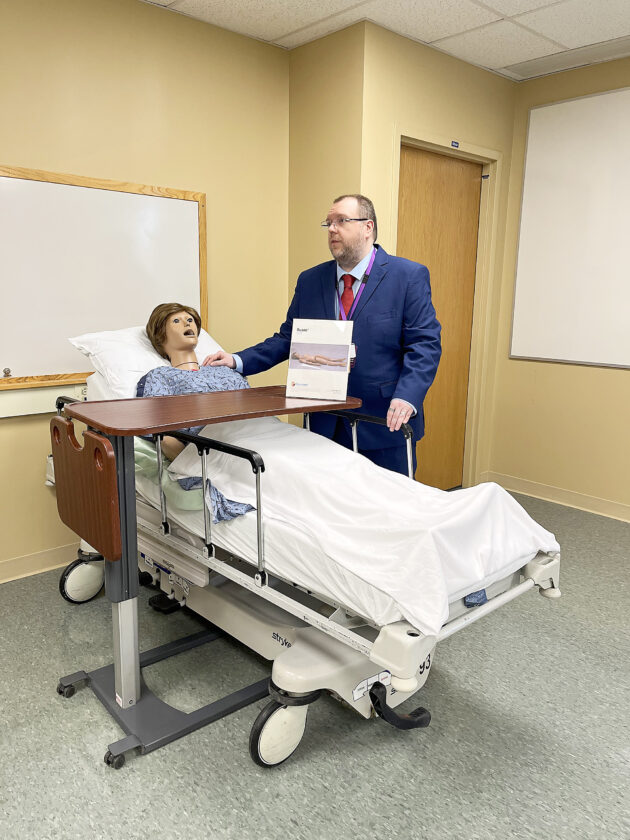
Nursing instructor Richard Patterson shows off a patient manikin that nursing students at UPMC Altoona’s UPMC Mercy School of Nursing satellite can use to practice various procedures without risk to actual patients. Mirror photo by William Kibler
Mid-1980s Altoona Hospital School of Nursing graduate Carol Ruffley nursed a feeling of disappointment for years after that school closed in 1996.
The announcement last year that successor hospital UPMC Altoona would revive the institution in the form of a UPMC Mercy School of Nursing satellite was a shot of adrenaline for Ruffley.
It motivated the veteran teacher at Conemaugh School of Nursing in Johnstown to apply for work here as an instructor, and now Ruffley is thrilled to be part of the delivery team in the rebirth of a local institution, she said Friday during a ribbon cutting for the school, located in the first floor of the G Building on the UPMC Altoona campus on Howard Avenue.
“I distinctly remember how upset I was,” Ruffley said, recalling a farewell dinner at the Blair County Convention Center, as she sat Friday in the lobby of the new school, while dignitaries toured the new facility, where classes will begin Aug. 31. “We were all sad, because we knew what we had and what we learned, and it was going away.”
Now, 30 years later, it’s coming back, with Ruffley one of two part-time instructors on a team that will have seven full-time and two casual teachers.
Nursing is different from most other professions, because of how directly its practitioners affect the lives and well-being of their patients, Ruffley said.
At the new school, she’ll be taking her students over to the hospital for their clinical sessions and helping them learn how to conduct those therapeutic interactions, which include introducing themselves, asking patients how they’re feeling, taking vital signs, holding their hands, explaining impending medical procedures and monitoring progress, according to Ruffley.
Different nurses have different styles, with some emphasizing humor, some projecting stoicism, some radiating calmness — as she herself tried to do when she worked in the emergency room and dealt with people who were often upset and in shock, she said.
There’s no single personality type associated with being a competent nurse, but it helps to be able to adjust your approach to the situation, according to Ruffley.
Her goal is for all her students to succeed, although some will realize as they go through the program that it’s not for them, she said.
The ones who succeed will be dedicated, she said.
“They’re the people who really want it,” she said.
The curriculum for the 16-month diploma course includes 900 hours of clinical training, according to school Director Jennifer Kowalkowski.
The curriculum is designed to prepare students for “real world care,” Kowalkowski said.
The curriculum is standardized among all eight UPMC schools of nursing: Mercy, Mercy at UPMC Altoona, St. Margaret, Shadyside, Shadyside
at UPMC Harrisburg, Jameson, Jameson at UPMC Hamot and Washington, according to Brandy Hershberger, chief nursing officer and vice president of academic affairs for all eight schools.
The programs at each are designed to be affordable, compact and convenient because of being located at hospitals where students can do their clinical work, and fairly quick to get through, according to Hershberger.
The facility at the G Building includes patient manikins offering varying levels of realism upon which students can practice wound care, ostomies, catheterizations, oxygen hookups and various other procedures without risk to actual patients, according to instructor Richard Patterson.
The most realistic of the manikins — which haven’t been delivered yet — talk, breathe, show a pulse and have eyes with pupils that retract in the light just like the eyes of real people, Patterson said.
These “high-fidelity” manikins are operated by faculty members using a control station to “load scenarios” which the students then deal with, he said.
There is a debriefing room in which the scenarios can be replayed for further discussion and constructive criticism for the benefit of the students who just went through those scenarios live and for other students who can learn from the replays.
Come late August, students at the new school “will not only grow in their knowledge and clinical skills, but in their ability to lead with compassion, advocate for their patients and one day, make a difference in the lives they touch,” said Kowalkowski, as quoted in a hospital news release.
Mirror Staff Writer William Kibler is at 814-949-7038.
Local News
UPMC Mercy School of Nursing to open on UPMC Altoona campus
New state Senate bill overhauls aviation funding
A new Senate bill overhauls the way aviation is funded in Pennsylvania. Senate Bill 1365 sponsored by Sen. Daniel ...
Honoring a great dad as Father’s Day approaches
Fathers Day is celebrated next weekend and I want to honor, in my estimation, a great man, my Dad. William ...
Claysburg-Kimmel School District sees $744K deficit
Claysburg-Kimmel School District is facing a $744,703 deficit as board members continue to work to balance the ...
Johnstown District Court erred in dismissal of former Mo Valley detainee’s counsel request
A federal appeals court last week ruled that a former magistrate judge serving in the U.S. District Court in ...
Public invited to Jaffa Shrine celebration
The Jaffa Shriners will celebrate the official listing of their Broad Avenue headquarters on the National Register ...