State proposes $6 million for EMS equipment statewide
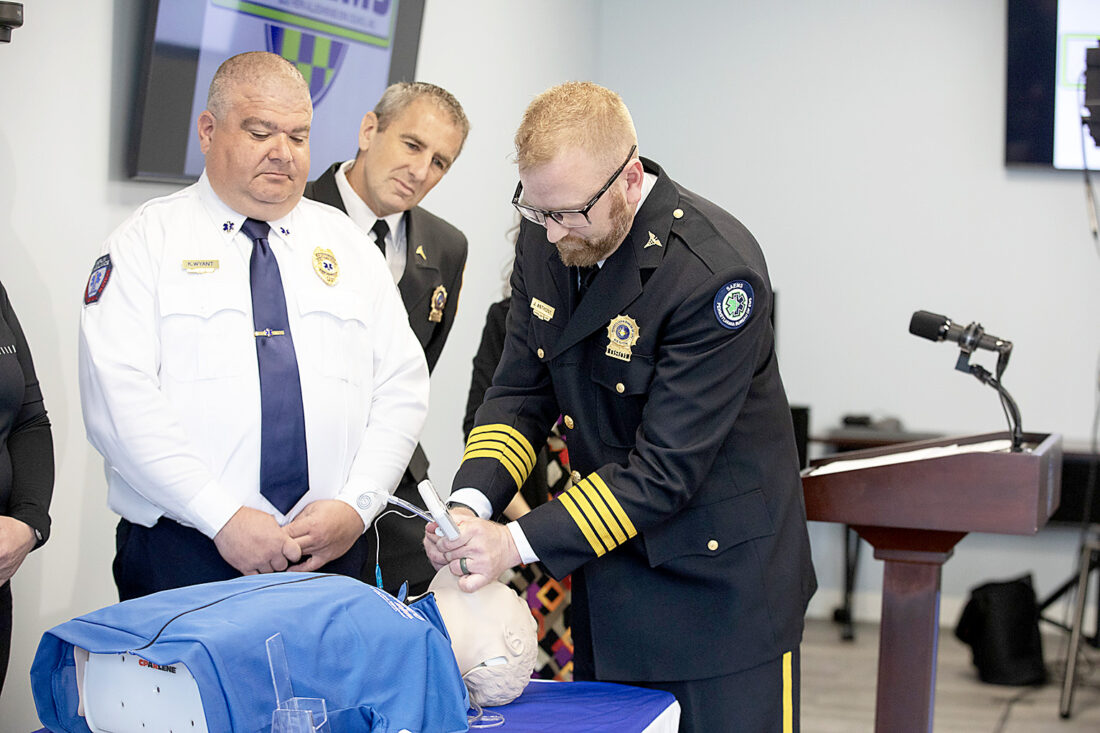
Southern Allegheny EMS Regional Council Director Jordan Anthony demonstrates video laryngoscopes as Berlin Area Ambulance EMS manager Kris Wyant (left) and Bureau Director of EMS Anthony Martin (center) looks on during a visit to Southern Allegheny EMS (SAEMS) Regional Council Headquarters in Altoona. Courtesy photo
The Shapiro administration has proposed a special $6 million allocation in its 2026-27 budget for emergency medical services equipment statewide, including $282,000 for the EMS council of the Southern Alleghenies — whose largest ambulance service is AMED, according to information from a news conference in Altoona on Monday.
Some regional councils have begun buying equipment based on the proposal, in expectation that the allocation will be approved, as was an additional $6 million for EMS last year in the current year’s budget, according to Southern Alleghenies EMS Council Executive Director Jordan Anthony.
On the presumption of success and eventual reimbursement, SAEMS has purchased 70 video laryngoscopes and 70 IV pumps “to improve care efficiency, procedure accuracy and patient outcomes,” according to Anthony and an administration news release.
Video laryngoscopes help providers perform airway intubations on patients in critical condition by enabling the providers to see what they’re doing via a camera at the end of a strategically curved blade that is fed down the throat of the patient toward the opening of the trachea, as the camera transmits images to a small screen mounted near a handle at the top of the blade, Anthony said.
During this procedure, providers guide a plastic tube down the patient’s throat and into the trachea, using the video feed on the screen to confirm that the tube is being inserted properly, he said.
Without such equipment, providers need to use a curved blade to get the tongue out of the way, then lift the “anatomy below the tongue” so that there’s a straight sightline to the larynx, which sits above the trachea opening — a sightline that can be hard to achieve, Anthony said.
Providers often hope that the patient’s tongue is not too big to see past and that the anatomical structures below it are adequatley visible to them, he said.
Even if they establish a straight sightline, providers who don’t have cameras need to re-establish their views of the larynx after the breathing tube blocks that view as it passes through the throat, according to Anthony.
With the camera, they never lose sight of the larynx, according to Anthony.
Providers using the video laryngoscopes do airway intubations on average more quickly, which is important, because the faster those are done, the faster the patient resumes processing oxygen, Anthony said.
In a similar vein, providers using video have a better chance of getting the airway tube in place on their first try with each patient, Anthony said.
Outcomes on average are better, he said.
The addition of IV pumps help eliminate the need for med math, while reducing human error in the administration of IV drugs — while also expanding the list of drugs that ambulance workers can infuse and making such infusions safer, Anthony said.
With an IV pump, a provider keys in the patient’s weight and the dosage of the medication, and the infusion is controlled automatically.
Without a pump, the provider needs to give some medications intermittently; needs to “push a little, then push a little more” for some other meds; and needs to keep constant watch to ensure the correct amount is delivered for yet another class of meds, according to Anthony.
Without a pump, there are certain drugs that ambulance workers are not permitted to administer at all.
SAEMS’ intention is to provide a video laryngoscope and an IV pump for each staffed ambulance in its territory.
AMED has 17 staffed ambulances, according to Anthony.
The new funding will also enable SAEMS to provide “Kardia 12” machines for its approximately 16 Basic Life Support services — services that don’t include paramedics.
The machines will enable BLS crews to perform electrocardiograms and to send the results electronically to a hospital, where an expert will interpret them, he said.
In the event an ECG shows that a patient needs a heart catheterization, the hospital can start to get its cath lab ready right away, he added, which sometimes will mean calling in staff members from home.
Having an early alert can save critical time, he said.
The additional $6 million in the proposed 2026-27 budget would come from the state’s EMS Operating Fund, according to an administration news release.
During the last three years, the administration has allocated $56 million for EMS equipment, according to the news release.
SAEMS is one of 13 regional EMS councils.
It oversees about 75 ambulance services in Bedford, Blair, Cambria, Fulton, Huntingdon and Somerset counties.
Statewide, 17,000 ambulance workers respond to 2.2 million calls per year, according to the news release.
Mirror Staff Writer William Kibler is at 814-949-7038.
Local News
State proposes $6 million for EMS equipment statewide

Spring swinging
Local veteran advocates plan modern military history museum
Bedford man charged with harassment for repeated calls to 911
A Bedford man was taken into custody and charged with 30 misdemeanor counts of harassment after allegedly calling ...

Mother, 6 children die in Mill Hall house explosion