Gov. Shapiro’s budget proposal: $53.2 billion spending plan for Pennsylvania
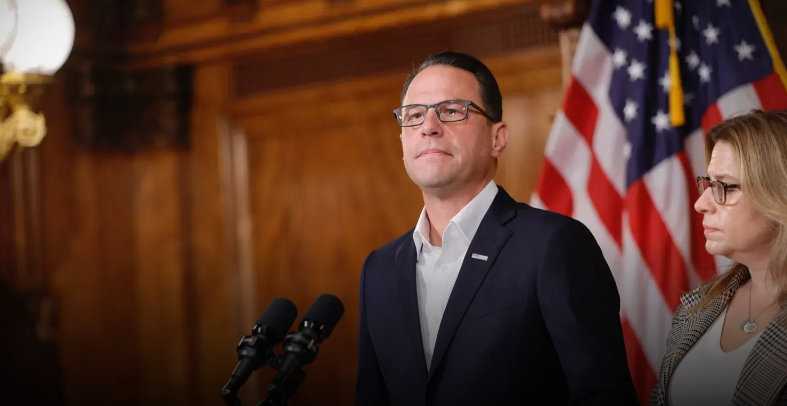
Gov. Josh Shapiro delivers his budget proposal on Tuesday in Harrisburg. Capitolwire
With finances tight, Gov. Josh Shapiro proposed creative ways Tuesday to pay for several new state initiatives during his annual budget address to lawmakers.
The Democratic governor proposed $1 billion in state bond borrowing to help pay for energy grid projects, housing and upgrading local government buildings through a new Pennsylvania Program For Critical Infrastructure Investment. (You can read the full transcript of his address here: https://tinyurl.com/y4yk7rfw)
He proposed a revived $100 million PA Innovation Program to underwrite emerging technology ventures.
The state would sell Insurance Premium Tax Credit to insurance companies to pay for the innovation program. Insurers would buy a credit thus generating revenue for the program, Shapiro administration officials said. An insurer would claim the credit on future tax filings.
Shapiro proposed creating a Federal Response Fund by transferring $100 million from the Rainy Day Fund. The response fund is designed to give the administration broad authority and flexibility to respond to federal aid and reimbursement cuts under the Trump administration in such areas as disaster aid and low-income food assistance.
Shapiro said Pennsylvania needs to do more than just filing lawsuits to counter the funding uncertainty at the federal level.
“Now is a time when we need to stand together for our Commonwealth – and be prepared should they try to take away more of what is owed to us,” he said.
Overall, Shapiro proposed a $53.2 billion state taxpayer-supported General Fund for Fiscal Year 2026-27. This would be a $2.7 billion or 5.4% spending increase if approved by lawmakers. The budget anticipates $54 billion in federal funds.
The budget would draw down the Rainy Day Fund from $7.8 billion to $3.3 billion, according to documents.
Spending increases in Shapiro’s budget are linked to increased Medicaid costs and new initiatives, officials said.
Shapiro appeared before a politically divided General Assembly where memories linger of last year’s divisive budget stalemate lasting more than four months.
In a nod to that, Shapiro said the leaders of the flour legislative caucuses will meet Wednesday to discuss the budget in his office.
“We learned that we all need to be at the table, and that we all need to be at the table sooner,” he said.
The compromise FY 2025-26 budget was balanced with shifting money from special funds to the General Fund and repurposing $1.6 billion in unspent appropriations.
Shapiro’s budget calls for no tax hikes, but again seeks a revamp of the unused EDGE state tax credit to finance major economic development projects.
As he seeks a second term, Shapiro cast his budget proposal on building on priorities and programs such as permit reform and workforce development outlined during his first term.
High-profile proposals
Shapiro’s specific proposals in high-profile areas are:
— EDUCATION: Another $565 million boost to address education spending disparities outlined by a Basic Education Funding Commission. A $50 million boost to the Basic Education Subsidy and $50 million more for special education.
— DATA CENTERS: Shapiro touted his new GRID principles for data centers that seek faster state permits and tax credits.
These include data centers bringing their own generation, engaging with local communities, hiring local workers and practicing water conservation.
“If companies adhere to these principles, they will unlock benefits from the Commonwealth, including certainty in permitting and available tax credits,” he said.
SNAP: Shapiro emphasized ongoing efforts to help recipients of Medicaid and Supplemental Nutrition Assistance Program (SNAP) benefits prepare for new federal work requirements.
Other spending initiatives include a $10 million boost for cybersecurity, $20 million to clean up hazardous waste sites, an additional $10 million to stabilize the child care workforce and
$18 million more for career and technical education and job apprentice programs.
Shapiro called again for passage of several first term revenue proposals that drew opposition in the Republican-controlled Senate – legalizing adult marijuana, increasing the state minimum hourly wage, licensing and taxing skill games and earmarking a share of state sales tax revenue for mass transit.
Legislative action
Shapiro emphasized the need for legislative action in numerous non-fiscal policy areas. He called on lawmakers to enact a statute of limitations law for child abuse survivors, a false claims act for Medicaid fraud and laws to help tenants and renters.
The Democratic-controlled House and Republican-controlled Appropriations Committees plan to start hearings on state agency budget requests Feb. 23.
The House panel scheduled three weeks of hearings. The Senate panel has scheduled two weeks of hearings.
Local News
Governor Shapiro’s 2026-27 budget address
HARRISBURG — Today, Governor Josh Shapiro delivered his 2026-27 Budget Address to the General Assembly and to the ...
Gov. Shapiro’s budget proposal: $53.2 billion spending plan for Pennsylvania

Haitians in Berks brace for end of protections
ICE buys warehouse in Berks County for $87M
Power supplier switch can be costly
Many Pennsylvanians who switched their power supplier to try to save money ended up paying more than if they’d ...