
Building Leaders: Claysburg-Kimmel Elementary students prep for LEGO competition
-
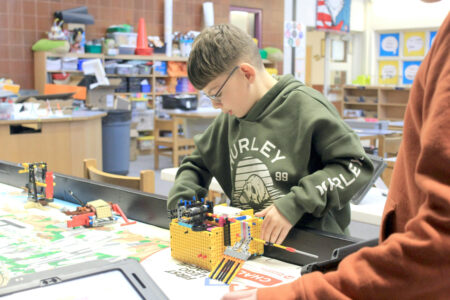
- Claysburg-Kimmel student and team captain Gage Morgan, 10, resets the team’s robot before programming its launch across the worktable, ready to fix any mistakes. Mirror photo by Colette Costlow
-
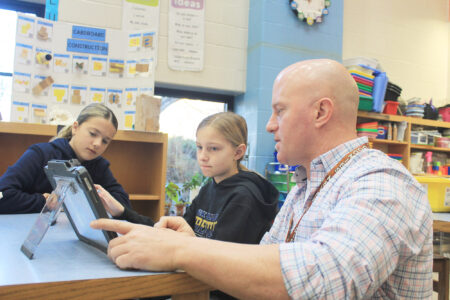
- Computer teacher Brandon Ickes (right) reviews computer codes for a LEGO robot with students Paislee Imler and Makeley Freeman. Mirror photo by Colette Costlow
-
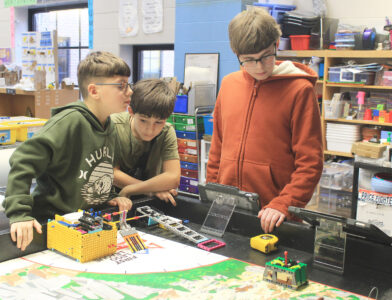
- Team captain Gage Morgan works with mission strategist Jaxon Brumbaugh and teammate Brennan Wicker on a robot competing in the FIRST LEGO League competition set for Jan. 31. Mirror photo by Colette Costlow
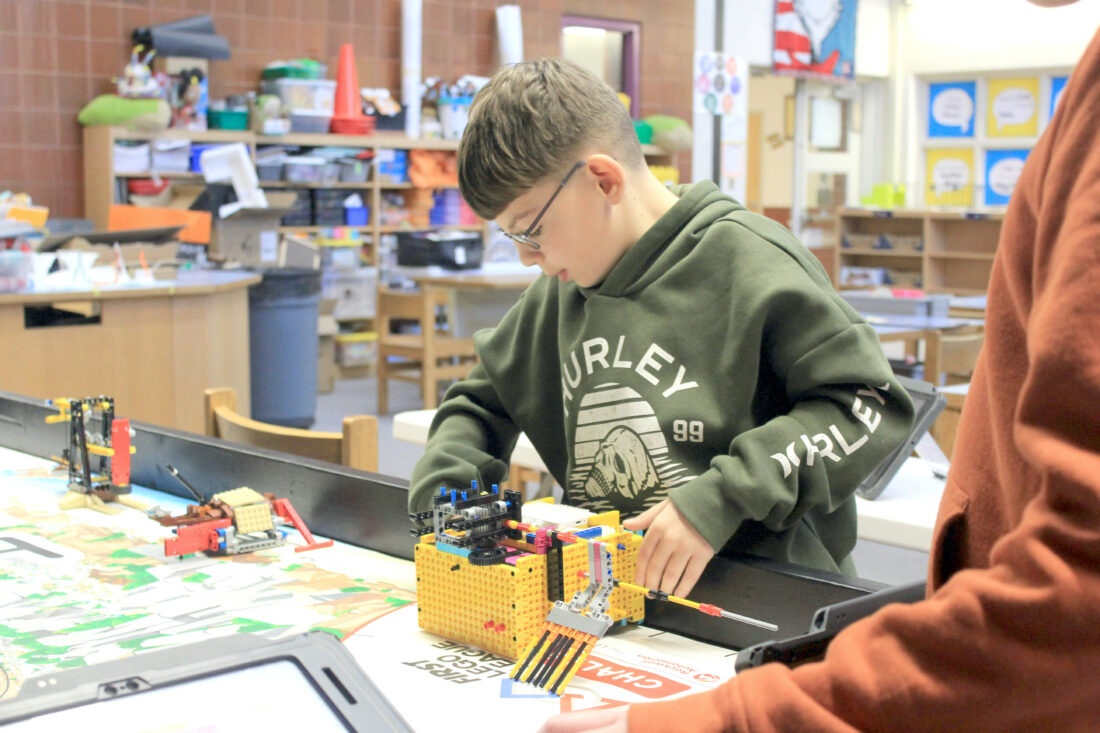
Claysburg-Kimmel student and team captain Gage Morgan, 10, resets the team’s robot before programming its launch across the worktable, ready to fix any mistakes. Mirror photo by Colette Costlow
CLAYSBURG — FIRST LEGO League elementary students are building real-world skill sets while assembling robots for an upcoming competition, STEAM teacher Suzanne Wicker said.
At the same time, “they’re building themselves,” she said. “They’re building their own skills, and they’re realizing their capabilities.”
Designed for young students, the league teaches STEM-related lessons through creating and navigating robots through “missions,” or tasks, that also remain relevant to specific real-world issues.
Since October 2025, 10 Claysburg-Kimmel elementary students have been working toward creating two student-designed LEGO robots and a research presentation for the FIRST LEGO League competition set for Jan. 31 at Central Cambria High School.
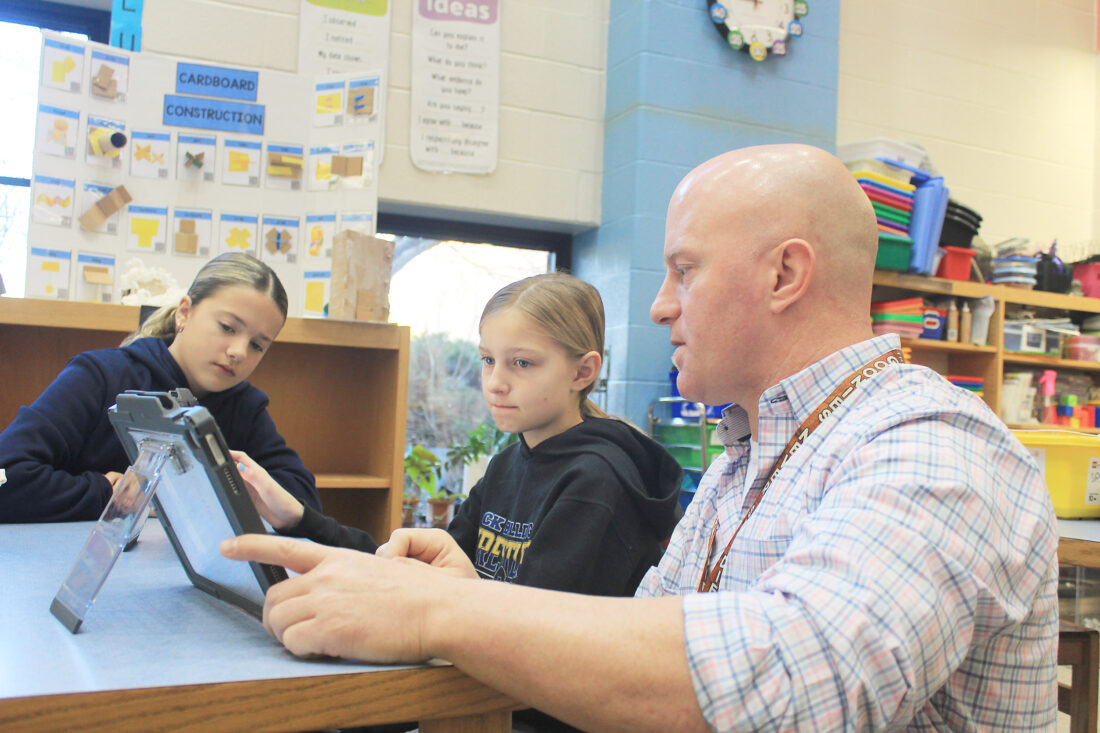
Computer teacher Brandon Ickes (right) reviews computer codes for a LEGO robot with students Paislee Imler and Makeley Freeman. Mirror photo by Colette Costlow
“It’s 21st-century skills,” said elementary Principal Kevin Edmondson, who also started the district’s league last fall.
Working together
For 45 minutes each day, FIRST LEGO League students gather in the STEAM classroom to assemble projects for the competition.
Computer teacher Brandon Ickes said interested students must complete an application and a round of interviews to be considered for the team.
Along with demonstrating good behavior and grades, he said, students are ultimately selected based on specific strengths that can benefit the team.
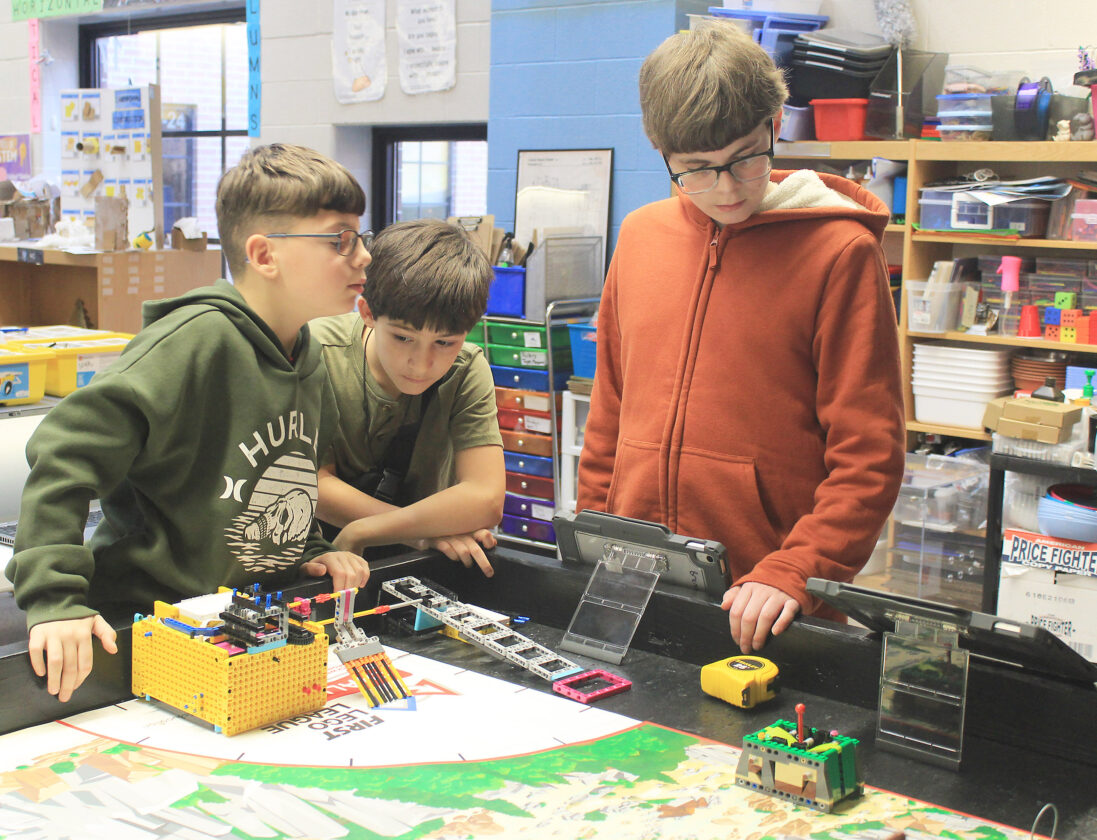
Team captain Gage Morgan works with mission strategist Jaxon Brumbaugh and teammate Brennan Wicker on a robot competing in the FIRST LEGO League competition set for Jan. 31. Mirror photo by Colette Costlow
“You don’t have to get straight As” to be in the club, he said, so he collaborated with Wicker and Edmondson to decide which kids were the “right fit for the group.”
Wicker added that “sometimes, the best kids are always the ones chosen,” so the teachers “wanted to look a little bit past that” while assembling their own LEGO League team, giving overlooked students a fair chance.
One student may exhibit strong drawing skills but shy away from public speaking, while another student might enjoy giving presentations, Edmondson said. “Everyone takes their certain skill set to help get a result,” he said.
Like real-life engineering cooperation, each student in the LEGO League contributes something to the group because “one person doesn’t do every piece,” Wicker said.
To create something, it must pass through multiple hands before its final stage, she said, adding “we see the little pieces built together to create something.”
Computer coding
This year’s competition theme is “unearthed,” with an emphasis on archaeology, encouraging students to solve a problem related to the science, Edmondson said.
At the start of the season, unassembled LEGO pieces are sent in bags, and a student-led team must create their own unique robotic model — equipped with a Bluetooth battery — to complete specific missions on a flat surface.
The Bluetooth battery within the robot responds to computer codes organized on iPad applications, “where engineering, science and math come into play,” he said.
“It’s problem solving, teamwork, collaboration, research,” he added.
Students are starting to see computer codes take action, Ickes said.
Students learn about computer coding in Ickes’ classroom, where he’s seen many students struggle with the concept. After watching code-controlled robots in real life, however, students start to understand it on a deeper level.
Comprehending computer coding gets students more motivated, as they start to see how technology works, he said.
During the competition, each task a robot completes amasses a certain number of points. According to entry type, competitors have five minutes or under to complete as many assignments as they can with pre-designed, student-made computer coding completed before the event.
Because it’s the school’s first LEGO League competition, Ickes said the team’s theory is “easy money,” gathering as many points as they can “with the least amount of struggle.”
Problem solving
Thursday morning, Ickes worked with team captain Gage Morgan, mission strategist Jaxon Brumbaugh and teammate Brennan Wicker, to fine-tune a robot’s mission before their competition.
As a 6th-grade student, Brennan said he loves the LEGO League program because it helps him “think outside of the box.”
When programming a robot or assembling projects at home, he said, “If I do this, then what’s going to happen with this? And one thing could change another dramatically.”
“It’s working on your problem solving, finding the flaws and working on the flaws to make them strengths,” Ickes said.
Brumbaugh, 11, said he has many LEGO sets at home and the program makes him feel more comfortable at school, while giving him more time to learn about computer programming and innovations.
For someone who loves both coding and LEGOS, Morgan, 10, enjoys being a teammate to “see stuff work.”
Building leaders
When teaching first grade a couple of years ago, Wicker remembered that Morgan struggled with confidence. He continued to deal with confidence issues in the fifth grade, but participating in the FIRST LEGO League changed that.
“You saw a kid with confidence today,” Wicker said.
LEGO League students are also applying classroom lessons to the club, Ickes said, learning life skills on an entirely new level.
“It’s not just sitting in a classroom and regurgitating material. It’s actually being applied,” he said.
As for the administration’s perspective, Edmondson said employers are looking for “collaboration, flexibility and problem solvers” in the next generation.
Instead of worrying about colleges or backgrounds, they want employees who can work well with others, he said. And preparation for the future starts at the elementary level and moves its way up.
“We’re trying to build leaders here,” he said. “We’re building ten leaders who are going out into the world and be leaders and innovators.”
Mirror Staff Writer Colette Costlow is at 814-946-7414.
Local News
Logan Township Police officers lauded for quick actions
A trio of Logan Township police officers worked together late last fall to safely deal with a Plank Road motorist ...
Luigi Mangione death penalty trial could start by year’s end
NEW YORK — Luigi Mangione’s federal death penalty trial in the killing of UnitedHealthcare CEO Brian Thompson ...
Meta lines up power supply for AI centers
Meta has cut a trio of deals to power its artificial intelligence data centers, securing enough energy to light up ...
Early typing classes beneficial later on
Push-pull, push-pull, push-pull. Around and around and around. My pencil flew over the paper, trying to comply with ...
Ex-Admiral Peary official charged with felony theft
The former business manager at Admiral Peary Area Professional Technical School has been charged with stealing more ...
