Claysburg-Kimmel assessment scores show continued improvement
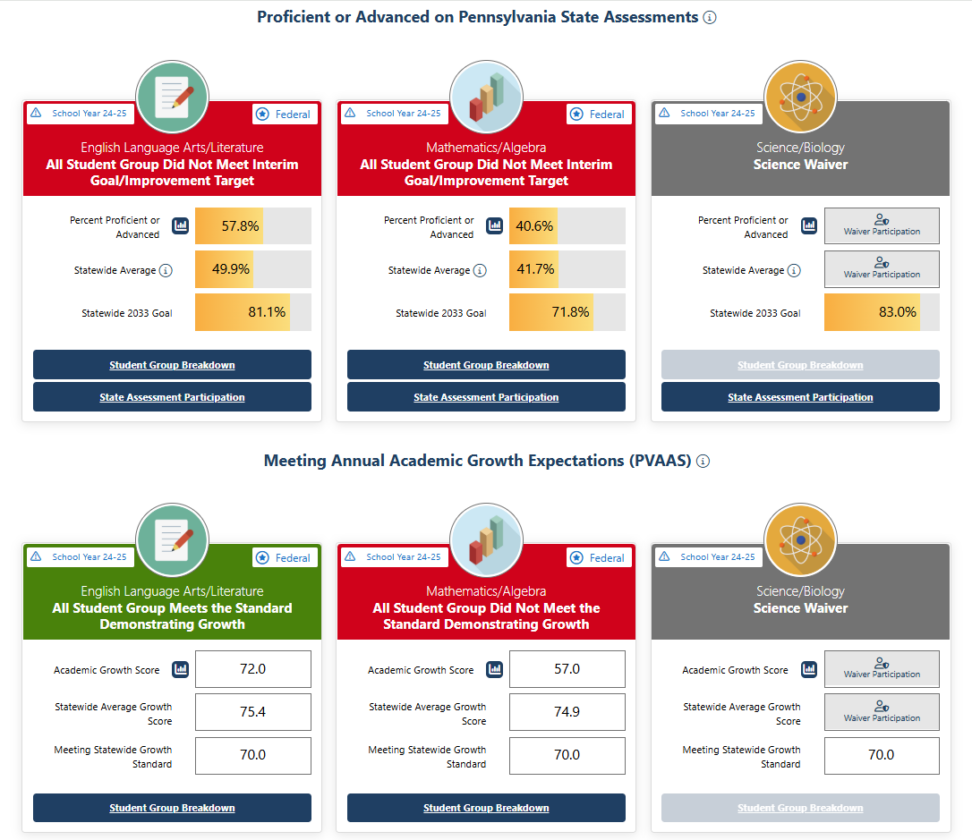
This graphic shows some of the Claysburg-Kimmel Senior High School’s scores for the 2024-25 assessments, which can be found at futurereadypa.org.
Editor’s note: The following, focused on the Claysburg-Kimmel School District, is the third in a series looking into how Blair County schools fared on the state assessment tests. The data for all Pennsylvania schools can be found at futurereadypa.org.
Claysburg-Kimmel School District’s assessment results this year show steady progress in several key areas, such as English Language Arts and elementary science, according to Superintendent Brian Helsel.
“Our growth measures indicate that many students exceeded predicted performance, demonstrating that our interventions and instructional strategies are working,” he said.
According to the state Future Ready index, 715 students are enrolled in the district. Of that number, 67.3% are economically disadvantaged, 19.4% are special education, 3.6% are homeless, 1.5% are gifted and 0.1% are military connected.
Elementary School
At the elementary school, 45.1% of students placed proficient or advanced in the English Language Arts section, 4.8% below the statewide average, while 39.4% of students placed proficient or advanced in the mathematics section, 2.3% below the statewide average.
Assessment results in the biology section were unavailable, showing “waiver participation” in place of unreleased — but tracked — scores.
The district’s youngest learners “showed gains in foundational reading skills,” Helsel said.
Kevin Edmondson, who is currently serving his first year as elementary school principal, said the assessment results are “not quite” where the administration would like them to be, so they are making note of additional data instruction and behavioral academic strategies to implement in the classroom.
To give students online assessment practice, the Pennsylvania Firefly Student Progress Indicators have been introduced to the school to track student progress and identify areas of improvement.
Edmondson also brought flex days to the school this year, which are positive behavioral lessons introduced to students once a week.
When students improve their behavior, then “academics will follow suit,” he said.
He remains focused on showing growth, aspiring to improve by 10% each assessment period.
“Growth looks different for every kid,” he said. “But if they’re showing growth, the achievement will show for itself.”
Junior and senior high schools
At the junior high school, 49.5% of students placed proficient or advanced in the English Language Arts section, which fell 0.4% below the statewide average. They earned an academic growth score of 76, 0.6 of a point above the average.
In mathematics, 31.6% of students placed proficient or advanced, which was 10.1% below the statewide average. They received an academic growth score of 50, falling 24.9 points behind the average.
Assessment results in the biology section were unavailable on the Future Ready website, showing “waiver participation” in place of unreleased — but tracked — scores.
At the senior high school, 57.8% of students placed proficient or advanced in the English Language Arts category, which was 7.9% above the state average.
In the mathematics section, 40.6% placed proficient or advanced, which was 1.1% below the state average.
High school students had an academic growth score of 72 in English, exceeding the statewide standard by two points. Students in the mathematics category had an academic growth score of 57, falling below the statewide average by 13.
Assessment results in the biology section on the Future Ready Index website were unavailable, showing “waiver participation” in place of unreleased — but tracked — scores.
‘Right level of support’
Teachers used systems such as benchmark assessments, curriculum-aligned tools and small-group instruction to “ensure students received the right level of support,” Helsel said.
“Strong collaboration among teachers, specialists and administrators helped ensure that academic and non-academic requirements were met constantly,” he added.
Looking at math scores, Helsel said their primary focus next year is to strengthen math outcomes and standards-aligned instruction in classrooms.
Additionally, he said “one of the most disappointing findings” was that a high percentage of benchmark results showed students at proficient or advanced placements, but it did not carry over to the state’s standardized assessments.
“We are closely examining why this misalignment may be occurring and are partnering directly with the exceptional support team at IU8 to analyze our practices,” he said.
Evaluating graduation rates, Helsel said they “remain strong,” comparing Claysburg-Kimmel’s 98.7% with the statewide average of 90.5%.
The district closely monitors student progress, offering intervention systems, mentoring programs and flexible pathways to help students graduate, he said.
Reviewing the results, Helsel said the district continues to push toward excellence.
“Overall, the data reflect a district committed to continuous improvement through targeted instruction and structured-literacy practices,” he said.
Local News

Close-knit flock: Underhill Farm’s unique sheep yield high-quality yarn
Salvation Army warming center opens again
The Salvation Army is opening its doors to serve as a warming center as temperatures are expected to drop once ...
Death under investigation
An investigation is underway in Cambria County after the body of man was found near the Blair-Cambria county line ...
Central Cambria Middle School receives honor
EBENSBURG — Central Cambria Middle School was recently designated one of the 2025-26 Don Eichhorn Schools: ...
Claysburg-Kimmel assessment scores show continued improvement