Jane Goodall, the celebrated primatologist and conservationist, has died
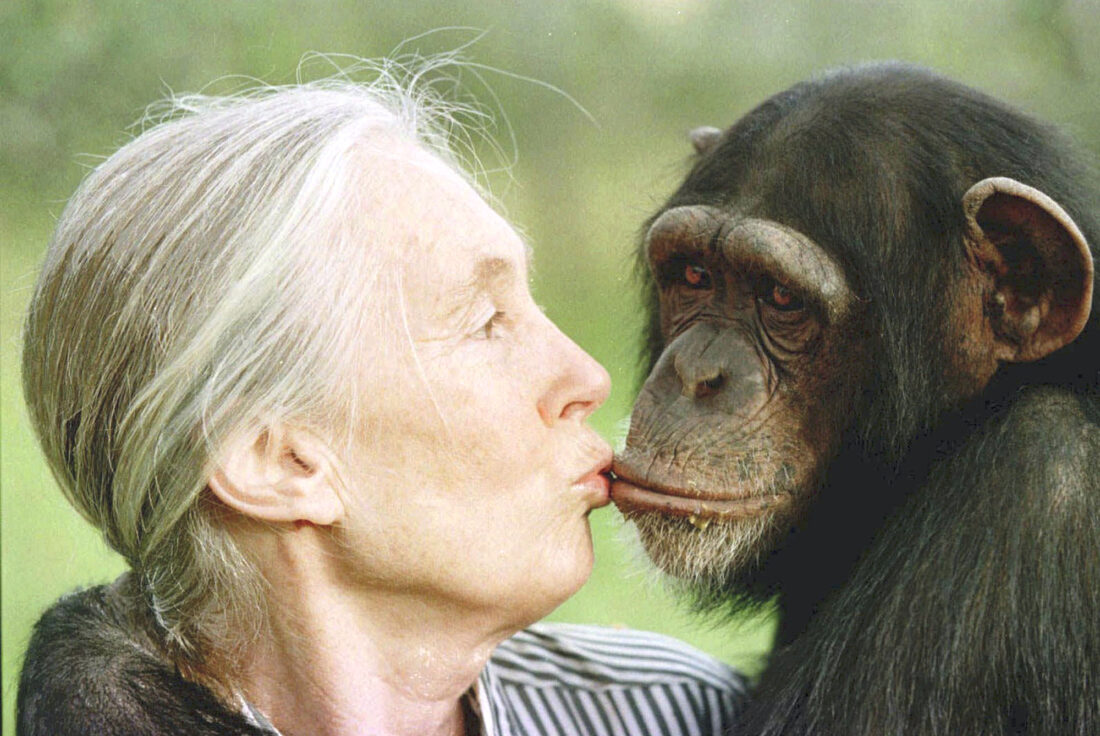
FILE - Jane Goodall kisses Tess, a female chimpanzee, at the Sweetwaters Chimpanzee Sanctuary near Nanyuki, north of Nairobi, on Dec. 6, 1997. (AP Photo/Jean-Marc Bouju, File)
Jane Goodall, the conservationist renowned for her groundbreaking chimpanzee field research and globe-spanning environmental advocacy, has died. She was 91.
The Jane Goodall Institute announced the primatologist’s death Wednesday in an Instagram post. According to the Washington, D.C.-based institute, Goodall died of natural causes while in California on a U.S. speaking tour.
Her discoveries “revolutionized science, and she was a tireless advocate for the protection and restoration of our natural world,” it said.
While living among chimpanzees in Africa decades ago, Goodall documented the animals using tools and doing other activities previously believed to be exclusive to humans, and also noted their distinct personalities. Her observations and subsequent magazine and documentary appearances in the 1960s transformed how the world perceived not only humans’ closest living biological relatives but also the emotional and social complexity of all animals, while propelling her into the public consciousness.
“Out there in nature by myself, when you’re alone, you can become part of nature and your humanity doesn’t get in the way,” she told The Associated Press in 2021. “It’s almost like an out-of-body experience when suddenly you hear different sounds and you smell different smells and you’re actually part of this amazing tapestry of life.”
Goodall never lost hope for the future
She had been scheduled to meet with students and teachers on Wednesday to launch the planting of 5,000 trees around wildfire burn zones in the Los Angeles area. Organizers learned of her death as the event was to begin at EF Academy in Pasadena, said spokesperson Shawna Marino. The first tree was planted in Goodall’s name after a moment of silence.
“I don’t think there’s any better way to honor her legacy than having a thousand children gathered for her,” Marino said.
Goodall in her later years devoted decades to education and advocacy on humanitarian causes and protecting the natural world. In her usual soft-
spoken British accent, she was known for balancing the grim realities of the climate crisis with a sincere message of hope for the future.
From her base in the British coastal town of Bournemouth, she traveled nearly 300 days a year, even after she turned 90, to speak to packed auditoriums. Between more serious messages, her speeches often featured her whooping like a chimpanzee or lamenting that Tarzan chose the wrong Jane.
Tributes from animal rights organizations, political leaders and admirers poured in following news of her death.
“Dr. Jane Goodall was able to convey the lessons of her research to everyone, especially young people. She changed the way we see Great Apes,” said Audrey Azoulay, director-general of UNESCO, the U.N. cultural agency.
Living among the chimpanzees
While first studying chimps in Tanzania in the early 1960s, Goodall was known for her unconventional approach. She didn’t simply observe them from afar but immersed herself in every aspect of their lives. She fed them and gave them names instead of numbers, which some scientists criticized.
Her findings were circulated to millions when she first appeared on the cover of National Geographic in 1963 and then in a popular documentary. A collection of photos of Goodall in the field helped her and even some of the chimps become famous. One iconic image showed her crouching across from the infant chimpanzee named Flint. Each has arms outstretched, reaching for the other.
In 1972, the Sunday Times published an obituary for Flo, Flint’s mother and the dominant matriarch. Flint died soon after showing signs of grief and losing weight.
“What the chimps have taught me over the years is they’re so like us. They’ve blurred the line between humans and animals,” she said in 1997.
Goodall earned top civilian honors from a number of countries. She was awarded the Presidential Medal of Freedom in 2025 by then-U.S. President Joe Biden and won the prestigious Templeton Prize in 2021.
“Her groundbreaking discoveries have changed humanity’s understanding of its role in an interconnected world, and her advocacy has pointed to a greater purpose for our species in caring for life on this planet,” said the Templeton Prize citation, which honors individuals whose life’s work embodies a fusion of science and spirituality.
Her work moved into global advocacy after she watched a disturbing film of experiments on laboratory animals in 1986.
“I knew I had to do something,” she said. “It was payback time.”
When the COVID-19 pandemic hit in 2020 and halted her in-person events, she began podcasting from her childhood home in England. Through dozens of “Jane Goodall Hopecast” episodes, she talked with guests including U.S. Sen. Cory Booker, author Margaret Atwood and marine biologist Ayana Elizabeth Johnson.
“If one wants to reach people; If one wants to change attitudes, you have to reach the heart,” she said during her first episode. “You can reach the heart by telling stories, not by arguing with people’s intellects.”
Local News
Logan Township mourns loss of longtime supervisor Metzgar

Oeschle found guilty of prison assaults

Suspect interviews focus of testimony in homicide trial for South Fork man
Together in prayer
Logan Township planners to consider changes to Cracker Barrel entrance
The Logan Township Planning Commission intends to invite residents of the neighborhood on Goods Lane next to the ...