
Rail artist Craig Thorpe’s work celebrates industry
-
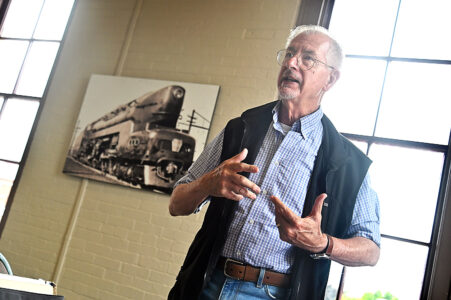
- Rail artist Craig Thorpe discusses art in railroading at the Railroaders Memorial Museum on Monday afternoon. Mirror photo by Patrick Waksmunski
-
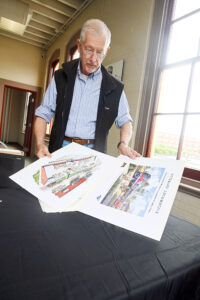
- Rail artist Craig Thorpe spreads out some on his work at the Railroaders Memorial Museum on Monday afternoon. Mirror photo by Patrick Waksmunski
-
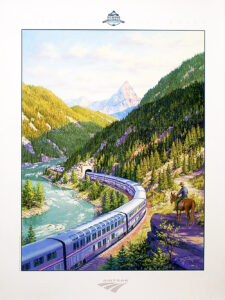
- Guardians of the Legacy by Craig Thorpe depicts a train emerging from a tunnel at Glacier National Park. Courtesy photo
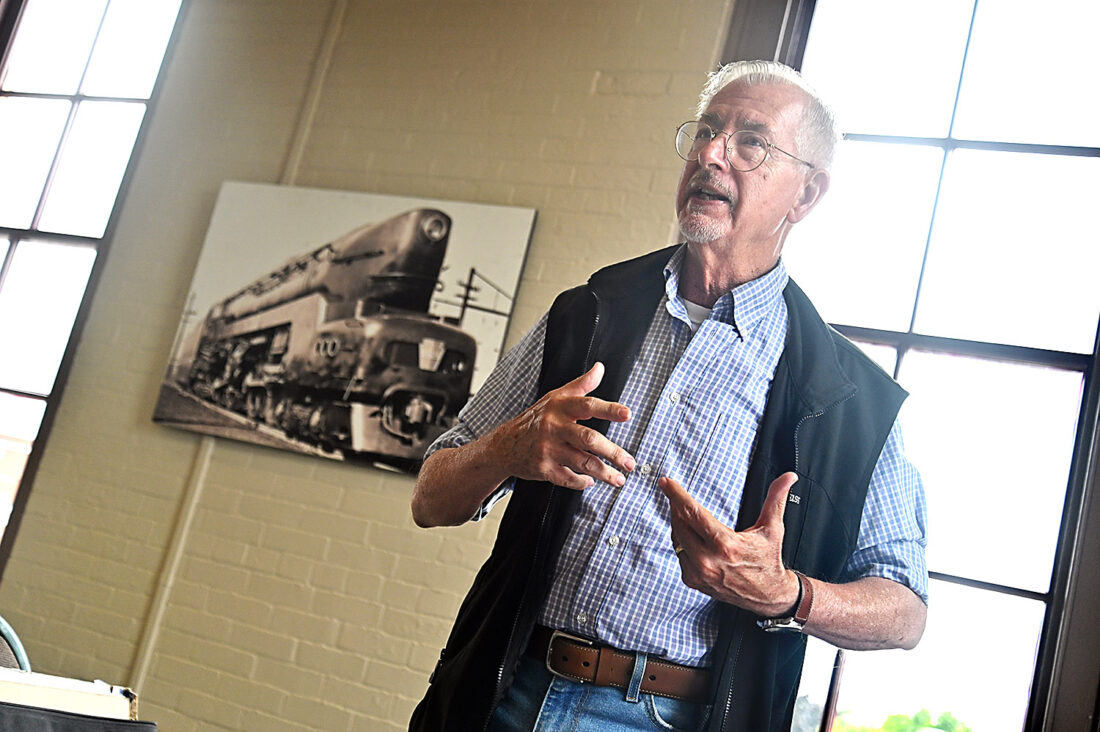
Rail artist Craig Thorpe discusses art in railroading at the Railroaders Memorial Museum on Monday afternoon. Mirror photo by Patrick Waksmunski
During an interview at the Railroaders Memorial Museum this week, nationally known railroad artist Craig Thorpe recalled seeing an auto ad that showed a Porsche against a background of swirling colors, designed to show how fast the car was traveling.
That ad is wholly antithetical to the kind of art that he creates for clients like Amtrak in the style of famed Pennsylvania Railroad calendar artist Grif Teller, said Thorpe, a Pittsburgh native living in Seattle who has been traveling through Pennsylvania during the latter half of August to reconnect with familiar rail sites and old friends.
The subtext of the Porsche ad is individuality, isolation, speed and universality of location — as in nowhere in particular, according to Thorpe, who spoke on the top floor of the rail museum, in the former PRR Master Mechanics building, overlooking the former PRR mainline tracks — now owned by Norfolk Southern.
By contrast, the subtext of Thorpe’s painting of a steam locomotive pulling passenger cars up to a loading dock in Altoona, with a PRR shop building in the background and a porter with a handcart and two overall-clad workers, plus a youngster — for a museum poster honoring PRR workers — shows community, connectedness, settledness and a highly particular sense of location, Thorpe said.
There aren’t many people doing his kind of work, but it’s timeless in the sense that it seeks to celebrate and connect railroading’s past, present and future, according to Thorpe’s friend Dan Cupper of Harrisburg, former conductor and engineer for Norfolk Southern and currently editor of Railroad History, a biannual journal of the Railway and Locomotive Historical Society.
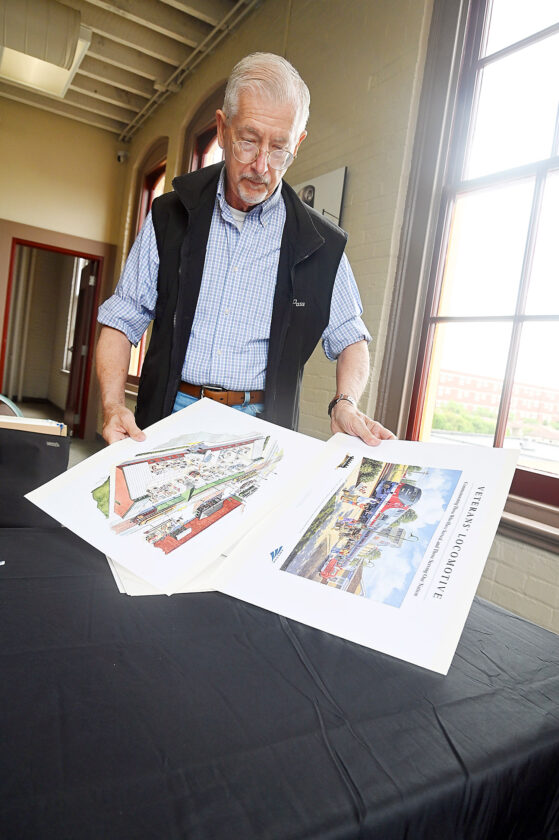
Rail artist Craig Thorpe spreads out some on his work at the Railroaders Memorial Museum on Monday afternoon. Mirror photo by Patrick Waksmunski
Railroads are special, according to both men.
Interstate highways slash across the landscape, cutting through mountains, bridging valleys.
Railroad tracks move sinuously and intimately through the terrain.
Airplanes streak across the landscape at 30,000 feet, and at hundreds of miles an hour, with passengers ensconced in a narrow shell that can make it impossible to see what’s below — and cramped in a way that discourages one from getting up and moving around — or even communicating with fellow passengers.
Trains, though, slide through the landscape at a civilized speed that enables passengers to connect emotionally with the houses, factories, farms, cars and waterways they see, and it’s easy to get up and move around — and not as daunting to interact with fellow passengers.
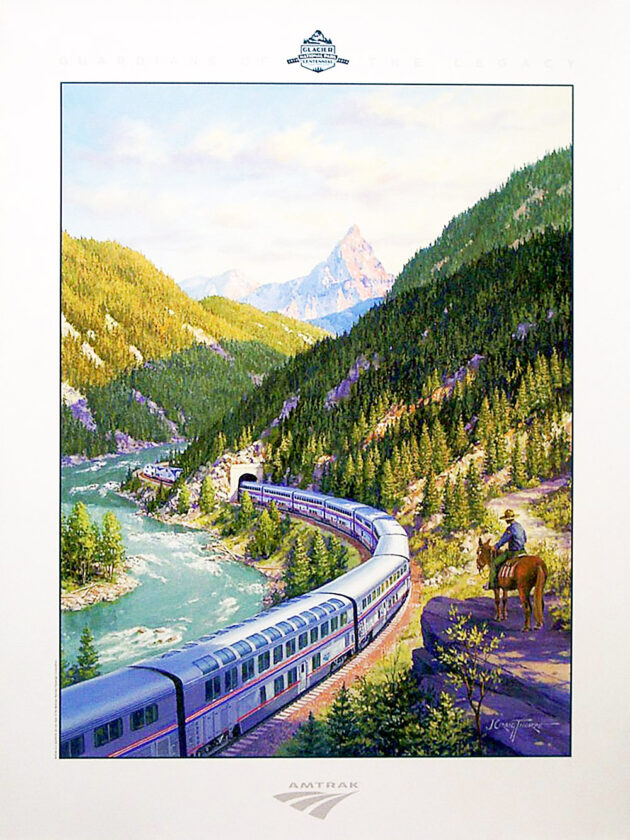
Guardians of the Legacy by Craig Thorpe depicts a train emerging from a tunnel at Glacier National Park. Courtesy photo
In a plane, the potential destinations are flyovers.
In a train, with their online but formerly printed timetables, there are towns with evocative names and histories — Philadelphia, Ardmore, Paoli, Exton, Lancaster, Elizabethtown, Harrisburg, Lewistown, Huntingdon, Tyrone, Altoona, Johnstown, Latrobe, Greensburg and Pittsburgh — and in between, places like Spruce Creek, Bellwood, Cresson and Gallitzin.
Unfortunately, the culture nowadays is more attuned to the auto and the airplane, according to Thorpe.
It “blows by” those places listed on the old PRR timetables, he said.
He finds that to be regrettable.
In a high school near his current home are sculptures of common facilities like benches that are represented as broken, along with a plaque bearing the phrase, “There’s no history here.”
That “stopped me cold in my tracks,” Thorpe said.
It’s not his kind of art.
He respects the artists who created the scene, and wouldn’t mind discussing aesthetics with them, but he questions “the thought and the values” that motivated it.
Thorpe became infatuated with trains as a kid.
A family friend worked for the PRR and gave them the annual calendars that the railroad produced, with images painted by Teller.
Those images are highly romantic — conveying industrial-level power, but in the homey context of the cities and small towns that the railroad’s main line pushed through.
One such image on the cover of Cupper’s “Crossroads of Commerce: The Pennsylvania Railroad Calendar Art of Griff Teller” shows a diesel engine pulling passenger cars next to a steam engine, both heading west on the mainline through Marysville, Perry County, west of Harrisburg, with a coal hopper heading in the opposite direction and a street cutting under the tracks to the left, with two houses and a 1930s auto parked in front them, along with a hill on the right with the top of a barn peeking over the slope; a forested, larger hill in the background.
The image is based on a pre-World War II scene photographed and studied by Teller, then used by him for the PRR’s 1947 calendar, Cupper said.
It was images like those by Teller that fired Thorpe’s imagination.
As an artist himself, Thorpe tries for a similar effect.
Before a lecture he once gave out west, a woman was struck by an image he showed of rail cars painted with the orange, brown and gold of the old Illinois Central from Chicago.
She told him a story about growing up in Memphis in a family that lacked the money for train trips.
To make up for it, her father took her once to the Memphis train station to see the City of New
Orleans (immortalized in a song written by Steve Goodman and sung by Arlo Guthrie) during a layover.
They toured the train — the coaches, lounge car, dining car, sleeping cars.
Being a teenager, the girl had rolled her eyes in anticipation of being bored.
But her father told her that that train wouldn’t be around much longer.
Now, looking at Thorpe’s pictures, contemplating that time years ago, she was full of emotion, Thorpe said.
It’s validating and humbling when people are inspired by his paintings — even sometimes to the point of booking rides on Amtrak, he said.
Painting and drawing is not simply equivalent to photography, he said.
Being more “allusive,” it can include referential elements strategically placed to draw people in, he said.
He showed a print of a painting of a train emerging from a tunnel at Glacier National Park.
It showed a bald, triangular peak dominating the background, between two forested mountains.
That peak is in the park, but from that perspective, in real life, it is out of sight behind one of those forested mountains, he said.
He moved it into the scene, though, to help him make his artistic statement, taking advantage of his chosen medium’s freedom — the freedom not to make the representation of scenes strictly literal, he said.
Mirror Staff Writer William Kibler is at 814-949-7038.
Local News
Uphill battle

Roadwork: Reservoir Road work begins
Senate boosts penalties for illegal trucking schools
The state Senate approved legislation Wednesday stiffening the penalties for illegal trucking schools but only ...

As gas hits $4.64, drivers ‘stressed and struggling’

A good mom is treasured for a lifetime
Blair County Commissioners mull ways to cut inmate population
HOLLIDAYSBURG — Some Blair County inmates may soon have the option of being released if they’re willing to ...