
PSU railroad program picking up steam
State Transportation Committee hearing discusses region’s effect on Pa. economy
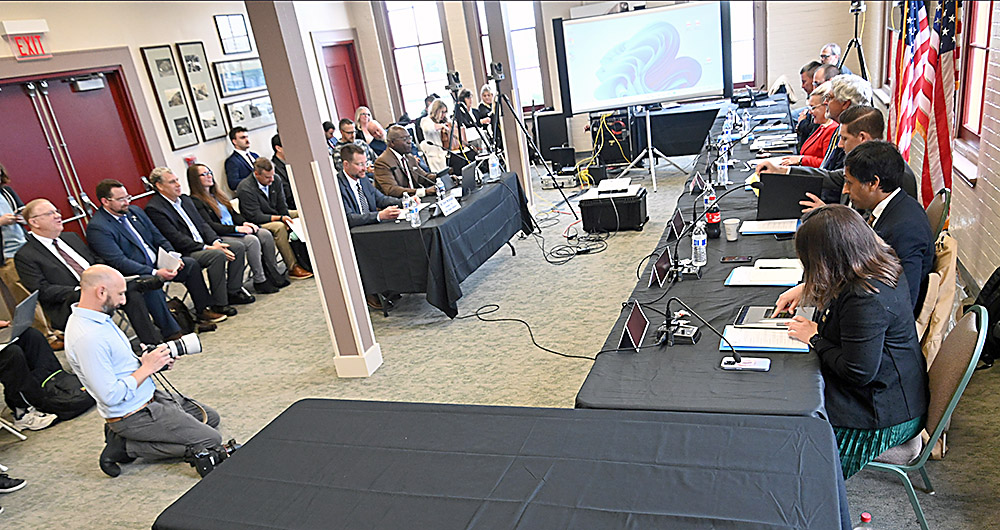
The Pennsylvania Senate Transportation Committee held its meeting at the Railroaders Memorial Museum in Altoona on Wednesday afternoon. Mirror photo by Patrick Waksmunski
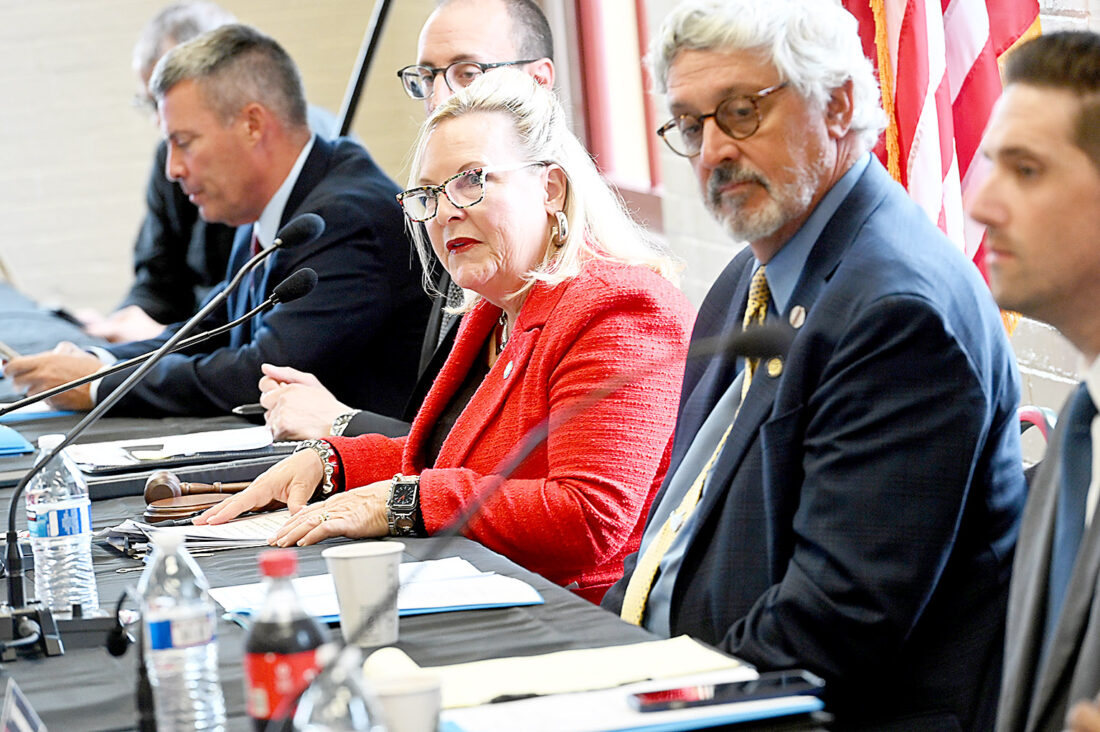
State Sen. Judy Ward, R-30th District, and state Sen. Tim Kearney, D-26th District, (right) preside over the Pennsylvania Senate Transportation Committee meeting at the Railroaders Memorial Museum in Altoona on Wednesday afternoon. Mirror photo by Patrick Waksmunski
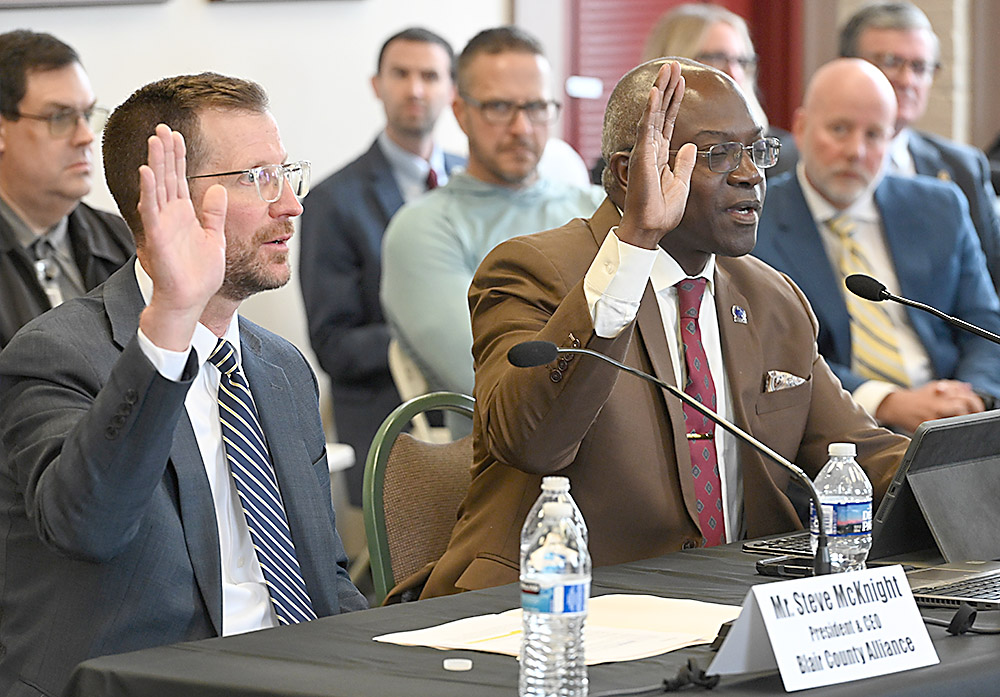
Blair County Alliance president and CEO Steve McKnight (left) Penn State Altoona Chancellor and Dean Dr. Ron Darbeau are sworn in during the Pennsylvania Senate Transportation Committee meeting on Wednesday. Mirror photo by Patrick Waksmunski
The Pennsylvania Senate Transportation Committee held its meeting at the Railroaders Memorial Museum in Altoona on Wednesday afternoon. Mirror photo by Patrick Waksmunski
State Sen. Judy Ward, R-30th District, and state Sen. Tim Kearney, D-26th District, (right) preside over the Pennsylvania Senate Transportation Committee meeting at the Railroaders Memorial Museum in Altoona on Wednesday afternoon. Mirror photo by Patrick Waksmunski
Blair County Alliance president and CEO Steve McKnight (left) Penn State Altoona Chancellor and Dean Dr. Ron Darbeau are sworn in during the Pennsylvania Senate Transportation Committee meeting on Wednesday. Mirror photo by Patrick Waksmunski
Trending
Penn State has been in the news recently with plans to shrink the number of its Commonwealth Campuses, but a program in one of the campuses slated to survive is on track to grow, according to testimony at a State Senate Transportation Committee hearing in Altoona on Thursday.
The Rail Transportation Engineering Program at Penn State Altoona graduates between eight and 11 students a year, but there's sufficient demand in the rail industry for many more, according to campus Chancellor Ron Darbeau.
Baby boomers are retiring at the rate of 180,000 per week in the U.S., and there is a skills gap that is large and expanding, including in the rail industry, Darbeau told the committee, chaired by state Sen. Judy Ward, R-Altoona.
He grows almost embarrassed when he talks with rail industry representatives who praise the quality of the program's graduates and demand more of the same, Darbeau said.
"If we could graduate 100 students a year, they would find opportunities," he said. "I'd like to see (the graduation numbers) move up significantly."
The program collaborates with the Railroaders Memorial Museum, where Thursday's hearing was held, Darbeau said.
The museum houses a locomotive donated by Norfolk Southern that the program uses as an educational tool, he said.
The collaboration is growing: the college plans to move the entire program "lock, stock and barrel" from its current main location in the Penn Building downtown to the museum, Darbeau said.
That effort will include building out the roundhouse and creating teaching labs and conference rooms.
The college and museum plan also to create a "hub" at the museum to educate students K-12 -- and also adults -- as a tool for industry workforce development, according to Darbeau.
The college is trying to recruit more students to the program using a strategy suggested by a focus group composed of program students, who suggested ads designed to reach kids who visit rail museums and kids who read rail magazines in place of a prior generalized approach in the "high school ecosystem,"
Darbeau said.
"It was like a light flash," he added about the suggestions.
Program officials further found that in a high percentage of cases, kids attracted to the program had "rail in their blood," as a result of parents, grandparents, cousins or others they knew who had worked in the industry, Darbeau said.
One mother of a student told college officials that her son was a rail fan since the time he would clutch a little red locomotive in his crib, Darbeau said.
Once kids enter the program and "rub shoulders" with people in it, they're often "hooked," he said.
The program began in 2012 with two students, and has produced 71 graduates so far -- with more than 90% remaining in the rail industry long term,
Darbeau said.
The college helps ensure that the students graduate with practical knowledge through internships that are served all over the country, with assignments ranging from short lines to Class A operations -- along with equipment manufacturers.
Students "get a feel" for what's required by the industry, which is in a "resurgence," even as it's losing workers who are aging out, he said.
That helps to ensure their "stickiness" with the industry, he said.
When asked by the committee why students choose to attend Penn State Altoona, Darbeau said "We are exceptionally good at what we do."
During the hearing, nearly a dozen speakers touched on a variety of transportation issues and how that affects economic development.
In addition to Darbeau, Steve McKnight, president and CEO of Blair County Alliance, addressed the committee, highlighting the history of Altoona and how the Horseshoe Curve led to industrial commerce and that in turn led to today's interstate system.
To carry not only the county's but the region's economy forward, McKnight said maintenance is important.
"We have to ensure our existing infrastructure is maintained," he said, noting the bridges and secondary roads are of great concern due to their age.
In addition, enhancing and creative corridors for "active transportation" is important, he said. Walking and biking are important, not only for recreation but for the health of the community.
McKnight noted what he called a "complete streets" plan and the need to make sure safety features and lighting can accommodate many types of active transportation.
When asked about the economic impact Blair County has on the state, McKnight said the county is a "critical player in the state's economy."
"We have a very resilient economy ... we don't have one concentrated sector, we try to attract and build upon that," he said.
In addition, Blair County "has a large number of family businesses ... which means all the corporate headquarters are here," McKnight said. "It's great to have homegrown businesses driving your local economy. ... It creates a lasting impact."
On a large scale, McKnight said Blair County is a regional economy, connected to Centre, Huntingdon and Bedford counties, and beyond, due to the area's extensive transportation network.
Tommy Nagle, vice president of the Pennsylvania Farm Bureau; Margaret Clark, manager of Government Affairs-Northeast, Amtrak; and Tracy Plessinger, airport manager at the Altoona-Blair County Airport, also spoke before the committee.
Rural infrastructure has been a key focus of Ward and the Senate Transportation Committee this session, as the committee looks to put a spotlight on the transportation issues that specifically affect rural Pennsylvania.
"Infrastructure is the backbone of our economy," Ward said. "Businesses depend on having a reliable and safe transportation network to move their goods to market. This hearing was an excellent opportunity to hear from stakeholders in transportation and economic development on how we can promote growth in rural Pennsylvania through efficient and effective infrastructure."
Mirror Staff Writer William Kibler is at 814-949-7038.