
Hidden report reveals Norfolk Southern crash illnesses
Workers got sick while cleaning up Ohio derailment
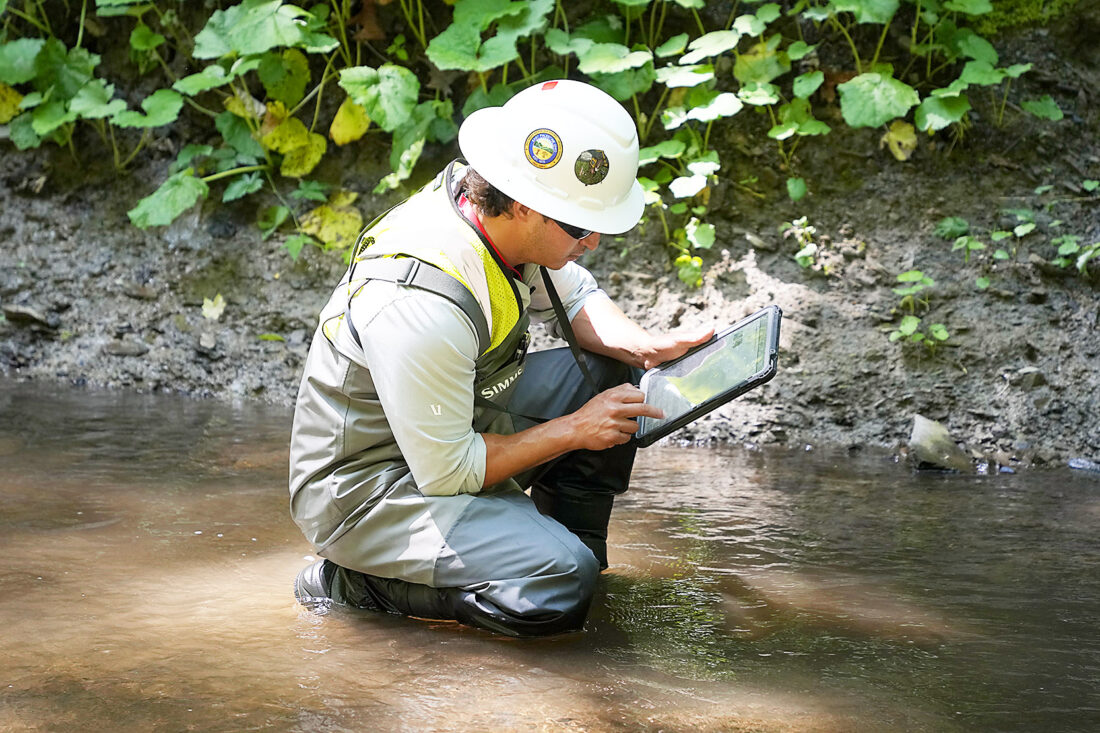
A Environmental Protection Agency worker works in Leslie Run in East Palestine, Ohio, on June 12, 2024. A hidden report obtained by The Associated Press has revealed how workers got sick while cleaning up Ohio derailment site. The Associated Press
The creeks around East Palestine, Ohio, were so badly contaminated by last year’s disastrous Norfolk Southern derailment that some workers became sick during the cleanup.
Workers who reported headaches and nausea — while shooting compressed air into the creek bed, which releases chemicals from the sediment and water — were sent back to their hotels to rest, according to a report obtained by The Associated Press about their illnesses.
The findings were not released to the public last spring, despite residents’ concerns about the potential health effects of exposure to the long list of chemicals that spilled and burned after the disaster. The workers’ symptoms, as described in the report, are consistent with what Centers for Disease Control and Prevention workers going door-to-door in town had reported shortly after the Feb. 3, 2023, derailment.
Since then some residents have also reported unexplained rashes, asthma and other respiratory problems, and serious diseases including male breast cancer.
Researchers are still determining how many of those health problems can be linked to the derailment and how the disaster will impact the long-term health of residents in the area near the Ohio-Pennsylvania border. Many wonder whether there will be cancer clusters down the road, which of course won’t be clear for years.
In the meantime, residents have until Aug. 22 to decide whether to accept up to $25,000 — as part of a $600 million class action settlement with the railroad to compensate them for any future health problems. Accepting that money though means giving up the right to sue later, when the cost of health care coverage and specific treatments needed will become more clear.
Norfolk Southern spokesperson Heather Garcia said none of the workers who got sick during the cleanup “reported lingering or long-term symptoms.”
“The health and safety of our employees, contractors, and the community has been paramount throughout the recovery in East Palestine,” Garcia said.
The creek cleanup work continued, but nearly three weeks later, another worker got sick. This time, it was halted altogether. While there’ve been other cleanup projects since then, they’ve stopped using high-pressure air knife tools.
Independent toxicologist George Thompson who has been following the aftermath of the Ohio wreck said the cleanup contractors, overseen by the Environmental Protection Agency, should have known the work they were doing would release chemicals from the sediment into the air and water. In fact, that is what CTEH was monitoring while the project was underway. And with one of the main streams, Sulphur Run, going directly through town and in culverts under homes and offices, Thompson said those chemicals could have infiltrated buildings.
“You’re just spreading out the chemicals for exposure,” Thompson said. “And I just think that it was not an informed decision to use air knifing at all.”
Resident Jami Wallace said she lost her voice for two weeks after she got too close to one of the air knifing machines, which was placed near her driveway. She said when the machine was turned on, it felt like being hit by an invisible wall emitting a sweet chemical smell much like when the train derailed.
The report from CTEH was submitted to Unified Command, the group overseeing disaster response — which included federal, state and local officials along with Norfolk Southern — but no one released it despite significant public interest. CTEH’s principal toxicologist Paul Nony confirmed the report was given to the command center, and officials there were alerted about the illnesses.
When CDC workers got sick — also with headaches and nausea — it generated headlines nationwide.
East Palestine resident Misti Allison said not enough is being done to monitor long-term health effects on the community, and this report substantiates their health concerns. She said this report should have never been kept from the public.
“It’s absolutely egregious, and that shouldn’t happen. I think that any type of information like that — just like when the CDC workers came to the area and got sick — that should be disclosed instead of diminished,” Allison said. “Especially when it comes to human health, nothing should be swept under the rug.”
Local News
‘Point of beginning’: Seven Ranges survey changed the country

Hollidaysburg grad awarded prestigious internship

Fun for all: Miracle League of Blair County celebrates 20th season with Saturday opener, Loco visit
Weak dollar making life more expensive
NEW YORK — A hidden force is quietly pushing up costs for everything from your summer vacation to your weekly ...
Tech giants get a blue-collar ally in battle for data centers
Bill to increase fines for illegal trucking schools advances
Senate Republicans are advancing legislation to crack down on so-called CDL mills by increasing the penalty for ...