
Sharing the warmth: Leaders reflect on winter warming center
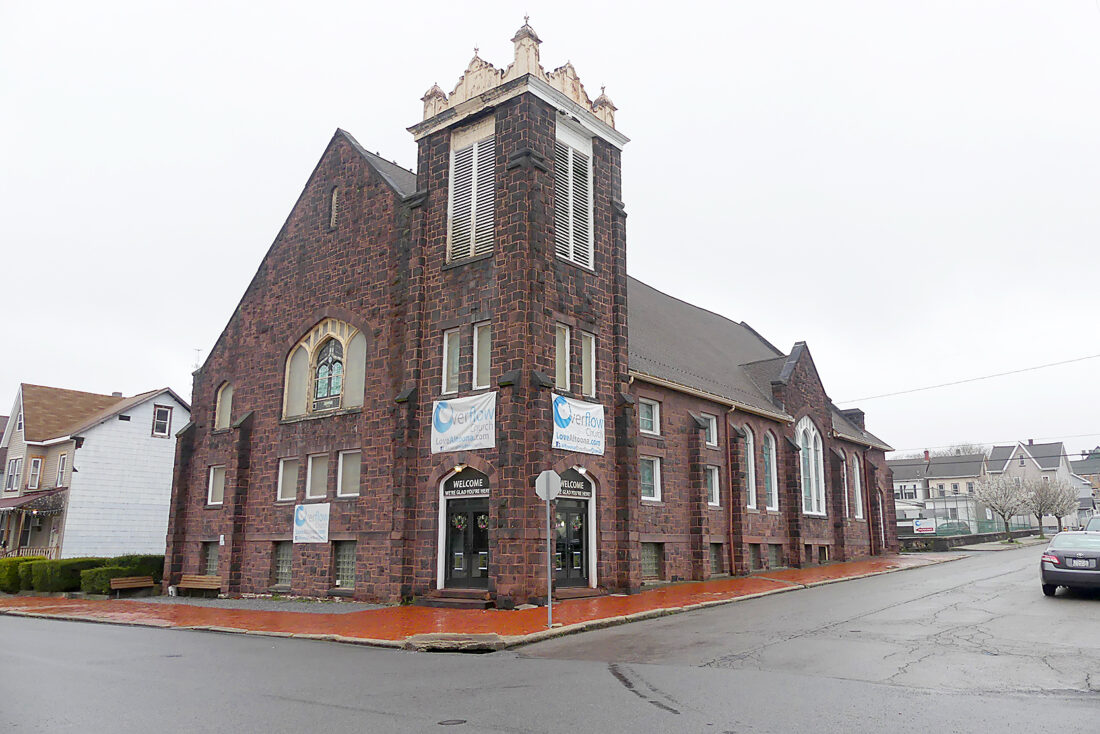
More than 200 people came together to create a warming center for the city at Overflow Church, 127 Fifth Ave. Mirror photo by William Kibler
When asked recently why he felt compelled to recruit local church people to help staff a proposed warming center over the winter in Altoona, Kevin Dellape of Overflow Church recalled a conversation a year and a half ago with a homeless man on Sixth Avenue, after Dellape asked where the man spent his nights.
Behind the Cathedral of the Blessed Sacrament, because if he slept next to a church, God might see him and help him, the man said, according to Dellape.
“I felt there was something wrong with churches being locked and dark on cold winter nights with homeless people sleeping outside,” Dellape explained, during a wrapup discussion with other local officials on completion of the warming center’s first season.
As many as 200 people were involved in the effort to create the center at Overflow Church, according to Amy Marten-Shanafelt, executive director of Blair Health Choices, which contracts with the state to administer behavioral health managed care for recipients of Medicaid.
The list of contributing organizations and the kinds of contributions they made occupy a full sheet of paper, double spaced, provided by Dellape, director of Backyard Ministries.
They include religious groups, city and county departments, a state agency, local human service agencies, nonprofit charities, businesses and medical organizations.
“It took a massive coalition,” Dellape said.
The vision that underlies the effort came from Sonny Consiglio, executive director of the Society of St. Vincent de Paul Council of Altoona-Johnstown, he said.
For the last couple years, as co-leader of a group called Hope for the Homeless, Consiglio pushed for something more sustainable than spending $10,000 a month to put up homeless people in motels, Dellape said.
In his post with St. Vincent de Paul, Consiglio was familiar with helping people pay utility bills to get through a rough patch in their household economy.
“But when you don’t even have a house,” he said, explaining why he felt drawn to the cause.
Consiglio’s fellow co-leader Brian Durbin brought Consiglio’s vision forward, City Councilman Dave Ellis brought in the city fire department, Marten-Shanafelt and former Blair County Community Action Program Executive Director Christine Zernick got the human service agencies involved, while Pam Townsend of the Hope Drop In Center kept the group apprised of her clientele’s individual needs and tribulations, officials said.
The members of the group were uncomfortable with inaction, Durbin said.
He also wasn’t comfortable with the response of some community members to the tents set up by some homeless people on vacant ground in the industrial area near the Seventh Street Bridge.
People would ask, “What are you going to do about those tents,” Durbin said.
“What do you mean?” he would say to them. “Step into the conversation. Don’t just sit back and criticize.”
The initial plan was to imitate a State College program that used a rotation of churches and their staffs to provide shelter for a week or two at a time.
But that fell through, as the recruitment of churches faltered.
Dellape was recruited to improve connections with those faith-based groups.
There were hopes for setting up a center for the winter of 2022-23, but they fizzled.
When Dellape finally could say the faith-based groups were ready, it was a “thank-God” moment for Durbin.
Still, it was almost too late for the most recent winter.
But when asked in November whether his church would be available, Overflow Pastor Richard Cox didn’t hesitate, according to Dellape.
“(So) we went all in,” Dellape said.
Once the shelter opened, information about its existence spread by word of mouth within the homeless community, as expected, Marten-Shanafelt said.
Not everyone always agreed on everything, but everyone respected everyone else’s opinions and they all would reach a broad consensus as they moved ahead step-by-step, Altoona Fire Chief Adam Free said.
It was critical that so many participated, because “we all have our limitations,” and there were aspects that some people were unable or unwilling to do — but that others could manage — so it all eventually got done, Dellape said.
“All together, (the group) created a beautiful thing,” he said.
“Amen,” Durbin said.
Program provided direction
Of the 91 guests who used the warming center, about 75 were able to access some other form of shelter following their stays, Dellape said.
The center provided a “short-term transition to better options,” he said.
“That’s success in my book,” Durbin said.
Some guests graduated to the city’s family shelter, some were able to obtain enough income to go to a motel, some went for treatment, including rehabilitation, and some went back to their home counties, Dellape said.
The staff at the shelter gathered information from them about their situations and tried to figure out how best to help them by connecting them with housing programs, the Social Security Administration, find apartments, move into those apartments, get identification cards or get into treatment, Durbin said.
“Whatever it took to get them to the next step,” Durbin said.
The program provided the guests direction, according to Ellis.
The group took some ideas for the center operation from a warming center leaders had visited in Williamsport, but expanded the concept to include the supportive efforts, officials said.
Representatives from 10 social service agencies took turns through the week at the shelter, which was open every night.
Before the guests entered each evening, agency staff would talk with them and take stock of their situations, in case any might be in mental health crisis, under the influence or in danger of overdosing.
A couple of the prospective guests were taken to detox.
With some prospective guests, staff would make plans to reconnect the following day.
Once inside, guests would interact with volunteers, who would get to know them and review what might have been said before they entered the church.
Not all homeless people fit the stereotype, as some have cars, some have jobs, some get Social Security or Social Security disability, according to Arlene Kuntz, administrative assistant at the Fire Department.
All the guests had an opportunity to speak with at least one staff member every night, Dellape said, adding there were lots of good conversations.
That enabled guests to share what they were going through, learn about potentially helpful resources and have the chance simply “to be heard,” he said.
Some volunteers prayed with the guests.
Most guests were receptive to interaction and welcomed help, Marten-Shanafelt said, noting all had unique stories to tell.
For some who embrace the wandering lifestyle and don’t think of homelessness as a problem, the shelter at least provided a night or nights in the warmth, Dellape said.
For agency employees who worked with homeless people during the day under pressure of “billable time,” the evening connections were a balm, including for workers in danger of burnout, according to Marten-Shanafelt.
The conversations allowed those agency employees to “be completely present” for as long as necessary with the guests, she said. They also allowed the employees to “reset and remember why they (came to such) work in the first place,” Marten-Shanafelt said.
Finding housing challenging
Mental health issues and substance use issues were among common contributors to the homelessness of those guests, officials said.
So was the difficulty of finding affordable housing quickly for those who’d been evicted or otherwise found themselves out of a home, Dellape said.
Finding affordable housing is especially hard in this area for single people under 55 and not on disability assistance, he said.
There are few public housing units available for those, so the private market may be the only option, and in general, it’s just too expensive, Dellape said.
Even those who get disability assistance can find it hard to get affordable housing, Marten-Shanafelt said.
There is actually a shortage of quality apartments in this area at all price levels, Durbin said.
The group worked hard to ensure that the neighborhood around the church remained safe, not only for the neighborhood residents, but for the guests at the center and for the staff there, officials said.
The group asked that the guests not loiter in the neighborhood upon the shelter’s closing in the mornings — a request with which the guests were “incredibly compliant,” Dellape said.
As an incentive, the group arranged for breakfast to be served every morning at the Catholic Charities offices next to the Cathedral, with food prepared by Greenbean Coffee House.
One thing that helped ensure there wasn’t friction with the neighborhood surrounding Overflow was the presence of homeless people there already, along with the membership of homeless people among the Overflow congregation, according to officials.
No major altercations or other incidents occurred at the center, according to Dellape. Just “minor speed bumps,” Free said.
The group hasn’t totaled up the cost of the effort, although it was surely low, compared to the cost of motels, Free said.
The expenses were mainly for utilities and security.
The agency and municipal employees who participated worked on their own time, while members of the faith-based community who came were volunteers,
Dellape said.
The church didn’t charge for use of its facilities, Dellape said.
There were lots of donations of supplies, according to Durbin.
The cost might have been about $10 per guest per night, Marten-Shanafelt guessed.
The group will evaluate what transpired to see if there needs to be any changes for next year, Free said.
Other initiatives
The experience of operating the shelter helped the group understand the overall homelessness situation better, so it can do a better job crafting additional housing solutions, Durbin said.
“We needed a baseline,” he said. “This is our baseline.”
Creating more housing options for people in need will involve establishing relationships with landlords, housing authorities and municipalities, discussing how best to deal with people who come out of rehab and getting access to funding, according to Durbin.
“It won’t happen overnight,” he said.
The next step would be creation of a low-barrier shelter, according to Durbin.
There isn’t even a plan for that yet, although it may end up involving a public-private partnership, he said.
It was both sobering and satisfying to see the guests sleeping safe and warm inside the church on nights when they would otherwise have had no place to go or no one to take them in — at least no one they were willing to ask, according to Marten-Shanafelt and Dellape.
“God brought this group of people together,” Dellape said. “We couldn’t have accomplished it on our own.”
Mirror Staff Writer William Kibler is at 814-949-7038.
Local News

Man charged in attempted assassination of Trump

Altoona Area School Board weighs tax increases

Cross hatch
Cross hatch
Altoona Area School Board weighs tax increases
The Altoona Area School Board will consider two proposed budgets — both with a tax increase — in a couple weeks ...
Man charged in attempted assassination of Trump
WASHINGTON — The man who authorities say tried to storm the White House Correspondents’ Association dinner with ...