
Logan crew does Newburg stream work; needs permit
Trending
A crew from the Logan Township Highway Department recently shored up an embankment on Dry Gap Run next to Washington Avenue in Newburg to protect the road from being undermined during storms.
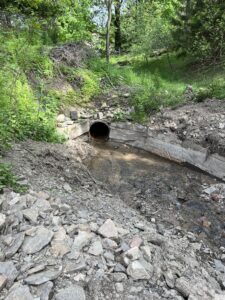
Using an excavator, workers also installed a pair of upstream rock barriers designed to dissipate water velocity, while clearing out a nearly choked culvert pipe that receives the Dry Gap Run just downstream from the farm property on which the road-protection work was done.
The farm residents are pleased because, as a side benefit, the work may help protect their house foundation, but the township should have obtained a permit before starting the work, according to Blair County Conservation District Manager Donna Fisher.
The township's highway foreman last week alerted Fisher to the work having been done, which led to a site visit this week and an arrangement under which Fisher will mediate between the township and the state Department of Environmental Protection to obtain a permit for the work after-the-fact, according to Fisher and township Highway Foreman Jim Hoffner.
The township probably could have obtained an emergency permit for the road protection work from DEP before starting, Fisher said.
Normally, in such cases, after performing the work, the permittee seeks a regular permit for what was done, Fisher said.
It's uncertain whether the township would have been able to do all that it did in the stream under such an emergency permit, however, Fisher said.
The project appears to have stabilized the embankment next to the road, according to Fisher.
The cut bank on the other side, however, is "pretty barren, and will probably continue to erode," she said.
To help prevent that, she has encouraged the township to apply seed mulch to the dirt, she said.
The property owner may help with that, according to Hoffner.
There may be an issue with the rock velocity dissipators, if they could interfere with aquatic life, although given the semi-urban nature of the stream in that area, water quality may not be high, and there may not be much aquatic life, Fisher said.
There are ways to build energy dissipators that don't interfere with aquatic life, she said.
The bank stabilization work next to the road and the removal of the gravel bar that was obstructing the downstream culvert probably will require a "General Permit No. 3," Fisher said.
The energy dissipators may require a different kind of permit, she said.
The stream channel itself may need to be stabilized, Fisher said.
"Whatever DEP decides," she said.
Fisher expects to ask DEP to send a representative to look at the site, which she hopes will result in a "meeting of the minds with the appropriate parties."
Residents had been complaining about "nothing being done," so the township took action, Hoffner said.
The township obtained permission from the property owner before going onto the farm ground for the project, Hoffner said.
Workers deposited material extracted from in front of the culvert pipe against the embankment adjacent to the farmhouse, which should offer some protection for the house foundation, said Jessica Dessert, who lives at the farm.
Workers spent four days on the project, ending May 11, according to Supervisors Chairman Jim Patterson.
"We were just trying to correct a problem," Patterson said, referring to the threat to the road.
That threat might have been avoided had he not been outvoted about accepting federal help for a flood protection project in the area offered in 1996 under direction of then-U.S. Rep. Bud Shuster, Patterson said.
PennDOT plans to replace culverts that carry Dry Gap Run under Route 36 in two places just upstream from the farm in two years, with culverts that are less steeply sloped than the existing ones and that contain velocity reduction barriers.
Such work presumably could help reduce erosion at the farm.
An online DEP booklet outlines three types of stream work as "Green Light--Go," "Yellow Light--Slow Down," and "Red Light--Stop."
Among work listed under green: removing material like litter and construction debris from streams; removing woody debris like trees, logs or brush while standing in streams; removing woody debris with heavy equipment, while that equipment remains on the bank, provided the equipment doesn't dig into the streambed.
Among work listed under yellow, which probably requires DEP notification, verbal pre-approval, an emergency permit or some other kinds of permit: streambank stabilization; armoring streambanks with riprap in emergencies; removing gravel bars with heavy equipment.
Among work listed under red that definitely requires a permit, or may not be allowed at all: redirecting streamflow by reshaping gravel bars or moving gravel to the streambank; armoring streambanks with concrete, construction debris or other impervious materials; relocating, dredging, diking or damming a stream or building a new bridge or culvert.
Mirror Staff Writer William Kibler is at 814-949-7038.