
City adds police dogs to force
Pair of black Lab littermates trained to sniff out drugs
Trending
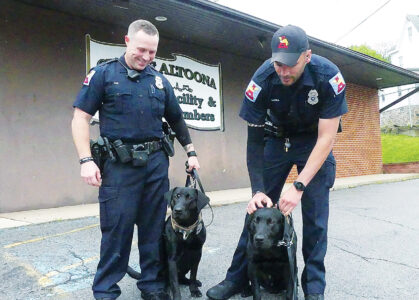
If it's better to show than tell, Tuesday's news conference introducing the Altoona Police Department's first K9 officers since the 1990s was successful.
Canines Blue and Pongo are floppy-eared drug-sniffers and people trackers so attendees were free to pet them and fuss over them, and the dogs responded in kind.
Their main jobs will be finding hidden drugs and locating missing persons, but the black Lab littermates will also be ambassadors at community events, schools and around town, to reinforce the department's efforts at community policing and to help kids to see police as friendly, rather than threatening, according to Sgt. Matt Plummer and Police Chief Joe Merrill.
"Community relations is the cherry on top," Merrill said.
Positive contacts with law enforcement at a young age can be a significant determinant of a person's future, including people who otherwise would have experienced only "negative" police interactions -- sometimes in their childhood homes, according to Plummer.
When the department hires new officers, it often hears from applicants that their desire to join the force stems from officers having visited their schools when they were kids, Plummer said.
"You realize that it impacted them" at a critical time in their development, he said.
With "substantial" but undisclosed financial support from Operation Our Town, the city has been working on the K9 project for about a year, according to Merrill.
OOT bought the dogs, paid for the training and for the "inserts" in their handlers' vehicles and for food, grooming and veterinary visits, said OOT board member Ron McConnell.
Former city officer and state Attorney General's agent Jim Walstrom's Keystone K9 and Security trained the animals and their handlers -- Stephen Fox for Blue and Ben Rivera for Pongo.
After obtaining Blue and Pongo from a West Virginia kennel, Walstrom "imprinted" them with the scent of drugs -- cocaine and its derivatives, heroin, meth and ecstasy, Walstrom said.
He then trained the handlers, who will need to be committed to their roles full-time, as the dogs live with them, Walstrom said.
The teams were certified after three months with a test requiring them to find all the drugs secreted in four of six cars, rooms, packages and lockers, Walstrom said.
Restarting the K9 program was one of Merrill's goals from the time he took the job following the retirement of Janice Freehling, Merrill said.
"We have a young, energetic department," he said. "(Officers) are constantly looking for ways to better themselves."
The dogs are tools to help achieve that, especially in their ability to detect drugs, as the animals can establish probable cause to make arrests at interactions like traffic stops, Merrill said.
Officers can bring the K9s out if the officers get "some indication (that there are drugs) based on their training and experience," Merrill said.
Two busts since operations began a week ago have netted 1,200 packets of heroin, more than 2 ounces of meth and various amounts of carfentanil, fentanyl and xylazine, Merrill said.
Floppy eared dogs like Labs are bred to hunt, and the training of Blue and Pongo directed that instinct toward hunting drugs, Walstrom said.
Pointy eared dogs like German shepherds can also sniff drugs, as well as doing "patrol work" to settle down people inclined to mischief, he said.
The pointy eared dogs thus have a "dual purpose," giving "more bang for the buck," Walstrom said.
But they're not suitable for going into schools, as they could get startled and bite, according to Merrill and Plummer.
Moreover, the floppy eared ones, being more specialized, are probably better at drug sniffing, Merrill said.
In addition to the drug sniffing, the department can use them to find people who wander off, due to conditions like dementia and autism, Merrill said.
Having the K9 teams will eliminate the need to borrow dogs from other agencies, when there's a need for people-tracking, he said. Instead, Altoona can be a provider of such services for neighboring departments.
Rivera is a native of Wichita, Kansas, and an Air Force veteran who's been on the local force for two years.
"I grew up with dogs," he said. "I love dogs."
Dogs are "like a friend you can always have beside you," Rivera said. "Someone you can hang out with when no one else (is available)."
He lives with his girlfriend and a pet husky.
Fox is an native Altoonan who has been "fond of dogs since I was little."
Working as a K9 handler is something he always wanted to do, and when the opportunity arose, "I jumped on it," he said.
He lives with his wife and two children, plus three German shepherds.
The dogs all get along.
Sometimes Blue thinks he's one of the German shepherds, Fox said.
The city has budgeted $35,600 this year for K9 team maintenance. Sylvan Veterinary Hospital of Hollidaysburg will provide care for the dogs.
Mirror Staff Writer William Kibler is at 814-949-7038.