
Rivals turned allies
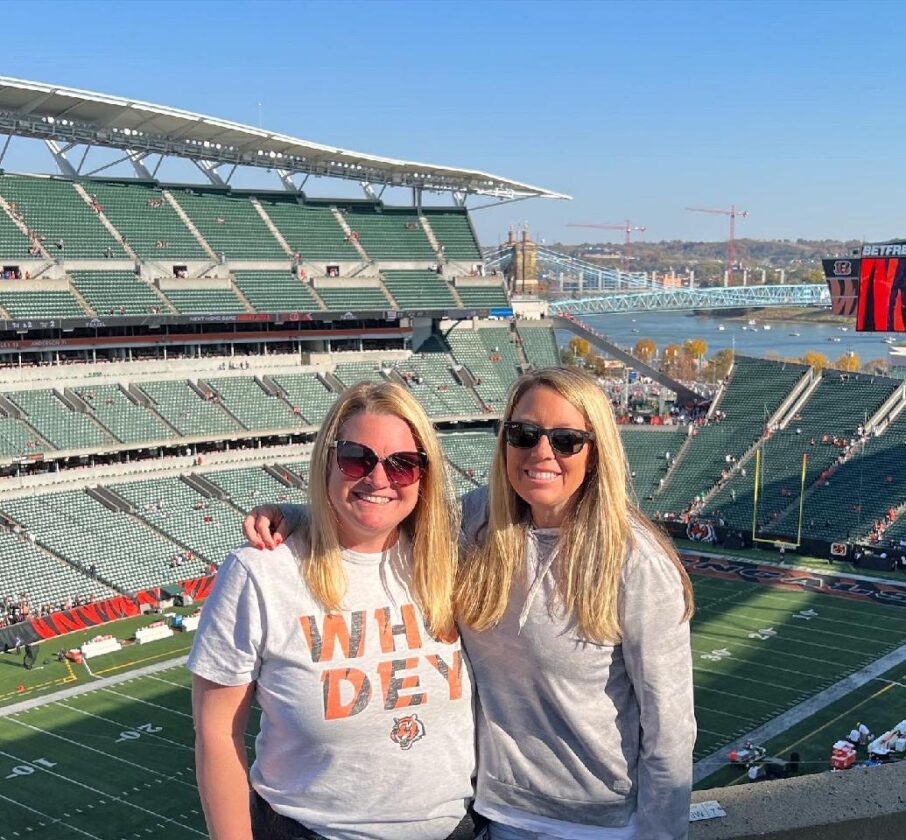
Courtesy photo / Jennifer Sloss (left) and Amanda Williams pose two months post-surgery at a Steelers/Bengals game. Never agreeing on football, Sloss is a Bengals fan while Williams roots for the Steelers.
-
- Courtesy photo / Jennifer Sloss (left) and Amanda Williams pose two months post-surgery at a Steelers/Bengals game. Never agreeing on football, Sloss is a Bengals fan while Williams roots for the Steelers.
-
- Courtesy photo / Jennifer Sloss (left) and Amanda Williams pose outside the Ohio Medical Center in Penn State and Ohio State gear before heading in for surgery.
That was the case for Ohio native Amanda Williams when, at 20, she was diagnosed with lupus while attending classes at Ohio State.
A chronic, autoimmune disease that occurs when a person’s immune system attacks itself, lupus can affect many parts of the body, according to the Centers for Disease Control and Prevention. For Williams, now 42, it resulted in chronic kidney disease.
“There were times when it was extremely difficult,” Williams said. “When I was diagnosed, I was told to drop out of college and move home for help, but I found a doctor at Ohio State who ran a lupus nephritis clinic.”
Williams always knew she would need a kidney transplant, but the clinic and medication helped manage her symptoms for a time.
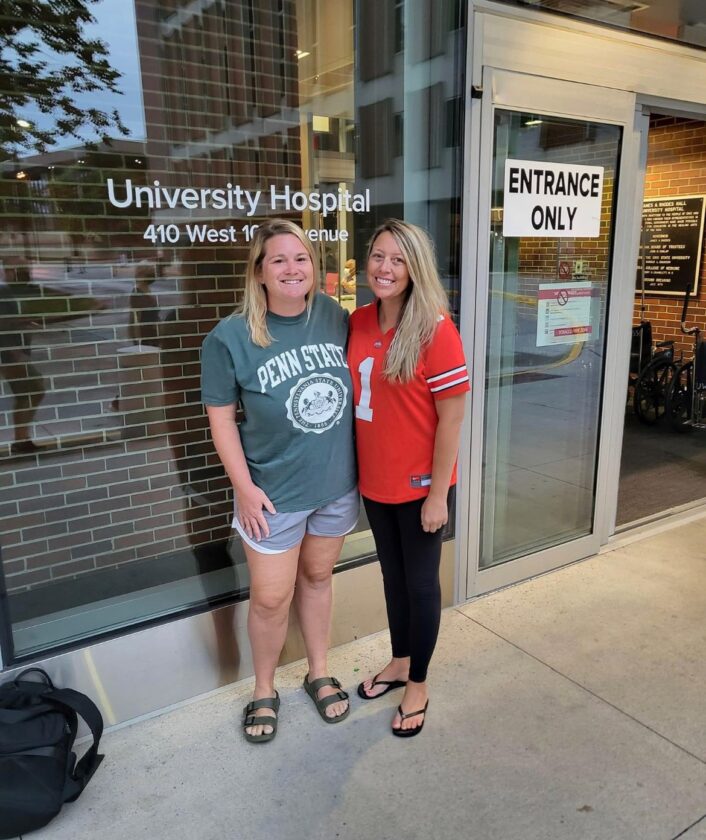
Courtesy photo / Jennifer Sloss (left) and Amanda Williams pose outside the Ohio Medical Center in Penn State and Ohio State gear before heading in for surgery.
“There were times when I forgot I was sick at all,” Williams said. “There were times when it was extremely painful — I lost a pregnancy and was told I couldn’t have kids after my son was born.”
Then in August 2021, Williams learned that her kidney function had dropped to a critical 13% and that she needed to start meeting with the transplant center to get on their registry.
Finding a donor
Williams met Tyrone native and Penn State alumna Jennifer Sloss, 39, in 2006 through a wedding planning website that had a different message board for every month. Once married, a group of about 15 women transferred to the website’s married version and then on to Facebook.
When it came time to start looking for a donor, Williams had to undergo blood and tissue type testing to determine if she would be approved for a transplant. She received her confirmation after about six months and began her search soon after, she said.
One of the great things about her Facebook wedding group is that it’s private, Williams said, and that she could share things there before going public.
“It’s a trusted group of friends,” Williams said. “I shared the news there privately first, and Jen was the first person to reach out. She said she wanted to be checked.”
According to the National Kidney Foundation, there are about 100,000 people waiting for kidney transplants with a new person being added to the list every 14 minutes. The average wait time for a kidney is about four years.
Sloss said the decision to get checked was easy.
“I thought you know, if I can help her, why not help her?” Sloss said. “I preach to my kids to be good and be kind. It was the right thing to do.”
Williams “kind of laughed” when she said she could help, Sloss said, adding that there is a lot that goes into finding a match.
“I think there was a part of me that said, ‘There’s no way she’ll be a match,'” Williams said. “How could a person who lives in another state, with no physical connection be a match?”
‘They thought we were sisters’
First was blood testing, then cheek swabs and tissue matching.
With the cheek swab, they knew Sloss was a candidate within 10 days, she said. At one point, Williams had other candidates, but they all ended up backing out.
That was in March, and Sloss was scheduled to go to Ohio in May for additional testing, she said.
“It was incredibly difficult for me to ask anyone to be checked, and it took me a long time to put it out there,” Williams said. “I kept my health issues very private. That part was the hardest part of the process — accepting that someone was going to put themselves through surgery to help with my own life is something you can’t put into words.”
Although the May trip would be the first time the pair met physically, Williams said they had always had a connection.
“We watched each other’s children grow up,” Williams said. “Because of what was going on with me and my health, it was very surreal, but like I knew her already.”
Sloss and Williams both underwent more testing. Then, an Ohio State board reviewed their case to see if they were healthy enough to undergo the surgery.
“They actually said everything about us was so similar they thought we were sisters,” Sloss said.
Williams said that one of the nurses told her “it was something they had never seen before” and that Sloss was a “near perfect match, which is highly unusual.”
‘She has a little piece of a Penn Stater’
The surgery was set for the end of July, Sloss said.
In the days leading up to the surgery, Sloss enjoyed the company of Williams and her family, going out to dinner and then going to the hospital together — with Sloss in a Penn State shirt and Williams in an Ohio State shirt.
“We said our final goodbyes,” Williams said. “There’s no other word than surreal when you’re having a surgery like that — you think about all the things that could go wrong. For me, I only accepted it was happening the moment I was in the operating room.”
Post-surgery, Williams kidney function went from 12% to 90%. She had been “very close to having to have dialysis,” Sloss said.
“The doctor actually told me my kidney was beautiful, as soon it connected to her it started producing urine,” Sloss said.
They stayed in the hospital for three nights and then had to be within two miles of the hospital for an additional 16 days, Sloss said. As she wouldn’t be able to travel back to Pennsylvania, Sloss stayed with Williams and her family.
“I joked from the very beginning since she has a little piece of a Penn Stater, she has to root for PSU a little bit,” Sloss said, laughing.
Road to recovery
Sloss and Williams both described their recoveries as tough, taking about six to eight weeks to start feeling normal. The magnitude of the surgery and the size and location of the incision made it especially difficult to move and recover, Williams said.
With little to no energy, Williams’ parents as well as her dad’s girlfriend took care of them, while friends set up a meal train, Sloss said.
“Most of the time until she could go home, we were recovering here, together at home,” Williams said.
Heavily immunocompromised, Williams said she had to have blood work done twice a week, take her vitals three times a day and couldn’t lift anything heavier than a gallon of milk.
“I’ve had a lot of things I’ve had to do and that I’m not allowed to do and once I get through that, I feel I can breathe a bit easier,” Williams said.
Throughout the process, the pair had a great support system, including their children and Sloss’ husband.
“He thought I was a little nutty, but he knows it was something I wanted to do,” Sloss said. “How do you know you’re a match to someone and say ‘no I can’t help you.'”
‘No one was talking me out of it’
Sloss has no regrets when it comes to her decision to give a kidney to Williams.
“It was a really weird feeling, I’ve never felt that sure of something,” Sloss said. “I thought ‘I’m going to be able to help her, I just feel it.’ No one was going to talk me out of it.”
In September, they reunited for a weekend to take their kids to the Steelers/Bengals game — with Sloss being a Bengals fan and Williams rooting for the Steelers.
“We don’t see eye to eye in the football world,” Sloss said, laughing.
Williams said she will always be grateful to the Ohio State Medical Center for her care and “keeping me alive for almost 22 years” as well as Sloss’ selfless actions.
“There will never be enough ways to thank Jen for the gift of life she’s given me,” Williams said. “She’s given me several years of life to share with my son and watch him grow up and watch him in a way that I have my energy back. I don’t feel like a sick person. I’ll be a regular mom, not someone who’s at home all the time.”
Mirror Staff Writer Rachel Foor is at 814-946-7458.
Local News
NS profit falls 27% for first quarter
Norfolk Southern railroad’s first-quarter profit fell 27% because it didn’t collect big insurance payments ...

Shooting suspect critical of Trump
Guardian of history: Newcomer historian breathes life into Altoona’s railroad past
Guardian of history: Newcomer historian breathes life into Altoona’s railroad past
Norfolk Southern profit falls 27% for first quarter
Norfolk Southern railroad’s first-quarter profit fell 27% because it didn’t collect big insurance payments ...