
State sees uptick in tick-borne diseases
Trending
Area residents are being urged to be on the lookout for disease-spreading ticks as Pennsylvania is experiencing a high prevalence of the tiny insects.
According to a news release, the Department of Environmental Protection this summer collected twice as many blacklegged tick nymphs as they did last year.
With that increase in ticks comes an increase in tick bites and tick-borne diseases.
"The increase in nymphs really drives home the message that we all need to adhere to the necessary precautions to stay safe from ticks," DEP Secretary Patrick McDonnell said.
Tick nymphs are extremely small, about the size of a poppy seed, and often hard to spot.
"It's those nymph ticks that often are spreading the disease because they are so tiny, they are difficult to detect and therefore stay attached longer and have a better chance of transmitting the disease," said Amber Altiero, a registered nurse and the regional leader of the Altoona Area Lyme Disease Support Group.
Altiero, who suffers from Lyme disease and Bartonella, said that people don't realize how common tick-borne diseases are.
"It can be very difficult," Altiero said. "It is different for everyone because the symptoms I experience might be different than what someone with persistent Lyme disease has."
She experiences chronic, body-wide pain and stiffness as well as neuropathy, she said.
Altiero warned that Pennsylvanians should also be on the lookout for American dog ticks and Lone Star ticks.
"There's a lot of different kinds of ticks that we need to be concerned with," she said. "It's a myth that if you don't get bitten by a deer tick, then you don't have to worry."
According to DEP director of communications Neil Shader, there's really no way to predict how tick populations will react in a given year.
"There are many environmental factors that can contribute to the tick populations, including temperature, humidity, rainfall and the availability of hosts," Shader said.
As certain species of ticks continue to expand their range in Pennsylvania, Shader said that could lead to increased risk to public health.
Shader referenced the 2021 Climate Impacts Assessment that states Pennsylvania already experiences the most Lyme disease cases in the country as a result of increased winter temperatures and the westward expansion of tick populations that carry Lyme disease.
Blacklegged ticks, also known as deer ticks, are the most common carrier of Lyme disease, anaplasmosis and Powassan virus, according to a news release.
While ticks typically thrive in tall grass, brush and wooded areas, deer ticks have been found in every county in the commonwealth and can live in any habitat.
"This year in particular, we are seeing increases in the number of Lyme disease reports across the state, and clinicians are reporting that they are seeing more cases of other tick-borne diseases, such as anaplasmosis," said Dr. Denise Johnson, Pennsylvania acting physician general.
According to a Wolf administration press release, common signs of a tick disease include fever, headache, chills and muscle aches. Lyme disease is often characterized by a bullseye-like rash, although Lyme disease may not always present itself with this obvious sign.
Additional symptoms for Powassan virus may include vomiting, weakness, confusion, loss of coordination, difficulty speaking or even seizures in severe cases.
While transmission for Lyme disease from tick to human takes approximately 24 hours or more, Powassan transmission from a tick bite can happen in as little as 15 minutes.
To reduce the chance of being bitten by a tick, area residents are urged to cover exposed skin with lightweight and light-colored clothing, avoid tick-infested habitats such as areas dense with shrubbery or tall grass, use an EPA-approved insect repellent, immediately check yourself and others for ticks upon returning home, take a shower to remove ticks that may be crawling on your skin, and, if possible, dry clothing and gear in a dryer to kill any ticks.
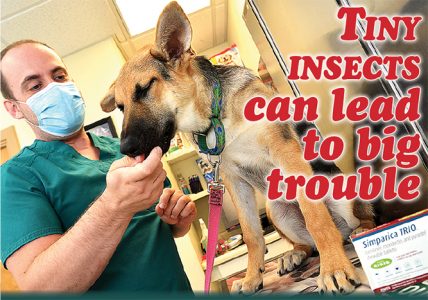
Tick bites and tick-borne diseases can also affect pets. Josh Nearhoof, a veterinarian technician with the Blair Animal Hospital, said that the hospital does see a lot of Lyme and anaplasmosis cases in the animals being brought in.
Nearhoof recommends checking pets for ticks after hikes or after being outdoors, using a year-round tick preventative, and vaccinating pets against Lyme disease.
He also cautioned that certain generic tick preventative products "don't work as well as name brand products like Seresto collars or oral preventatives."
Mirror Staff Writer Rachel Foor is at 814-946-7458.