
Hollidaysburg borough dealing with dam problem
Plan is to create running waterway
Trending
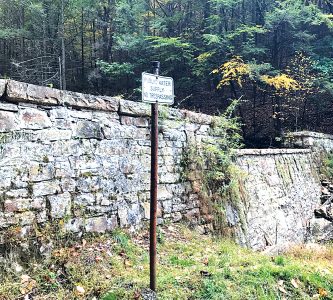
Down on a gravel road on Brush Mountain, a dam is wasting away.
Weeds poke through the black cracks in its stone. Moss crawls along the facade. After years of holding back mountain cascades, it's losing a battle against time and the elements.
Rick Pope, Hollidaysburg public works director, stood atop the structure and gazed into the dry quarry, littered with dead trees and leaves.
"A lot of our guys would come here to swim when they were younger," he said. "When they got older, they'd catch people swimming and skinny dipping up here."
Pope admitted there's no benefit to having the dam now. During a September borough authority meeting, he told members that the structure went unmanaged for more than a quarter century, and the amount to repair it now could be in the hundreds of thousands of dollars.
As such, the borough has opted to return it to nature.
Three months ago, Pope's team drained the 350,000-gallon quarry. The task now is to rebuild the eroded grounds around the dam, turning it into a running waterway that fosters aquatic life. American Rivers will take on this project.
American Rivers' mission is to "protect wild rivers, restore damaged rivers and conserve clean water for people and nature." In 2019, it worked in 39 states to restore 286 miles of river and protect 1,800 miles more, according to its website.
The organization's western Pennsylvania field office has been working with the Hollidaysburg Borough since 2010. Director of River Restoration Lisa Hollingsworth-Segedy said this will be the organization's third local dam removal.
"A couple of years ago I was leading a tour, showing a few groups how we had taken these two areas and put them back to regenerating themselves," she said. According to Hollingsworth-Segedy, the next project began when Pope turned to her and said, "You know, we have another dam."
A new trout stream
Pope pointed down into the quarry to a lone fish in the small pond hugging the stone.
"That white koi fish has been there since before I started this job in 2001," he said. On the other side of the dam runs a dry rock bed connecting to a shallow stream that eventually meets Brush Creek. On neither side were brook trout, Pennsylvania's official state fish.
Jerry Green, president of the local chapter of Trout Unlimited, said dams not only block native trout migration, they heat the water and lower dissolved oxygen content, all of which are bad for the species.
Hollingsworth-Segedy said restoring waterways like the one on Brush Mountain helps bring back brook trout that need fast-flowing, deep, clear water. She called them a "species of greatest conservation need."
"Brook trout are sort of like the 'canary in the coal mine,'" Hollingsworth-Segedy said.
"They only live in the coldest, cleanest streams."
This species is as important ecologically as it is economically, according to both.
"People don't realize what the outdoor industry brings into Pennsylvania," Green said. "We're fortunate in Blair County to have year-round trout streams."
Yet, Green said brook trout populations in the eastern United States have been decimated by a variety of human factors, including impaired waterways. Their struggle to survive is part of a larger problem: American Rivers say 40% of North America's freshwater species are at risk of extinction.
Breaking down the dam is removing "obsolete infrastructure" that isn't threatening anyone's safety or well-being but is blocking another stream for brook trout, Hollingsworth-Segedy said.
"We don't take out dams just because they're old," she said. "We focus on rivers and streams that benefit most from having those dams removed."
Future fishermen may encounter a "No Trespassing" sign leading to the dam, but Pope said he doesn't stop or discourage people from visiting.
The road ahead
Hollingsworth-Segedy has been with American Rivers since 1992. She said she has worked on 150 dam removal projects around the state, with a few in West Virginia and Georgia,
For Hollingsworth-Segedy, these projects are about revitalizing natural assets and reconnecting them with small towns and rural communities. This, she said, improves quality of life.
"We want somebody to go to this site and say, "There was a dam here once, but I'm not sure I can tell,"" she said.
To achieve that on Brush Mountain, her team would start by hauling excavation equipment down the narrow road that leads to the structure.
They would use an excavator to break the joints of the dam and remove the concrete and stonemasonry. While one machine is dismantling the dam, a smaller excavator or loader would shovel rubbish out of the dried quarry.
After the wall is dismantled, the team would crush the concrete into pieces using a hydraulic hammer, then place those bits in the riverbed to be covered with dirt and plants. Hollingsworth-Segedy said the stonemasonry from the dam is still in good shape and would be preserved for the borough to use on another site if needed.
To restore the riverbed, the team has to reshape the eroded impoundment. They would take the litter of dead trees and lay them as guides for the new water route. Some trees will be removed, Hollingsworth-Segedy said, but done "surgically" -- the more trees, the faster the site rehabilitates. Some trees will be replanted.
The dam removal design for the Brush Mountain project is already complete, and the state Department of Environmental Protection Division of Dam Safety has OK'd the removal. Hollingsworth-Segedy said they plan to remove the dam next summer or fall. Right now, the organization is working to get funding.
The two prior dams American Streams worked on with the Hollidaysburg Borough were the Klatter Dam built in the 1920s and an earthen dam whose origins are unknown but likely used for milling operations. Both dams blocked unnamed tributaries to the Frankstown Branch of the Juniata River.
American Rivers says its goal is to remove 400 hazardous and outdated dams and restore 10,000 miles of rivers and 1,000 acres of floodplains.
Mirror Staff Writer Dom Cuzzolina is at 946-7428.