
Tech comes to fire stations
Putting out fires remains dangerous, but new devices help
Trending
While the building that houses it was built in 1927, the latest Altoona Fire Department truck is as modern as it gets.
Engine 351 is a sophisticated platform ladder truck specially built to fit into the tight confines of Station 1 on Washington Avenue and uses the latest technologies to help the city's firefighters do more in less time.
Altoona Fire Department Chief Timothy Hileman pointed out that features such as the 360 degree cameras that allow the driver to see all around the truck while driving down the street have also made the task of deploying the outriggers that are used to stabilize the truck much more efficient.
The tight streets of Altoona have always created scenerios where the outriggers can't be deployed and required firefighters to get out of the truck, look at the space available and inch the truck into position. Now this process is aided by the cameras and the markings that appear on the computer screen inside the cab that show exactly how much space will be needed.
"Do you know how much time that saves?" Hileman asked.
Putting out fires remains hard, dangerous work, but improving technologies continue to make the job safer and more efficient.
"We try to do more with less people," Hileman said. "We put our best foot forward as far as technology goes."
Bluetooth allows radios to be integrated into firefighters' masks, making communicating easier as they are much clearer and easier to hear at a fire scene, Hileman said.
Firefighters keep the radio in their pocket and everyday make sure it pairs with the mask via Bluetooth technology.
While not new, thermal imaging cameras have become significantly better in recent years. The biggest drawback to using the devices has always been the lag time between what the shutter captures and what the firefighter sees on the screen. As Hileman pointed out, using the cameras meant the firefighter had to stop because that lag time created a dangerous situation if they were walking and looking at the thermal images on the screen.
"So, if you're walking and see a hole in the floor, you've already fallen through it," Hileman said. With the latest cameras, firefighters have less lag time between what the camera is capturing and what can bee seen on the screen.
Also, the imaging cameras are integrated into the firefighters' airpacks, located on a display just below the oxygen monitor on the regulator -- which itself is using the latest technology to help not only the firefighter wearing the airpack but also the commanders at the scene.
"It actually allows us to see how much air a person has on scene and who is on air," Hileman said.
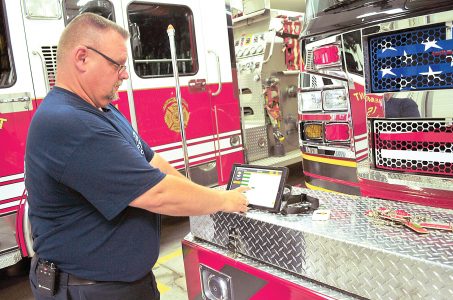
Instead of waiting until firefighters emerge after the audible alarm goes off on the airpack to send in replacement firefighters with fresh air, the chiefs can group firefighters into companies and monitor their air use on a tablet computer screen.
This means firefighters with fresh oxygen can be sent in at just the right time.
"That time is important," Hileman said of any delay in having people working inside to put out a fire. "It can mean the difference between an 1.5-hour fire and a five- or six-hour fire."
Soon, the department will pilot a system that will allow the chiefs to see on a screen where their firefighters are located at a scene, what direction they are moving and also monitor the conditions around them through telemetry.
"One of the biggest dangers to firefighters is getting lost," Hileman said.
While this was once tried with GPS, it was found that technology didn't work well when trying to track people above or below the first floor of a building, Hileman noted. Plus, each person had to wear a GPS unit and with all of the other gear they carry, it wasn't practical.
The chief said the ability to know where everyone is at a scene will make a tremendous difference, not only in putting out fires but also in keeping tabs on everyone to make sure they're safe. If they are watching the screen and see someone isn't moving, it can alert them to possible trouble and they can check in on the firefighter over the radio to find out if everything is all right.
He stressed that while technology can make it safer, they still can't do it without sending people into a burning building.
"You can have all this technology, but you still need a good firefighter to go in and put the fire out," Hileman said.
That point isn't lost on the volunteer firefighters in the area, who unlike the paid fire service in Altoona, aren't sure from incident to incident how many firefighters will respond when a call comes in.
"Accountability has always been important, but from incident to incident it varies," noted Jeff Blake of the Logan Township United Fire Department.
It's especially important to know who is on the scene of a burning building or on a search and rescue operation and anywhere firefighters won't always be in sight of the incident commanders.
Until now, the township's five departments had a system, but it was manual. Blake pointed out the township firefighters will be pilot testing a system to keep track of incidents and personnel on scene using the Boggs Accountability System -- a simple to use tablet computer-based system that costs about $6,000 for the 60 or so volunteer firefighters plus their support personnel.
The system works by having sensors on each truck and electronic tags that firefighters tap in with when they get on board to go to a scene. That information is then available to the incident commander, who by using a tablet computer, can designate who has been assigned to what task.
It will work in conjunction with the Iamresponding.com system the department has been using for the past five years that allows firefighters to know who is on their way to a call and details about how long it will take them to arrive at the fire station.
Firefighters arrive, and using their tags, they connect to a truck through WiFi and then hang the tag in the truck. A chief at a scene can then see how many people are coming on a particular truck and assign duties -- placing firefighters on tasks such as attack, search or vent.
There is a tablet in each truck as well, and as the incident commander makes decisions as to what each firefighter has to do, another officer uses the system to record those decisions that are then available at a glance and the tap of a screen.
"The big thing is keeping track of everyone on the firetruck," said Lakemont Volunteer Fire Department Assistant Chief Dave Lynch.
While the system doesn't use telemetry to track individual locations in real time or track oxygen use, when a firefighter is assigned a duty, it is noted if they are using oxygen and the countdown is started. Lynch pointed out that with this, the officers get a color-coded warning when a firefighter has been on air for 20 minutes so they can then make decisions before it hits that 30-minute mark when an airpack will run out. Officers can even keep track of where firefighters are within a structure to ensure no firefighter is overlooked or forgotten should a situation become chaotic.
It's customizable, so incident tracking can even include a checklist of other tasks, such as calling utilities and calling in the state police fire marshal.
The ultimate purpose, Lynch said, is to account for everyone on a fire call. By having the system, the volunteers will have a fast and efficient way of tracking who is doing what and where. The system runs on tablets along with other apps used by the firefighters, such as the maps program that not only helps them plan routes and survey the surrounding area, but also provides an updated overlay of fire hydrant locations.
The tablet computers also have replaced a library of paper books and binders related to things such as HAZMAT that once had to be stored in the cramped space of a fire truck.
"Now you can have it all on a tablet," Lynch said.
Blake said the pilot program is an exciting development that makes the complex tasks of responding to a variety of incidents, whether a fire or a water rescue, more manageable and ultimately safer for the volunteers and the community.
"Our best assets are supposed to go home after a call," Blake said.
Mirror Staff Writer Greg Bock is at 946-7458.