
Another train derails at Curve
Witnesses describe event
Trending
(This story was edited at 4 p.m. Monday to fix incorrect information.)
Another Norfolk Southern freight train derailed as it traveled around the Horseshoe Curve about 4:10 p.m. Friday.
The derailment, six cars by the estimate of onlookers, a number later confirmed by Norfolk Southern in an email, was the second derailment in the span of three weeks on the three-track stretch of railroad.
The cars involved in the July 5 derailment had been moving in the same, westbound direction, and they remain there within sight of the newly derailed cars.
All of Friday's derailed cars were empty and remained upright, Norfolk Southern said. The mixed-freight train was southbound en route from Enola to Conway, when the incident occurred. There were no reported injuries to the NS train crew and no release of hazardous materials.
To the amateur train experts and visitors who witnessed Friday's incident from the Curve's train viewing area, it looked like both derailments were caused by the same thing.
Rece Kasten, a first-year rail engineering student at Penn State Altoona, visited the Horseshoe Curve after hearing of the derailment on the radio. Kasten, as well as Dan Knouse of Altoona and Ryan Wolfe of Hollidaysburg, who witnessed the derailment, were among the few dozen people at the Horseshoe Curve National Historic Landmark's picnic area Friday. Each gave their unofficial opinions, and all agreed.
"String lining" is what happens when there's unequal weight distribution along the train.
In the case on Friday, the speculation of onlookers was that the three empty cargo-beamer cars connected to the locomotives at the front were not heavy enough to handle the curve and would have been better placed at the end of the 2-mile train, supported by helper engines, which were absent, the witnesses said.
All three cargo beamers and about three other enclosed freight cars were derailed. Cargo beamers are a type of freight car with specially designed pallets fitted on top of flatcars. The vast majority of other cars in the train appeared to be refrigeration cars, though it wasn't clear whether they contained freight.
Calls to Norfolk Southern to verify the cause of the derailment were not returned Friday. One of the crewmen working to right the toppled cars declined to comment.
Witnessess did not report seeing anyone injured by the derailment. Teresa Shifflett of Harrisonburg, Va., said they saw a conductor sticking his head out of the window and looking back at the cars just before they derailed.
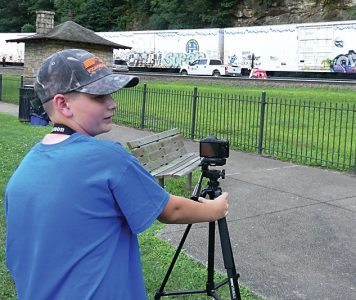
To her son, 12-year-old train chaser Brady Shifflett, it was an exciting sight. The Horshoe Curve landmark was on his list of rail sites he wanted to visit, and his parents took him on a roadtrip to Altoona on Friday.
Brady described seeing the cars lean before they derailed and the smoke billowing from under the cars after it happened.
"The brakes were loud, so it was hard to hear, but it was pretty much a big 'boom.'" he said.
Brady's father, Jeff Shifflett, said the event certainly added an extra surprise to the trip.
"This was like the World Series for him; a grand slam at the bottom of the ninth," Jeff said.
The July 5 incident involved 11 derailed cars and the cause was last reported to be under investigation.
Mirror Staff Writer Russ O'Reilly is at 946-7435.