
Tough topics tackled at community dinner
PSU hosts event to fight rising tide of divisiveness
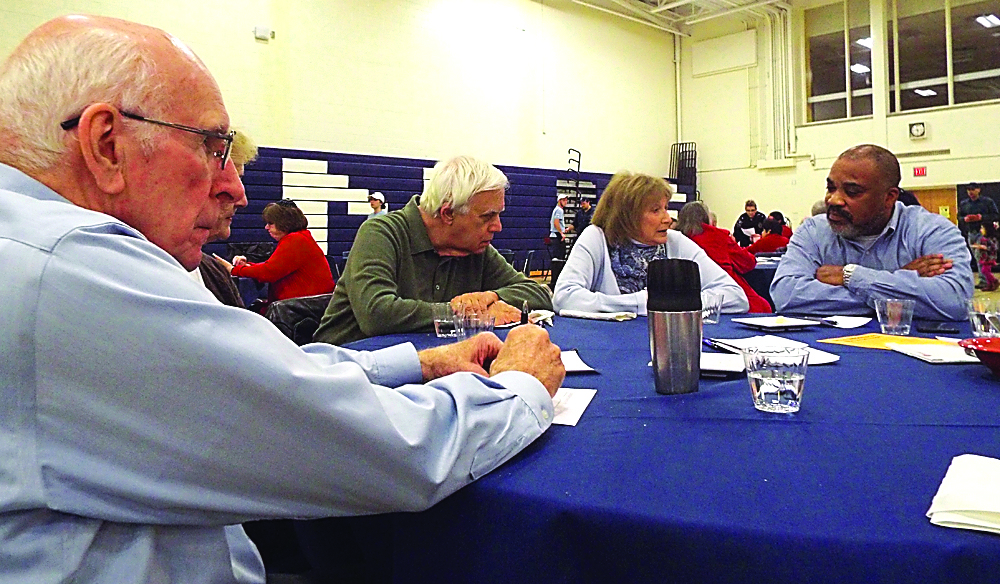
Discussing a wide range of issues are (from left) Jerry Hymes, Diane Osgood, Neil Port, Mickey Port, and Will Leightner at Penn State Altoona’s community dinner. Photo for the Mirror by Matthew Callan
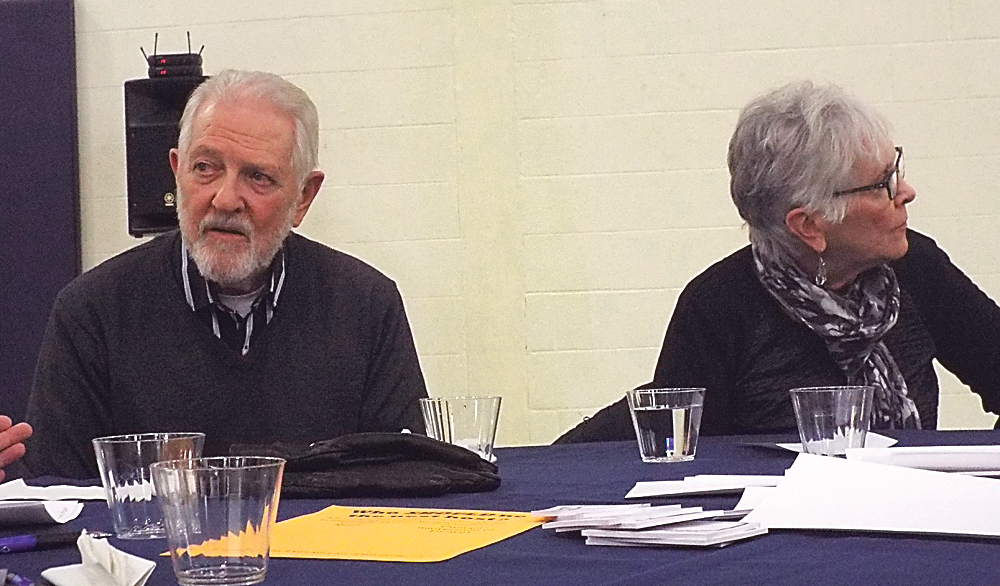
Frank Rosenhoover and Ann Rosenhoover discuss today’s issues with the rest of their group at Penn State Altoona’s community dinner. Photo for the Mirror by Matthew Callan
Discussing a wide range of issues are (from left) Jerry Hymes, Diane Osgood, Neil Port, Mickey Port, and Will Leightner at Penn State Altoona’s community dinner. Photo for the Mirror by Matthew Callan
Frank Rosenhoover and Ann Rosenhoover discuss today’s issues with the rest of their group at Penn State Altoona’s community dinner. Photo for the Mirror by Matthew Callan
Trending
Simple things like soup and bread combined with the more complex -- conversation with topics like racism, immigration and gun control -- Monday at a Penn State Altoona community dinner that organizers hope will spark many more.
The idea for the dinner came from the same concept that created Operation Our Town, said Lori Bechtel-Wherry, chancellor and dean of Penn State Altoona. Operation Our Town, formed in 2006, is a partnership of concerned citizens, including business and civic leaders, who came together to battle illegal drugs in Blair County.
From escalating negative rhetoric to mass shootings on a national scale that have hit close to home, Bechtel-Wherry said she and others at the campus felt compelled to propose a similar effort to fight against the rising tide of hate and divisiveness.
"We have witnessed entire groups of people attacked and marginalized and, in some cases, even killed,'' she said.
The campus took its first step with the dinner, which was open to anyone who wanted to attend. The event drew about 70 people from all kinds of groups -- Penn State Altoona students and faculty members, clergy representatives, political group members, military representatives and others.
The participants sat at round tables eating, discussing the chaotic situation of the world they currently live in and what they think needs to happen to make it safer and better for them and especially for their children and grandchildren.
"It's easy to think, what can one person do, but what I've always tried to do is when I see a stranger, I always greet them. I always say hello,'' attendee Neil Port said. "We're living in a world that's so engrossed in every single activity that we do, so to make somebody feel good just by saying hello to them, that's something.''
But the tone at his table soon turned more fatalistic, with his wife, Mickey Port, saying things might have progressed beyond the place where a mere smile can make a difference.
"I don't know. I think things are a lot more serious, and there's a deeper split between us now,'' she said.
The people at the table also discussed the lack of minorities in the local area, which led to a discussion of migration that mirrored the debate that is currently splitting the country. Jerry Hymes said the country needs to protect its borders.
"They can come across legally; I have no problem with that. It's when they come across illegally, that's when I don't agree with that,'' he said.
But Jane Petroski, who was also at the table, said she'd lived in southern California and women would bring their sick children across the border for medical treatment.
"The babies had TB, what else were they supposed to do?'' she said.
Still others at the table said immigration wasn't the most pressing problem facing the community, at least as far as young people are concerned.
Will Leightner works at a youth facility with young men, a job he said he chose, but one that he often finds draining. A retired state worker, Leightner said the men have usually low self-esteem and come from such dire circumstances that it's very difficult to inspire any hope for the future in them.
"They don't feel they can even get an education,'' he said. "They have to fight not to feel defeated all of the time. I don't know how to communicate to them sometimes that they can turn things around. It's very frustrating.''
At another table where political representatives gathered, the talk centered on the divisive rhetoric that has escalated in recent times. The people at the table said they thought that arguments have gone from lively -- but still civil -- discussion to hateful polarizing wars of words.
"It just seems, in general, people want to hear negative things about life instead of the positive things -- race relations problems instead of the great things that this country is about,'' said Frank Rosenhoover, a member of the Democratic State Committee and a member of the Northcentral Democratic Caucus.
Wife and fellow Democrat, Ann Rosenhoover, sitting beside her husband, shared the view of many when she said she thought the national discourse changed and became coarser with the election of Republican President Donald Trump in 2016.
"I think he's given people permission to treat people however they want,'' she said.
The president has said he speaks in everyday language, and unlike other presidents, frequently uses Twitter, but he has said that he believes his words are not directly responsible for the actions of others, according to press secretary Sarah Sanders.
When the groups presented what they'd discussed, they said topics ranged from areas such as gun control, voting and mental health issues. Participant Harriett Gaston, chairman of minority programs, division of undergraduate studies at Penn State Altoona, said they were really "preaching to the choir.'' The people at the dinner come to events like that because they care about the community, she said.
If they're going to make the project an ongoing success, they need to reach the rest of the community, Gaston said.
"How do we get the other folks to see the other as someone like you?'' she said.