
Few changes found in FAA funding bill
Trending
For all the talk of slashed services, labor-law shifts and privatization that followed its slow trip through Congress, this month's Federal Aviation Administration funding bill -- a longtime goal of Rep. Bill Shuster, R-9th District -- included few of the major changes its proponents wanted.
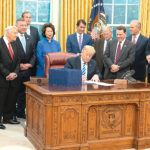
President Donald Trump signed the bill on Oct. 5, authorizing five years' worth of funding for the FAA. The bill easily passed both chambers of Congress and found its way to the president's desk in time for midterm elections -- with Shuster and his father, longtime congressman Bud Shuster, in attendance.
"Being able to stand in the Oval Office alongside my father, who once chaired the same committee that I now chair, while the president of the U.S. signs into law a major piece of infrastructure legislation is an incredible honor," said the younger Shuster, who is leaving office after the November election.
But one of Bill Shuster's main goals -- the privatization of the nation's air traffic control system -- is nowhere to be found in the new law. Proponents, including many Republicans and the Trump administration, had pushed to spin air traffic control into a new, nonprofit board overseen in part by the aviation industry. While supporters claimed it would allow for new technology and innovation, opponents -- including consumer organizations, some airlines and affected unions -- denounced it as a "distraction."
Facing headwinds in the Congress, supporters eventually dropped the proposal, leaving air traffic control in the FAA's hands for the foreseeable future.
Other changes, including some that would directly affect central Pennsylvania, were also scrapped. Airport operators expressed concerns last year, when Trump's budget proposal suggested cutting the Essential Air Service program, which subsidizes otherwise less-profitable or underused flights in rural areas.
The Department of Transportation granted a waiver this summer for Altoona-Blair County Airport to keep receiving funds through the program, which ran just over $300 per passenger in 2017.
Despite early fears that the federal government would cut the program entirely, the final law includes annual funding increases for Essential Air Service: $155 million for 2018, rising gradually to $172 million in 2023. It also establishes a study to examine the program's financial state, and any laws or reforms that could help it save money.
"This significant development means that we finally have long-term, stable support for ongoing airport projects funded by the Airport Improvement Program through 2023, and it means that we can address our critical workforce shortage issues," a representative of rural aviation lobby group Alliance for Aviation Across America said in a letter to supporters. "But our fight is not over."
The changes scrapped in the final law weren't all airborne. Even trucking rules pushed by major haulers failed to reach Trump's desk, frustrating the owners of major hauling companies.
Trucking companies had pushed for an amendment -- included in the FAA bill for legislative reasons -- that would have barred states from establishing their own, more strict labor regulations on drivers. The move targeted California, which requires drivers to stop for a break every four to five hours, instead of every eight as required by federal law.
While the final bill might have frustrated lawmakers seeking more open labor rules and privatization, its broad support in both houses signaled their willingness to drop some demands. FAA officials, now set for funding into the 2020s after a monthslong extension, praised the move.
"The FAA's reauthorization delivers a safer, more secure and efficient aviation system to the traveling public and helps fuel economic growth and competitiveness," officials said in a news release. "We applaud the House and the Senate in crafting a bipartisan bill, and with its signing, the FAA is ready to get to work on the bill's key provisions."
Marijuana bill gets broad new support
A bill to drop the punishment for possessing a small amount of marijuana to a summary offense -- akin to a hefty traffic ticket -- easily cleared a House committee in Harrisburg last week, marking a sea change in the way lawmakers view recreational use.
House Bill 928, introduced by Rep. Barry Jozwiak, R-Reading, would drop the punishment for those caught with less than 30 grams of marijuana from a criminal offense to a summary one, meaning those accused could merely pay a fine.
Under current law, possessing even a small amount of marijuana leads to driver's license suspension and, in some cases, jail time.
"Downgrading this offense from a misdemeanor to a summary offense would have a positive effect on local law enforcement efforts, allowing police and prosecutors to focus their time and resources on more serious offenses," Jozwiak said in a memo to colleagues.
Under his proposal, someone convicted for the first time would face a fine up to $300, with diversionary programs and expunged records possible for minors. Subsequent cases would incur larger fines.
The bill drew wide support in the House Judiciary Committee, including from a solid majority of its Republican membership. The bill passed 20-4, with 11 Republicans voting to send it to the House floor. Rep. Jesse Topper, R-Bedford, was among the no votes.
Among the bill's co-sponsors are members of both parties, including Rep. Rich Irvin, R-Huntingdon. The bipartisan support for partial marijuana decriminalization -- a process already launched in Philadelphia, Pittsburgh and other cities -- demonstrates a rapid cultural shift following the legalization of medical marijuana.
"As a former law enforcement officer, I strongly believe in cracking down on drug dealers and those who prey on the young or weak with drugs. But those defendants are addressed elsewhere in the Controlled Substances Act," Jozwiak wrote. "For individuals who merely possess small amounts of marijuana, I believe this adjusted grading makes sense."
Ryan Brown can be emailed at rbrown@altoonamirror.com.