
Area preparing for solar eclipse
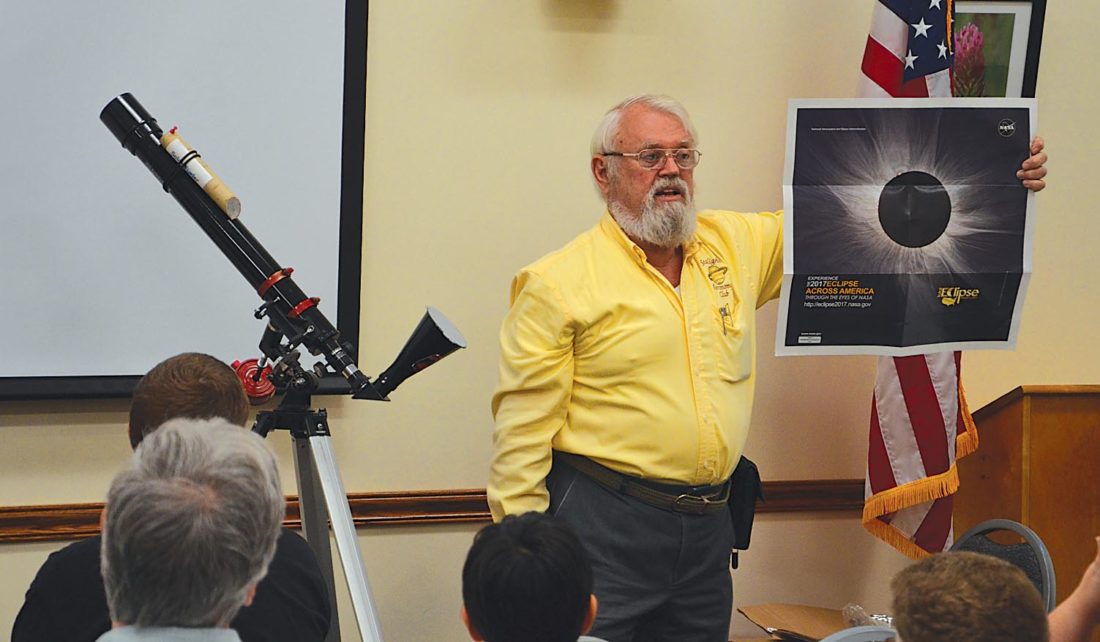
Mirror photos by Brian Yermal Jr. / Starlight Astronomy Club President Tom Kasner talks about the upcoming solar eclipse to a crowd at the Hollidaysburg Area Public Library recently. The United States will get to witness the eclipse Aug. 21
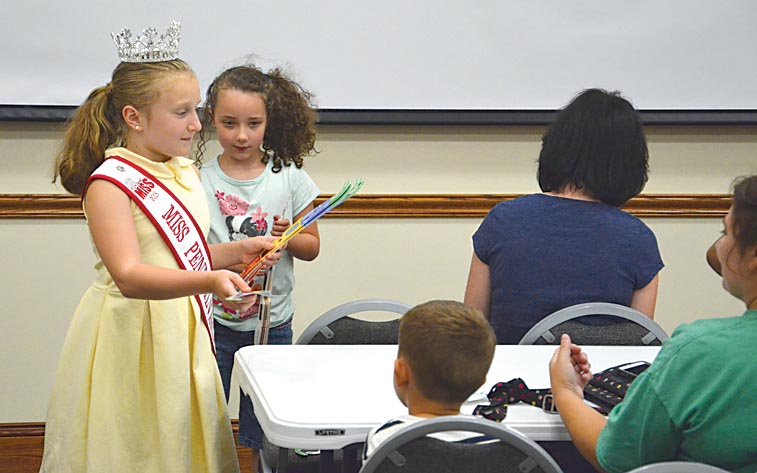
Mirror photo by Brian Yermal Jr. / Kinsley Palilla, 2018 USA National Miss Pennsylvania princess, and Madigan Kephart, both of Altoona, hand out eclipse glasses to guests at a meeting about the eclipse at the Hollidaysburg Area Public Library.
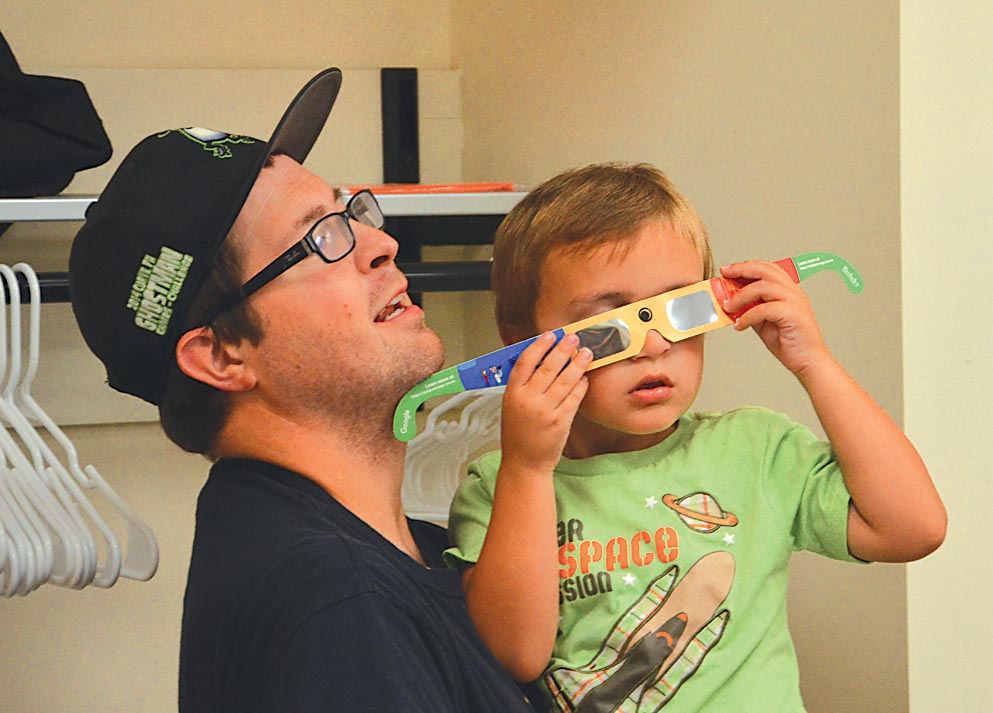
Mirror photo by Brian Yermal Jr. / Michael Gerchak of Duncansville watches as his son, Zeke, tests a pair of eclipse glasses at the Hollidaysburg Area Public Library recently. The glasses should not be used with any other optical appliances such as cameras, binoculars or telescopes, according to the print on the arm of the glasses.
Mirror photos by Brian Yermal Jr. / Starlight Astronomy Club President Tom Kasner talks about the upcoming solar eclipse to a crowd at the Hollidaysburg Area Public Library recently. The United States will get to witness the eclipse Aug. 21
Mirror photo by Brian Yermal Jr. / Kinsley Palilla, 2018 USA National Miss Pennsylvania princess, and Madigan Kephart, both of Altoona, hand out eclipse glasses to guests at a meeting about the eclipse at the Hollidaysburg Area Public Library.
Mirror photo by Brian Yermal Jr. / Michael Gerchak of Duncansville watches as his son, Zeke, tests a pair of eclipse glasses at the Hollidaysburg Area Public Library recently. The glasses should not be used with any other optical appliances such as cameras, binoculars or telescopes, according to the print on the arm of the glasses.
Trending
The United States is in for a rare sight Aug. 21. For the first time in nearly a century, the path of a total solar eclipse will travel coast-to-coast across the nation.
Solar eclipses occur about two to four times per year, a NASA website states, but the area covered in totality by the moon's shadow is only about 50 miles wide. In any given location on Earth, a total solar eclipse happens only once every 100 years or so.
The total eclipse's "path of totality" will go through 10 states: Oregon, Idaho, Wyoming, Nebraska, Missouri, Illinois, Kentucky, Tennessee, North Carolina and South Carolina.
People in the path of totality can view the eclipse with their naked eyes, but only while the moon and sun are perfectly aligned for about two and a half minutes.
For everyone outside of the path of totality, including Pennsylvania, eclipse glasses must be worn at all times during the eclipse.
Here in Altoona, the alignment of the sun and moon won't appear perfect; it will be a partial eclipse with about 80 percent of the sun obscured. Looking at it without proper eyewear would cause eye damage.
According to the National Weather Service, the eclipse is to begin in the Altoona area at 1:15 p.m. and reach its maximum alignment at 2:38 p.m. It will end at about 4 p.m.
Protective shades available
Eclipse shades are available at a few local places.
The Starlight Astronomy Club for Altoona and Hollidaysburg donated glasses to the Altoona Area Public Library.
They are free and distributed on a first-come, first-served basis. There are also 200 pairs of glasses available at the Hollidaysburg Area Public Library from 10 a.m. to 2 p.m. Saturday and 1 to 5 p.m. Sunday.
On the day of the eclipse, free glasses will be given away from 10 a.m. until the end of the eclipse, while supplies last.
Lowe's in Altoona and Walmart also confirmed they have limited pairs of glasses in stock.
Saint Francis University's Science Outreach Center has scheduled a eclipse program at 1 p.m. next Monday at the Hollidaysburg library. Attendees receive a free pair of eclipse glasses (first come, first served) to view the event safely from the library's outdoor amphitheater.
The glasses should not be used with any other optical appliances such as cameras, binoculars or telescopes, according to the print on the arm of the glasses.
"The intensity of the sun will burn your eye, and you don't have time to blink," Starlight Astronomy Club President Tom Kasner said.
The Pennsylvania Optometric Association said in a release, "The sun is so bright that our instincts normally cause us to look away, but during the eclipse, the sun's rays may not seem as intense and we may be tempted to watch the movement of the moon across the face of the sun. Although you may not feel discomfort while watching an eclipse, the risk to your eyes remains the same as when looking at the fully exposed sun. Looking at the eclipse can result in a condition known as solar retinopathy, which is damage to the retina, the portion of the eye responsible for collecting light and transmitting images to the optic nerve. Damage to the retina from the sun could be permanent and could cause blindness."
The optometric group said people should make sure any safety glasses for viewing the eclipse are stamped with the International Safety Organization's reference number 12312-2, which indicates that the lenses meet the necessary safety standards to block the harmful rays.
"It is also important to use only new glasses. Lenses more than three years old are expired and no longer safe to protect your retinas from damage," the association said.
Some head for totality
Most of the Starlight Astronomy Club's Altoona and Hollidaysburg members have plans to travel to the path of totality where they can view the total eclipse without glasses, Kasner said.
Kasner is traveling to Louisville, Ky. He's avoiding hotels that he said are gouging for the event, so he'll travel 80 miles from Louisville to view it.
"In the totality zone where the central part of the moon's shadow hits the Earth, it will start getting darker and darker until it (the sun's light) goes out," he said.
Viewing the total eclipse is an unforgettable experience, said Fred Marschak, retired professor of astronomy and first planetarium director at Hollidaysburg Area School District.
He traveled to China to see a total eclipse in 2009.
"It is a pretty incredible thing. You can look up at the sun during totality," he said.
The moon is about 400 times smaller than the sun, but it is about 400 times closer to the Earth. The result is that from Earth, they appear to be the same size during an eclipse.
"It was just an incredible personal experience. There were 60 or 70 of us on the Yangtze River. The dogs began howling and the birds would do their thing."
During a total eclipse, the normal rhythms of Earth are disrupted. The sudden blocking of the sun makes the day appear to be night in more ways than just the loss of light. The temperature drops and plants and animals react as if it is dusk -- birds can be seen flying home to settle in for sleep in the middle of the day, NASA's website states.
Sun's corona visible
Under normal circumstances, the bright yellow surface of the sun, called the photosphere, is the only feature able to be observed. A total solar eclipse allows scientists to observe the corona or the outer atmosphere of the sun. When the moon blocks the sun's face during a total solar eclipse, the corona is revealed as a pearly-white halo around the moon.
It was observing the positions of background stars close to the sun's edge during an eclipse in 1919 that helped prove Albert Einstein's theory of relativity, that space is combined with time to make a universewide space time. And space time is like a fabric, warped by massive objects like the sun the way a trampoline is warped by a bowling ball.
The positions of the stars were measured during the eclipse and then compared with their normal positions in the sky to help prove the sun's mass warped space time.
Mirror Staff Writer Russ O'Reilly is at 946-7435.