
Rain garden project moving along in city near church
Trending
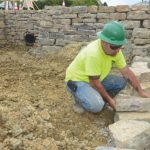
Mirror photo by Gary M. Baranec / Ron Kurtz of Yellow Springs, an employee with G&R Excavating and Demolition, sets stone for a rain garden project at 25th Avenue and Fourth Street recently. The project, which is expected to take five weeks to complete, is meant to control the flow of water to the Chesapeake Bay. Please see story on Page A8.
The rocks are heavy and the machine looks clunky, but under the guidance of Ron Kurtz, the handling of those rocks is deft -- even delicate.
Kurtz, a foreman, site superintendent and self-professed jack-of-all-trades for G&R Excavating, has been working alone to create Phase 1 of a rain garden for the city, the Blair County Conservation District and the Alliance for Chesapeake Bay on a triangular island at 25th Avenue and Fourth Street, near St. Therese of the Child Jesus Church.
It's part of a larger effort by the Intergovernmental Stormwater Committee -- comprising 11 municipalities -- to comply with increasingly strict regulations designed to keep stormwater pollutants out of streams and ultimately Chesapeake Bay.
As of a few days ago, using a mini-trackhoe, blueprints, a laser level and his bare hands, Kurtz had scooped out a depression and built most of a mortarless wall with buttresses on the incoming end of the rain garden at Fourth Street.
Rain gardens slow stormwater and cleanse it, ideally by letting it percolate into the ground, so that it actually doesn't enter streams directly.
The St. Therese rain garden will do the cleansing, although perhaps not so much percolating, according to Kurtz.
The stones -- most of which came from the foundation walls at the former Bon Secours hospital complex being partially demolished by G&R as part a new Graystone housing project -- weigh between 30 and several hundred pounds, by their looks.
Teams of workers must have set the larger stones at the hospital more than 100 years ago, according to Kurtz.
Otherwise, if it were one man, "I would not want to meet with that guy," Kurtz said.
Those long-ago workers didn't have the benefit of Kurtz's mini-trackhoe -- much less the "feel" for operating such equipment that Kurtz developed during most of his 57 years, starting on a farm in Spruce Creek where he spent his early childhood, before moving with his family to Philadelphia, then back to the Tyrone area, where he attended high school.
Kurtz demonstrated his method readily, moving the trackhoe partway down into the depression, using its control leavers to introduce the underhand bucket beneath a 60-pound stone, pinning the stone in place there with a thumblike arm at the top of the bucket, then swinging the bucket on its boom across the depression and gently laying the stone in position on the wall before finally nudging it into conformity with the course below.
He makes that last move with his bare hands sometimes.
"I like to do tricky things," Kurtz said of the project. "It keeps it interesting."
The rain garden is designed to capture runoff coming into the median through the city's upstream storm system, then, with the help of vegetation and the soil media in which the vegetation will grow, to filter out pollutants -- mainly sediment, phosphorous and nitrogen -- before sending the cleansed water back into the system at the lower end of the island, according to landscape architect Chris Foster of Stiffler McGraw & Associates.
Some water will infiltrate through a rock channel that Kurtz will install at the bottom of the depression, Foster said.
Foster designed the rain garden to be inviting to the public, and so called for a pair of stone benches, which Kurtz will build.
The benches will help dispel the idea that such facilities are "off-limits," Foster said.
The inviting design, coupled with an interpretive sign that will be installed in the median, may help people consider the reason for rain gardens and encourage them to get behind the cleanup cause that motivates their construction, according to Foster.
The total cost of Phase 1 is $70,000 -- with $45,000 of that money coming from an Alliance grant and $25,000 from a Conservation District grant, Foster said.
There are in-kind contributions by the city, he said.
Phase 2 will be a similar facility across Fourth Avenue, near a brick-mounted sign for the parish.
The city has received $56,000 from the state Department of Environmental Protection for the Phase 2 project.
Kurtz said he can't wait until his work is done, so he can take in the completed project.
He's enjoyed the compliments of passersby and neighbors, he said.
"I'm kinda pleased," he stated.
Mirror Staff Writer William Kibler is at 949-7038.